


Diversity, composition, altitude, and seasonality of high-altitude windborne migrating mosquitoes in the Sahel: Implications for disease transmission
- PMID: 38455321
- PMCID: PMC10910920
- DOI: 10.3389/fepid.2022.1001782
Diversity, composition, altitude, and seasonality of high-altitude windborne migrating mosquitoes in the Sahel: Implications for disease transmission
Abstract
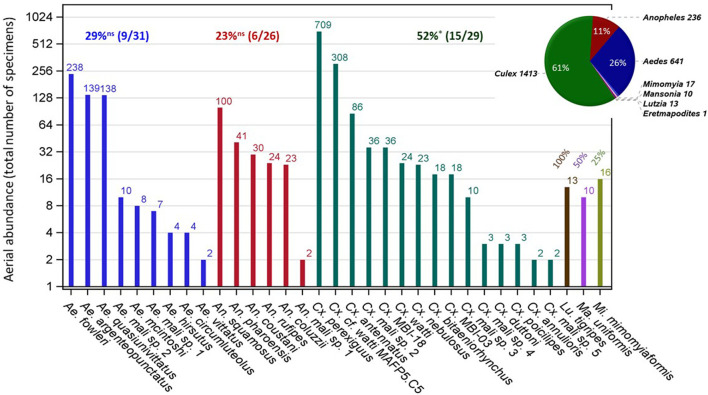
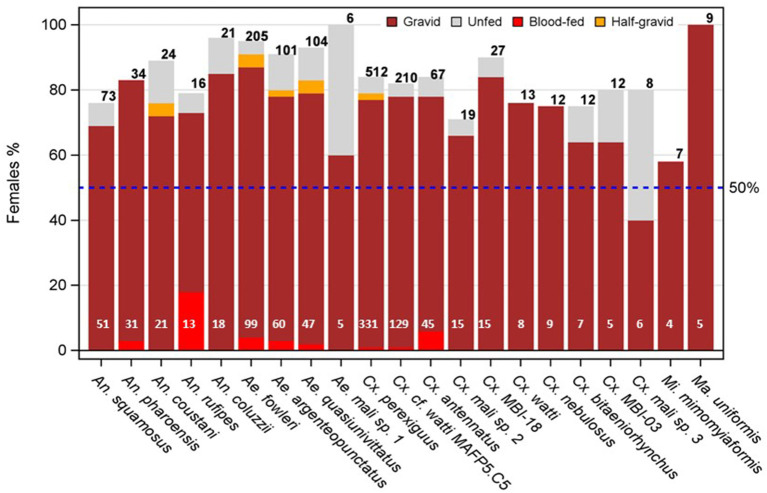
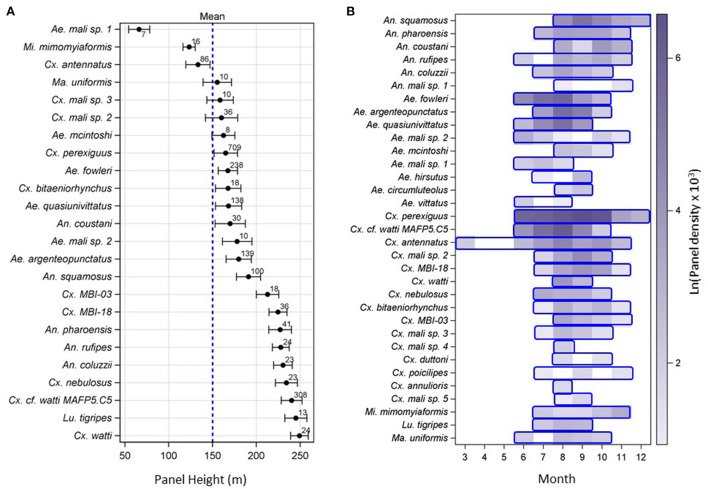
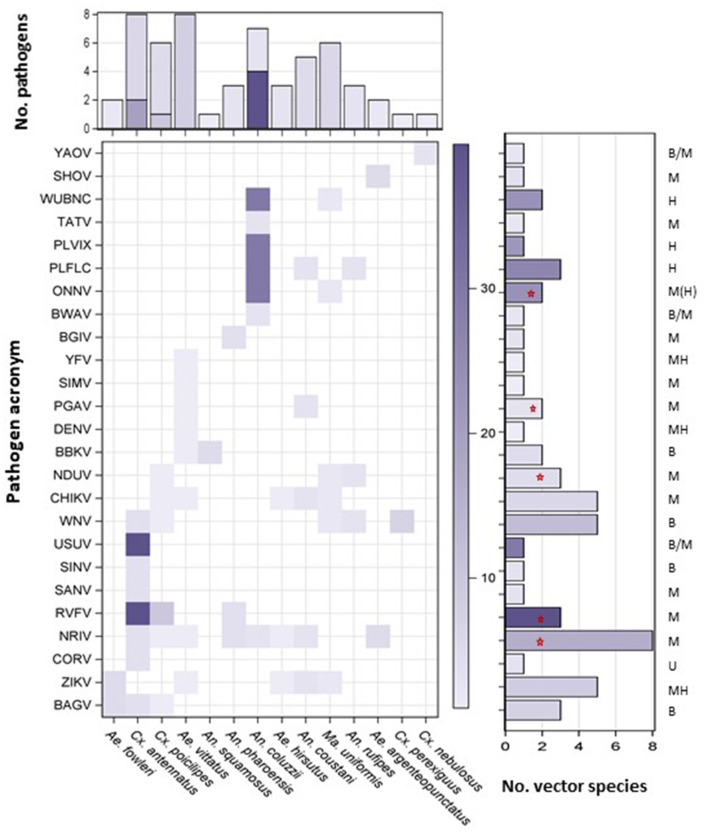
Recent studies have reported Anopheles mosquitoes captured at high-altitude (40-290 m above ground) in the Sahel. Here, we describe this migration modality across genera and species of African Culicidae and examine its implications for disease transmission and control. As well as Anopheles, six other genera-Culex, Aedes, Mansonia, Mimomyia, Lutzia, and Eretmapodites comprised 90% of the 2,340 mosquitoes captured at altitude. Of the 50 molecularly confirmed species (N = 2,107), 33 species represented by multiple specimens were conservatively considered high-altitude windborne migrants, suggesting it is a common migration modality in mosquitoes (31-47% of the known species in Mali), and especially in Culex (45-59%). Overall species abundance varied between 2 and 710 specimens/species (in Ae. vittatus and Cx. perexiguus, respectively). At altitude, females outnumbered males 6:1, and 93% of the females have taken at least one blood meal on a vertebrate host prior to their departure. Most taxa were more common at higher sampling altitudes, indicating that total abundance and diversity are underestimated. High-altitude flight activity was concentrated between June and November coinciding with availability of surface waters and peak disease transmission by mosquitoes. These hallmarks of windborne mosquito migration bolster their role as carriers of mosquito-borne pathogens (MBPs). Screening 921 mosquitoes using pan-Plasmodium assays revealed that thoracic infection rate in these high-altitude migrants was 2.4%, providing a proof of concept that vertebrate pathogens are transported by windborne mosquitoes at altitude. Fourteen of the 33 windborne mosquito species had been reported as vectors to 25 MBPs in West Africa, which represent 32% of the MBPs known in that region and include those that inflict the heaviest burden on human and animal health, such as malaria, yellow fever, dengue, and Rift Valley fever. We highlight five arboviruses that are most likely affected by windborne mosquitoes in West Africa: Rift Valley fever, O'nyong'nyong, Ngari, Pangola, and Ndumu. We conclude that the study of windborne spread of diseases by migrating insects and the development of surveillance to map the sources, routes, and destinations of vectors and pathogens is key to understand, predict, and mitigate existing and new threats of public health.
Keywords: Africa; arbovirus; disease-spread; dispersal; malaria; mosquito-borne pathogen; one health; surveillance.
Copyright © 2022 Yaro, Linton, Dao, Diallo, Sanogo, Samake, Ousmane, Kouam, Krajacich, Faiman, Bamou, Woo, Chapman, Reynolds and Lehmann.
Conflict of interest statement
The authors declare that the research was conducted in the absence of any commercial or financial relationships that could be construed as a potential conflict of interest.
Figures
References
-
- Reynolds DR, Riley JR. A migration of grasshoppers, particularly Diabolocatantops axillaris (Thunberg) (Orthoptera: Acrididae), in the West African Sahel. Bull Entomol Res. (1988) 78:251–71. 10.1017/S000748530001302X - DOI
-
- Drake VA, Reynolds DR. Radar Entomology:Observing Insect Flight and Migration. Wallingford: CAB International; (2012). 10.1079/9781845935566.0000 - DOI
-
- Riley JR, Reynolds DR, Farrow RA. The migration of Nilaparvata lugens (stål) (Delphacidae) and other hemiptera associated with rice during the dry season in the Philippines: a study using radar, visual observations, aerial netting and ground trapping. Bull Entomol Res. (1987) 77:145. 10.1017/S0007485300011627 - DOI
LinkOut - more resources
Full Text Sources
Research Materials
