


Effects of Plyometric Training on Physical Fitness Attributes in Handball Players: A Systematic Review and Meta-Analysis
- PMID: 38455436
- PMCID: PMC10915623
- DOI: 10.52082/jssm.2024.177
Effects of Plyometric Training on Physical Fitness Attributes in Handball Players: A Systematic Review and Meta-Analysis
Abstract
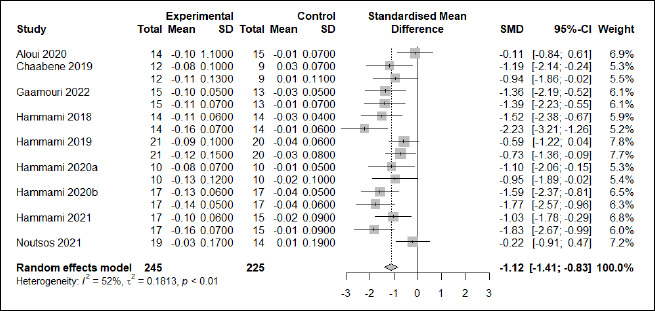
This meta-analysis aimed to examine the effects of plyometric training on physical fitness attributes in handball players. A systematic literature search across PubMed, SCOPUS, SPORTDiscus, and Web of Science identified 20 studies with 563 players. Plyometric training showed significant medium-to-large effects on various attributes: countermovement jump with arms (ES = 1.84), countermovement jump (ES = 1.33), squat jump (ES = 1.17), and horizontal jump (ES = 0.83), ≤ 10-m linear sprint time (ES = -1.12), > 10-m linear sprint time (ES = -1.46), repeated sprint ability with change-of-direction time (ES = -1.53), agility (ES = -1.60), maximal strength (ES = 0.52), and force-velocity (muscle power) (ES = 1.13). No significant impact on balance was found. Subgroup analysis indicated more pronounced agility improvements in players ≤ 66.6 kg compared to > 66.6 kg (ES = -1.93 vs. -0.23, p = 0.014). Additionally, greater improvements were observed in linear sprint and repeat sprint ability when comparing training durations of > 8 weeks with those ≤ 8 weeks (ES = -2.30 to -2.89 vs. ES = -0.92 to -0.97). In conclusion, plyometric training effectively improves various physical fitness attributes, including jump performance, linear sprint ability, maximal strength, muscle power and agility.
Keywords: Plyometric training; handball; jumping training; performance; physical fitness.
© Journal of Sports Science and Medicine.
Figures




References
-
- Aloui G., Hermassi S., Hammami M., Cherni Y., Gaamouri N., Shephard R. J., Van Den Tillaar R., Chelly M. S. (2020) Effects of elastic band based plyometric exercise on explosive muscular performance and change of direction abilities of male team handball players. Frontiers in Physiology 11, 604983. https://doi.org/10.3389/fphys.2020.604983 10.3389/fphys.2020.604983 - DOI - PMC - PubMed
-
- Aloui G., Hermassi S., Hayes L. D., Shephard R. J., Chelly M. S., Schwesig R. (2021) Effects of elastic band plyometric training on physical performance of team handball players. Applied Sciences 11, 1309. https://doi.org/10.3390/app11031309 10.3390/app11031309 - DOI
-
- Amoako A. O., Nassim A., Keller C. (2017) Body mass index as a predictor of injuries in athletics. Current Sports Medicine Reports 16, 256-262. https://doi.org/10.1249/JSR.0000000000000383 10.1249/JSR.0000000000000383 - DOI - PubMed
-
- Asadi A., Arazi H., Ramirez-Campillo R., Moran J., Izquierdo M. (2017) Influence of maturation stage on agility performance gains after plyometric training: a systematic review and meta-analysis. The Journal of Strength & Conditioning Research 31, 2609-2617. https://doi.org/10.1519/JSC.0000000000001994 10.1519/JSC.0000000000001994 - DOI - PubMed
-
- Asadi A., Arazi H., Young W. B., De Villarreal E. S. (2016) The effects of plyometric training on change-of-direction ability: A meta-analysis. International Journal of Sports Physiology and Performance 11, 563-573. https://doi.org/10.1123/ijspp.2015-0694 10.1123/ijspp.2015-0694 - DOI - PubMed
Publication types
MeSH terms
LinkOut - more resources
Full Text Sources