


Mortality, and life expectancy in Epilepsy and Status epilepticus-current trends and future aspects
- PMID: 38455899
- PMCID: PMC10910932
- DOI: 10.3389/fepid.2023.1081757
Mortality, and life expectancy in Epilepsy and Status epilepticus-current trends and future aspects
Abstract
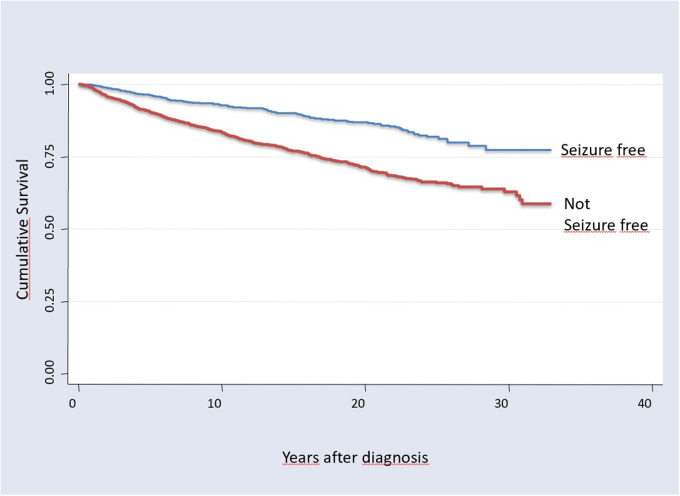
Patients with epilepsy carry a risk of premature death which is on average two to three times higher than in the general population. The risk of death is not homogenously distributed over all ages, etiologies, and epilepsy syndromes. People with drug resistant seizures carry the highest risk of death compared to those who are seizure free, whose risk is similar as in the general population. Most of the increased risk is directly related to the cause of epilepsy itself. Sudden unexplained death in epilepsy patients (SUDEP) is the most important cause of epilepsy-related deaths especially in the young and middle-aged groups. Population based studies with long-term follow up demonstrated that the first years after diagnosis carry the highest risk of death, while in the later years the mortality decreases. Improved seizure control and being exposed to a specialized comprehensive care centre may help to reduce the risk of death in patients with epilepsy. The mortality of status epilepticus is substantially increased with case fatality rates between 4.6% and 39%, depending on its cause and duration, and the age of the population studied. The epidemiological data on overall and cause specific mortality as well as their determinants and risk factors are critically reviewed and methodological issues pertinent to the studies on mortality of epilepsy and Status epilepticus are discussed.
Keywords: case fatality; death rate; epilepsy; seizures; standardized mortality ratio.
© 2023 Trinka, Rainer, Granbichler, Zimmermann and Leitinger.
Conflict of interest statement
ET reports personal fees from EVER Pharma, Marinus, Arvelle, Angelini, Argenx, Medtronic, Bial-Portela & Ca, NewBridge, SK, Pharma, GL Pharma, GlaxoSmithKline, Boehringer Ingelheim, LivaNova, Eisai, UCB, Biogen, Sanofi, Jazz Pharma, and Actavis. His institution received grants from Biogen, UCB Pharma, Eisai, Red Bull, Merck, Bayer, the European Union, FWF Österreichischer Fond zur Wissenschaftsforderung, Bundesministerium für Wissenschaft und Forschung, and Jubiläumsfond der Österreichischen Nationalbank. GZ gratefully acknowledges the support of the WISS 2025 project “IDA-Lab Salzburg” (20204-WISS/225/197-2019 and 20102-F1901166-KZP). ML has no conflicts of interest in the past five years. The remaining authors have no conflicts of interest.
Figures

References
-
- Organization WH. Epilepsy. Fact sheet. No. 999. 2012. Updated February 2016. (2016).
Publication types
LinkOut - more resources
Full Text Sources
Medical
