


Learning ratio performance on a brief visual learning and memory test moderates cognitive training gains in Double Decision task in healthy older adults
- PMID: 38457007
- PMCID: PMC11226577
- DOI: 10.1007/s11357-024-01115-1
Learning ratio performance on a brief visual learning and memory test moderates cognitive training gains in Double Decision task in healthy older adults
Abstract
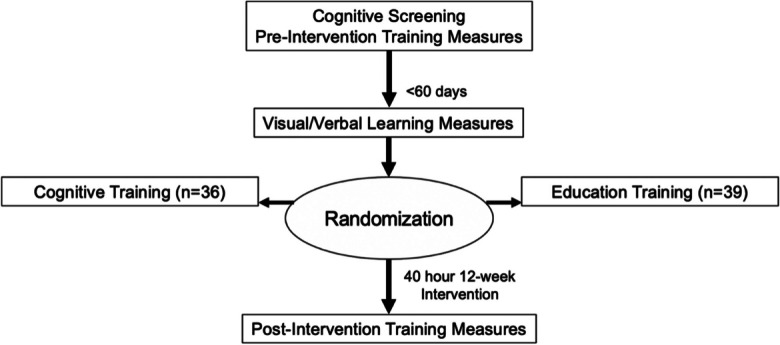
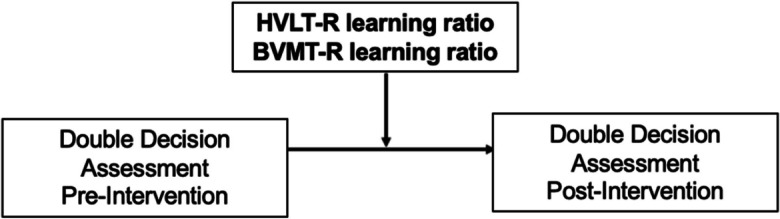
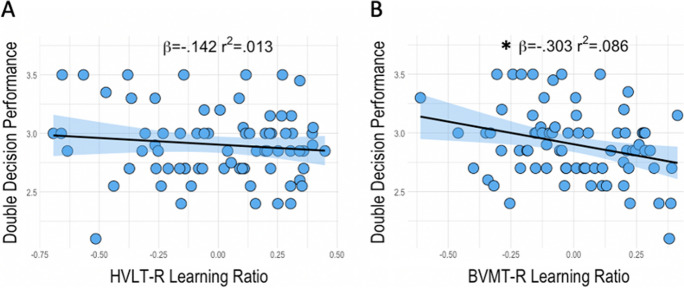
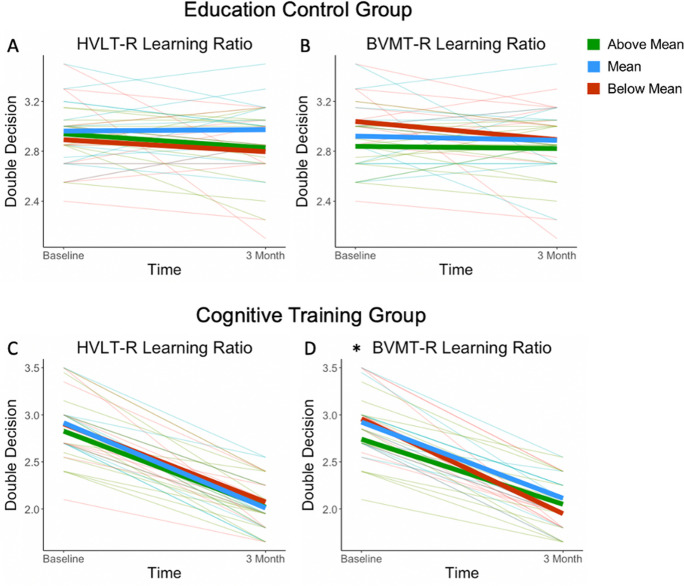
Cognitive training using a visual speed-of-processing task, called the Useful Field of View (UFOV) task, reduced dementia risk and reduced decline in activities of daily living at a 10-year follow-up in older adults. However, there was variability in the achievement of cognitive gains after cognitive training across studies, suggesting moderating factors. Learning trials of visual and verbal learning tasks recruit similar cognitive abilities and have overlapping neural correlates with speed-of-processing/working memory tasks and therefore could serve as potential moderators of cognitive training gains. This study explored the association between the Hopkins Verbal Learning Test-Revised (HVLT-R) and Brief Visuospatial Memory Test-Revised (BVMT-R) learning with a commercial UFOV task called Double Decision. Through a secondary analysis of a clinical trial, we assessed the moderation of HVLT-R and BVMT-R learning on Double Decision improvement after a 3-month speed-of-processing/attention and working memory cognitive training intervention in a sample of 75 cognitively healthy older adults. Multiple linear regressions showed that better baseline Double Decision performance was significantly associated with better BVMT-R learning (β = - .303). This association was not significant for HVLT-R learning (β = - .142). Moderation analysis showed that those with poorer BVMT-R learning improved the most on the Double Decision task after cognitive training. This suggests that healthy older adults who perform below expectations on cognitive tasks related to the training task may show the greatest training gains. Future cognitive training research studying visual speed-of-processing interventions should account for differing levels of visuospatial learning at baseline, as this could impact the magnitude of training outcomes and efficacy of the intervention.
Keywords: Cognitive training; Healthy aging; Speed of processing; Verbal learning; Visual learning.
© 2024. The Author(s), under exclusive licence to American Aging Association.
Conflict of interest statement
The authors declare no competing interests.
Figures
References
-
- Kueider AM, Bichay K, Rebok G. Cognitive training for older adults: what is it and does it work. Cent Ageing Am Inst Res. 2014;1–8.
-
- Rebok GW, Ball K, Guey LT, Jones RN, Kim H-Y, King JW, et al. Ten-year effects of the advanced cognitive training for independent and vital elderly cognitive training trial on cognition and everyday functioning in older adults. J Am Geriatr Soc. 2014;62:16–24. doi: 10.1111/jgs.12607. - DOI - PMC - PubMed
-
- Ball KK, Owsley C. The useful field of view test: a new technique for evaluating age-related declines in visual function. J Am Optom Assoc. 1993;64:71–79. - PubMed
Publication types
MeSH terms
Grants and funding
LinkOut - more resources
Full Text Sources
