


Escalating climate-related health risks for Hajj pilgrims to Mecca
- PMID: 38457640
- PMCID: PMC11149718
- DOI: 10.1093/jtm/taae042
Escalating climate-related health risks for Hajj pilgrims to Mecca
Abstract
Background: Global temperatures are on the rise, leading to more frequent and severe heatwaves with associated health risks. Heat-related illnesses (HRIs) are an increasing threat for travellers to hot climate destinations. This study was designed to elucidate the interplay between increasing ambient temperatures, incidence of HRIs and the effectiveness of mitigation strategies during the annual Hajj mass gathering over a 40-year period.
Methods: An observational study was conducted utilizing historical records spanning four decades of meteorological data, and the rates of heat stroke (HS) and heat exhaustion (HE) during the Hajj pilgrimage in Mecca, Saudi Arabia. With an annual population exceeding 2 million participants from over 180 countries, the study analysed temporal variations in weather conditions over two distinct Hajj hot cycles and correlated it with the occurrence of HS and HE. The effectiveness of deployed mitigation measures in alleviating health vulnerabilities between the two cycles was also assessed.
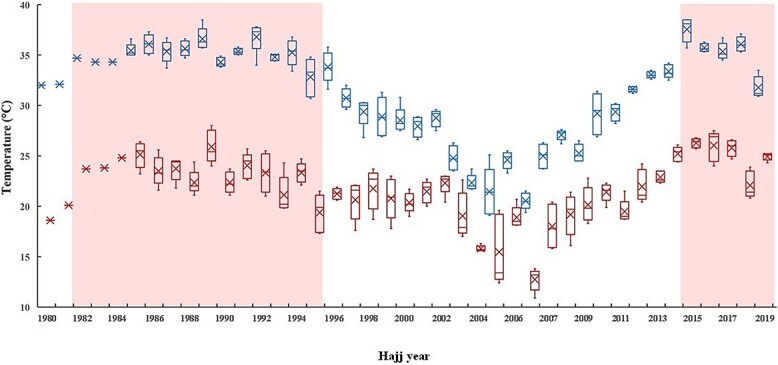
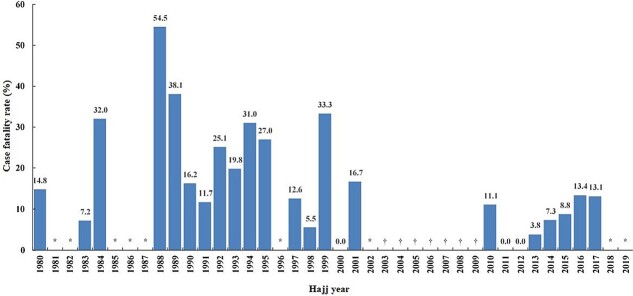
Results: Throughout the study period, average dry and wet bulb temperatures in Mecca escalated by 0.4°C (Mann-Kendall P < 0.0001) and 0.2°C (Mann-Kendall P = 0.25) per decade, respectively. Both temperatures were strongly correlated with the incidence of HS and HE (P < 0.001). Despite the intensifying heat, the mitigation strategies including individual, structural and community measures were associated with a substantial 74.6% reduction in HS cases and a 47.6% decrease in case fatality rate.
Conclusion: The study underscores the escalating climate-related health risks in Mecca over the study period. The mitigation measures' efficacy in such a globally representative setting emphasizes the findings' generalizability and the importance of refining public health interventions in the face of rising temperatures.
Keywords: Mass gatherings; ambient temperatures; climate change; health outcomes; heat exhaustion; heat stroke; incidence; mitigation strategies; mortality; public health.
© International Society of Travel Medicine 2024. Published by Oxford University Press.
Conflict of interest statement
None declared.
Figures



References
-
- Robine JM, Cheung SL, Le Roy Set al. Death toll exceeded 70,000 in Europe during the summer of 2003. C R Biol 2008; 331:171–8. - PubMed
-
- Zhao Q, Guo Y, Ye Tet al. Global, regional, and national burden of mortality associated with non-optimal ambient temperatures from 2000 to 2019: a three-stage modelling study. Lancet Planet Health 2021; 5:e415–25. - PubMed
Publication types
MeSH terms
LinkOut - more resources
Full Text Sources
Medical
