


Physician awareness and understanding of chronic inflammatory demyelinating polyradiculoneuropathy in Japan: a web-based study
- PMID: 38458807
- PMCID: PMC10928770
- DOI: 10.1136/bmjopen-2023-083669
Physician awareness and understanding of chronic inflammatory demyelinating polyradiculoneuropathy in Japan: a web-based study
Abstract
Objectives: To investigate potential knowledge gaps between neurologists and non-specialists and identify challenges in the current management of chronic inflammatory demyelinating polyradiculoneuropathy (CIDP), with a focus on 'early diagnosis' and 'appropriate treatment' for CIDP.
Design: A non-interventional, cross-sectional, web-based quantitative survey of physicians working in healthcare clinics or hospitals in Japan.
Setting: Participants were recruited from the Nikkei Business Publications panel from 18 August to 14 September 2022.
Participants: Responses from 360 physicians (120 each of internists, orthopaedists and neurologists) were collected.
Outcome measures: Responses relating to a CIDP hypothetical case and current understanding were assessed to determine awareness, collaboration preferences and diagnosis and treatment decisions.
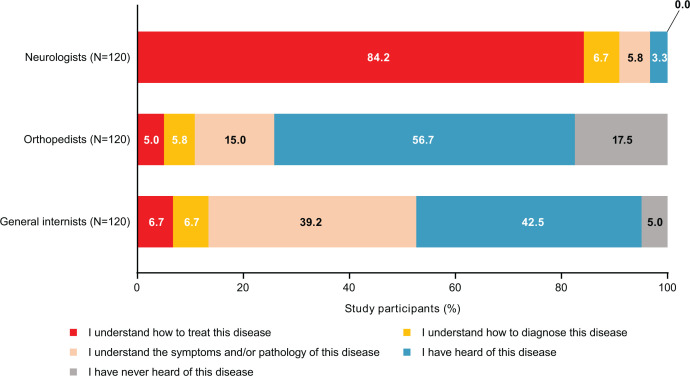
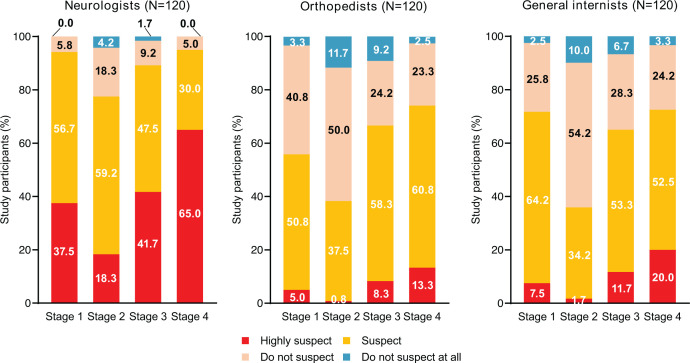
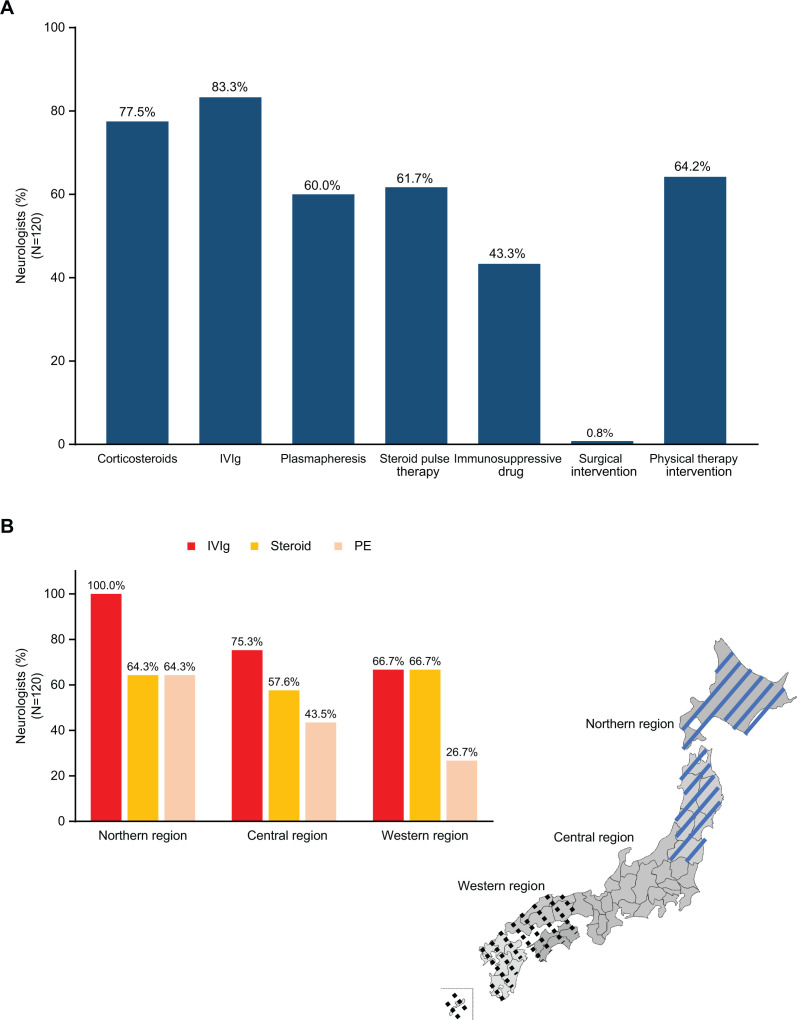
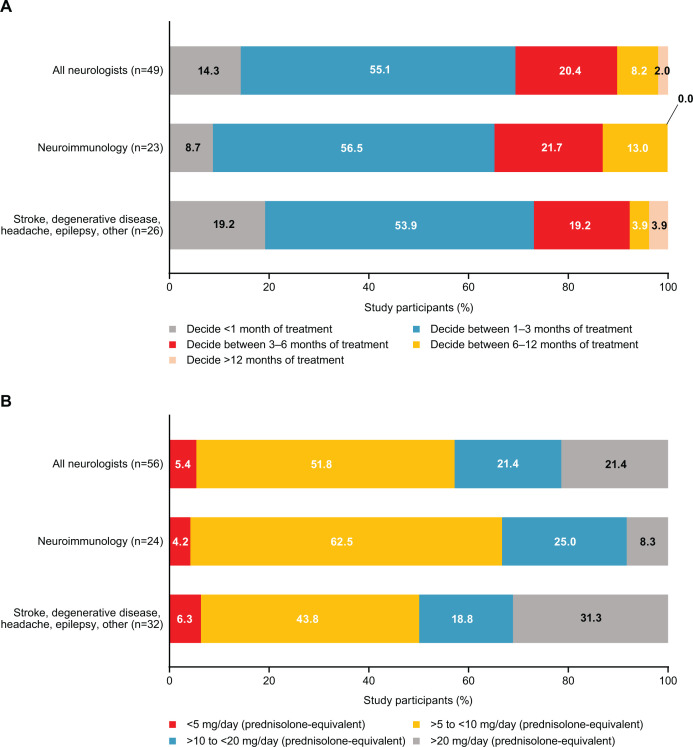
Results: Understanding of CIDP was 90.8% among neurologists, 10.8% among orthopaedists and 13.3% among internists; >80% of orthopaedists and internists answered that neurologists are preferable for treatment. Diagnostic assessment using a hypothetical case showed 95.0% of neurologists, 74.2% of orthopaedists and 72.5% of internists suspected CIDP. Among orthopaedists and internists suspecting CIDP, >70% considered referring to neurology, while ~10% considered continuing treatment without a referral. Among neurologists, 69.4% chose intravenous immunoglobulin (IVIg) as first-line treatment and determined effectiveness to be ≤3 months.
Conclusions: Orthopaedists and internists had lower CIDP awareness compared with neurologists, which may lead to inadequate referrals to neurology. Evaluation of IVIg effectiveness for maintenance therapy occurred earlier than the guideline recommendations (6-12 months), risking premature discontinuation. Improving CIDP knowledge among orthopaedists and internists is critical for better diagnosis and collaboration with neurologists. Neurologists should consider slow and careful evaluation of IVIg maintenance therapy.
Trial registration number: UMIN000048516.
Keywords: Awareness; Clinical Competence; Cross-Sectional Studies; Polyradiculoneuropathy, Chronic Inflammatory Demyelinating.
© Author(s) (or their employer(s)) 2024. Re-use permitted under CC BY-NC. No commercial re-use. See rights and permissions. Published by BMJ.
Conflict of interest statement
Competing interests: YT and YI have received support and consulting fees from Takeda Pharmaceutical Company Limited. AO, MK and NO are employees of Takeda Pharmaceutical Company Limited.
Figures
Similar articles
-
Diagnosis and treatment of chronic inflammatory demyelinating polyradiculoneuropathy in clinical practice: A survey among Dutch neurologists.J Peripher Nerv Syst. 2020 Sep;25(3):247-255. doi: 10.1111/jns.12399. Epub 2020 Jul 9. J Peripher Nerv Syst. 2020. PMID: 32583568 Free PMC article.
-
Current practice patterns in CIDP: A cross-sectional survey of neurologists in the United States.J Neurol Sci. 2019 Feb 15;397:84-91. doi: 10.1016/j.jns.2018.11.031. Epub 2018 Nov 28. J Neurol Sci. 2019. PMID: 30597419
-
European Academy of Neurology/Peripheral Nerve Society guideline on diagnosis and treatment of chronic inflammatory demyelinating polyradiculoneuropathy: Report of a joint Task Force-Second revision.Eur J Neurol. 2021 Nov;28(11):3556-3583. doi: 10.1111/ene.14959. Epub 2021 Jul 30. Eur J Neurol. 2021. PMID: 34327760
-
[Cutting edge of diagnosis and treatment for chronic inflammatory demyelinating polyradiculoneuropathy (CIDP) based on the EAN/PNS guideline 2021].Rinsho Shinkeigaku. 2024 May 24;64(5):321-325. doi: 10.5692/clinicalneurol.cn-001937. Epub 2024 Apr 20. Rinsho Shinkeigaku. 2024. PMID: 38644208 Review. Japanese.
-
Intravenous immunoglobulin treatment in chronic inflammatory demyelinating polyradiculoneuropathy, a time to start and a time to stop.J Peripher Nerv Syst. 2016 Sep;21(3):121-7. doi: 10.1111/jns.12176. J Peripher Nerv Syst. 2016. PMID: 27241239 Review.
References
-
- Van den Bergh PYK, van Doorn PA, Hadden RDM, et al. . European Academy of Neurology/Peripheral Nerve Society guideline on diagnosis and treatment of chronic inflammatory demyelinating polyradiculoneuropathy: report of a joint Task Force-Second revision. Eur J Neurol 2021;28:3556–83. 10.1111/ene.14959 - DOI - PubMed
Publication types
MeSH terms
Substances
LinkOut - more resources
Full Text Sources
