. 2024 Mar 8;15(1):2135.
doi: 10.1038/s41467-024-45159-5.

The role of interdecadal climate oscillations in driving Arctic atmospheric river trends

Affiliations

The role of interdecadal climate oscillations in driving Arctic atmospheric river trends

Weiming Ma et al. Nat Commun. .

Abstract

Atmospheric rivers (ARs), intrusions of warm and moist air, can effectively drive weather extremes over the Arctic and trigger subsequent impact on sea ice and climate. What controls the observed multi-decadal Arctic AR trends remains unclear. Here, using multiple sources of observations and model experiments, we find that, contrary to the uniform positive trend in climate simulations, the observed Arctic AR frequency increases by twice as much over the Atlantic sector compared to the Pacific sector in 1981-2021. This discrepancy can be reconciled by the observed positive-to-negative phase shift of Interdecadal Pacific Oscillation (IPO) and the negative-to-positive phase shift of Atlantic Multidecadal Oscillation (AMO), which increase and reduce Arctic ARs over the Atlantic and Pacific sectors, respectively. Removing the influence of the IPO and AMO can reduce the projection uncertainties in near-future Arctic AR trends by about 24%, which is important for constraining projection of Arctic warming and the timing of an ice-free Arctic.


Conflict of interest statement

The authors declare no competing interests.

Figures
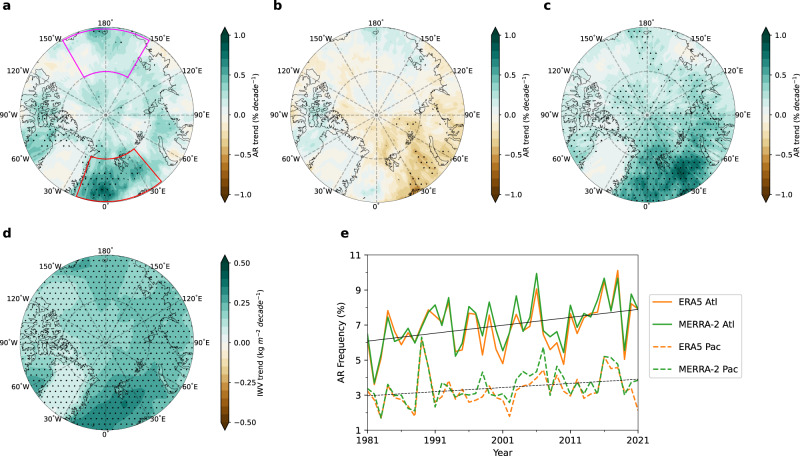
Fig. 1
Fig. 1. Observed Arctic atmospheric river (AR) trends.
a Arctic AR frequency trend during 1981–2021 in ERA5. The decomposed dynamical and thermodynamical contributions are shown in (b) and (c), respectively. d The observed trend in column-integrated water vapor (IWV) during 1981–2021 in ERA5. Stippled areas in (a), (b), (c), and (d) indicate significant trends at the 0.05 level based on the Student’s t-test. e Time series of area-average AR frequency over the Atlantic sector (solid lines; area outlined by the red box in (a) and Pacific sector (dashed lines; area outlined by the magenta box in (a). The black lines in (e) are the mean linear trends of the two reanalysis datasets (ERA5 and MERRA-2). The ensemble mean trends over both the Atlantic sector and Pacific sector are significant at the 0.05 level based on the Student’s t-test.
Fig. 2
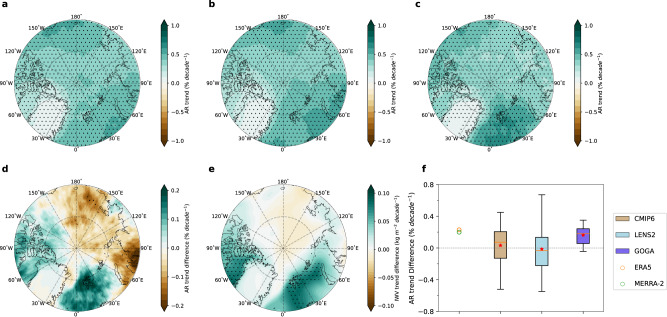
Fig. 2. Simulated Arctic atmospheric river (AR) trends during 1981-2021.
a Ensemble mean trend in the Arctic AR frequency simulated in LENS2. b Ensemble mean Arctic AR frequency trend in LENS2 due to thermodynamical changes. c Ensemble mean Arctic AR frequency trend in GOGA. d Difference between the ensemble mean AR frequency trends in GOGA and LENS2 (GOGA – LENS2). e Same as (d) but for the column-integrated water vapor (IWV). The stippled areas in (a), (b), (c), (d), and (e) indicate trends or differences that are significant at the 0.05 level based on the Student’s t-test. f, Trend differences between the Atlantic sector (red box in Fig. 1a) and Pacific sector (magenta box in Fig. 1a) in reanalyses (circles) and simulations (bars and whiskers). The orange lines (red stars) in (f) represent the ensemble median (mean). The boxes represent the 25th–75th percentile range of the spread. The whiskers denote the maximum and minimum of the spread.
Fig. 3
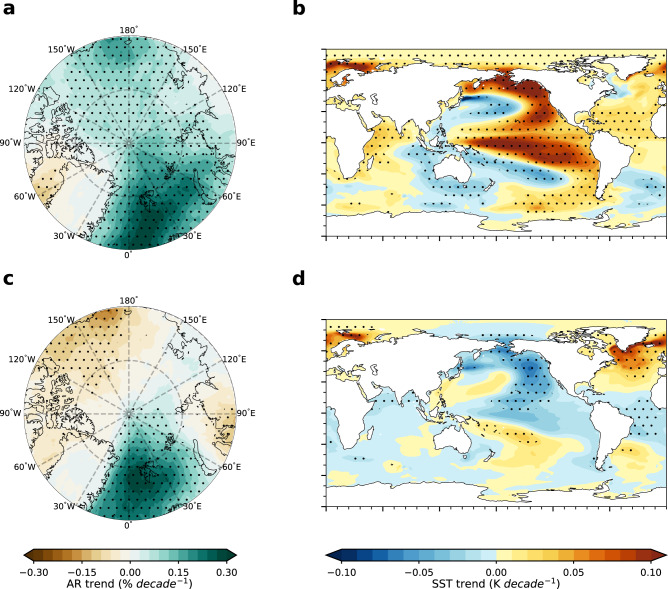
Fig. 3. Leading modes of covarying Arctic atmospheric river (AR) trends and global sea surface temperature (SST) trends due to internal variability.
a Spatial pattern of the Arctic AR frequency trend associated with the first mode of maximum covariance analysis (MCA). To focus on the portion of the co-variability between Arctic AR trend and global SST trend driven by internal variability, the ensemble mean trends of both the Arctic AR frequency and SST in the 50-member LENS2 (Fig. 2a) have been removed from individual members before applying the MCA. b SST trend pattern associated with the first mode. c, d Same as (a), (b) but for the second mode of MCA. The fraction of covariance explained by the first and second mode is 65% and 12%, respectively. These patterns are obtained by regressing the internally generated trends across 50 members onto their respective standardized expansion coefficients. Stippled areas indicate that regressions are significant at the 0.05 level based on the Student’s t-test.
Fig. 4
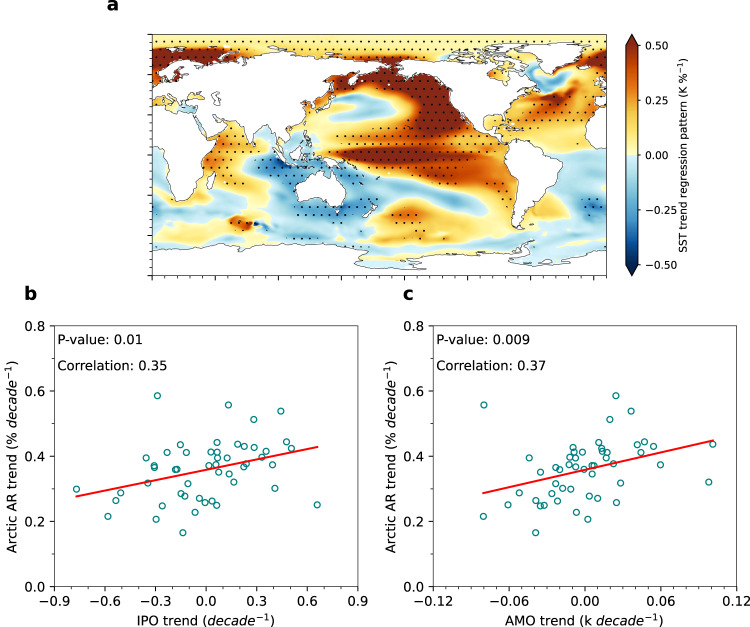
Fig. 4. Relationship between the Arctic spatial mean atmospheric river (AR) frequency trends and the Interdecadal Pacific Oscillation (IPO)/Atlantic Multidecadal Oscillation (AMO).
a LENS2 intermember regression of the sea surface temperature (SST) trends onto the Arctic spatial mean AR frequency trends. The regression pattern is obtained by regressing the SST trends at each grid point across all 50 members onto the spatially averaged Arctic AR frequency trends across all 50 members. Stippled areas indicate that the regression is significant at the 0.05 level based on the Student’s t-test. b shows scatterplots between the Arctic mean AR frequency trends and the IPO trends, where the red lines show the regression of data points for 50 members of LENS2. c same as in (b), but for the AR trends and AMO trends.
Fig. 5
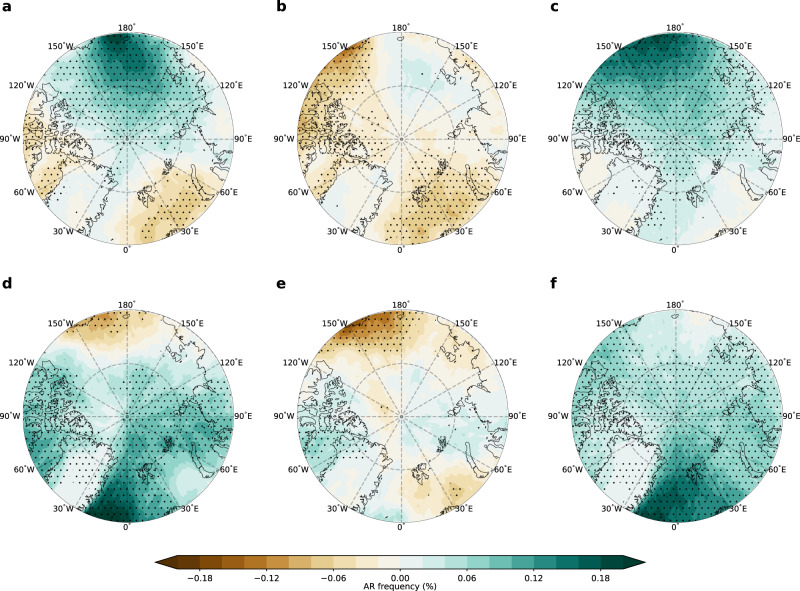
Fig. 5. Mechanisms of the Interdecadal Pacific Oscillation (IPO) and Atlantic Multidecadal Oscillation (AMO) in driving Arctic atmospheric river (AR) trends.
a Ensemble mean pattern of the regression of Arctic AR frequency time series onto the standardized IPO index, which represents the total effect of IPO on AR frequency trend. b Similar to (a), but obtained by regressing the Arctic AR frequency time series associated with circulation variability onto the standardized IPO index, which represents the dynamical contribution of IPO to the total AR frequency trend. c Obtained by taking the difference between (a) and (b), representing the thermodynamical contribution of the IPO to the total AR frequency trend. d–f Same as (a)–(c), but for the AMO. These regression patterns are based on the historical + SSP370 data in LENS2 from 1979 to 2100. Stippled areas indicate the regression is significant at the 0.05 level based on the Student’s t-test.
Fig. 6
Fig. 6. Near-future Arctic atmospheric river (AR) frequency trends with and without the influences of the Interdecadal Pacific Oscillation (IPO)/Atlantic Multidecadal Oscillation (AMO).
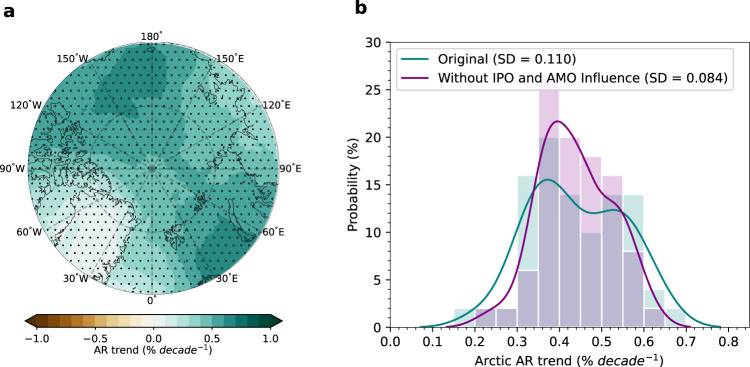
a Ensemble mean near-future (2024-2064) Arctic AR frequency trend in LENS2. Stippled areas indicate the trend is significant at the 0.05 level based on the Student’s t-test. b Histograms (bars) and the probability density function based on kernel density estimation (lines) of the near-future Arctic spatial mean AR frequency trends. The teal bars and line represent the original Arctic mean AR frequency trends, while the purple bars and line denote the Arctic mean AR frequency trends without the influences of the IPO and AMO. Note that the gray bars indicate an overlap between purple and teal.

References

    1. Rantanen M, et al. The Arctic has warmed nearly four times faster than the globe since 1979. Commun. Earth\Environ. 2022;3:168.
    1. Wang X, Liu Y, Key JR, Dworak R. A new perspective on four decades of changes in arctic sea ice from satellite observations. Remote Sens. 2022;14:1846. doi: 10.3390/rs14081846. - DOI
    1. Liu Z, et al. Acceleration of western Arctic sea ice loss linked to the Pacific North American pattern. Nat. Commun. 2021;12:1519. doi: 10.1038/s41467-021-21830-z. - DOI - PMC - PubMed
    1. Årthun M, Eldevik T, Smedsrud LH, Skagseth Ø, Ingvaldsen RB. Quantifying the influence of Atlantic heat on Barents Sea ice variability and retreat. J. Clim. 2012;25:4736–4743. doi: 10.1175/JCLI-D-11-00466.1. - DOI
    1. Li D, Zhang R, Knutson TR. On the discrepancy between observed and CMIP5 multi-model simulated Barents Sea winter sea ice decline. Nat. Commun. 2017;8:14991. doi: 10.1038/ncomms14991. - DOI - PMC - PubMed