Inhaled corticosteroids and Stenotrophomonas maltophilia in outpatients with chronic obstructive pulmonary disease: a retrospective cohort study
- PMID: 38460975
- PMCID: PMC10928788
- DOI: 10.1136/bmjresp-2023-001929
Inhaled corticosteroids and Stenotrophomonas maltophilia in outpatients with chronic obstructive pulmonary disease: a retrospective cohort study
Abstract
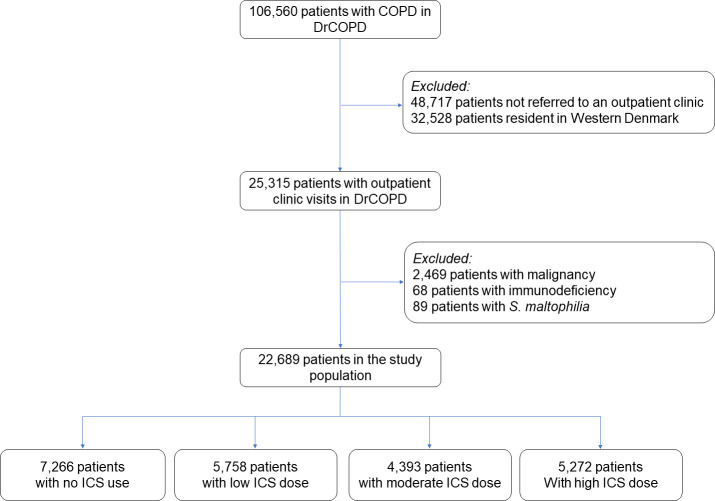
Objectives: Inhaled corticosteroids (ICS) are widely used in patients with chronic obstructive pulmonary disease (COPD). However, ICS are associated with an increased risk of adverse effects.We aimed to determine whether an association between a lower respiratory tract culture with Stenotrophomonas maltophilia and increasing ICS dosing in patients with COPD exists.
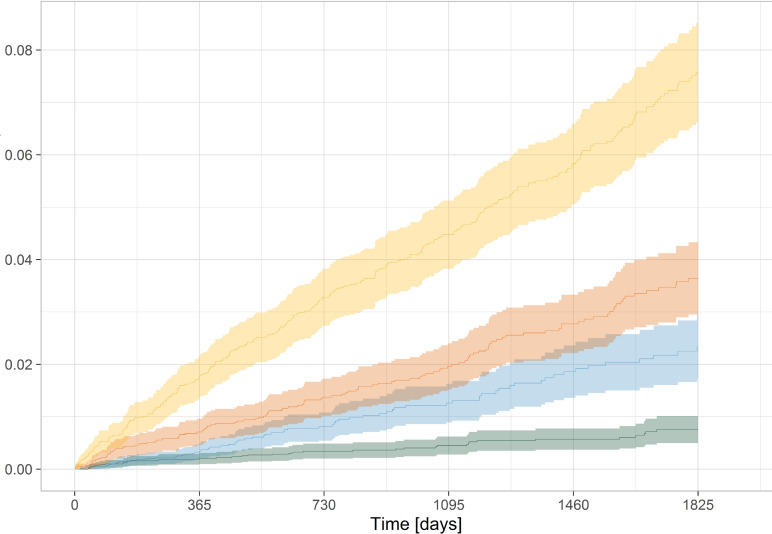
Design: An observational cohort study of outpatients with COPD in Denmark between 2010 and 2018.ICS exposure was categorised into four groups based on average daily consumption 1 year prior to inclusion: no use, low ICS dose (≤400 µg), moderate ICS dose (400-800 µg) and high ICS dose (>800 µg). Dose-response relationship was investigated by a multivariable Cox proportional hazards regression.
Results: Of the total 22 689 patients, 459 had lower respiratory tract cultures positive for S. maltophilia. The HR of S. maltophilia increased with increasing daily ICS dose: low ICS dose HR 2.6 (95% CI 1.6 to 4.0), moderate ICS dose HR 3.0 (95% CI 1.9 to 4.6) and high ICS dose HR 5.7 (95% CI 3.8 to 8.5).
Conclusions: We found that ICS was associated with a high, dose-dependent increased hazard of S. maltophilia in outpatients with COPD. High dose users had a nearly six times increased hazard compared with non-users of ICS. When appropriate, attempts at de-escalating ICS treatment should be made.
Keywords: COPD Pathology; COPD epidemiology; Pulmonary Disease, Chronic Obstructive.
© Author(s) (or their employer(s)) 2024. Re-use permitted under CC BY-NC. No commercial re-use. See rights and permissions. Published by BMJ.
Conflict of interest statement
Competing interests: Outside the submitted work, RBD has been on an advisory board for Pfizer. CSU has received grants from Sanofi, Boehringer Ingelheim, AstraZeneca and Novartis; consulting fees from Chiesi, Orion Pharma, AstraZeneca, GSK and TEVA; speaker fees from Orion Pharma, AstraZeneca and TEVA; and been on advisory boards for Novartis, Sanofi, Glaxo-Smith Kline, Chiesi, AstraZeneca and Boehringer Ingelheim.
Figures
References
Publication types
MeSH terms
Substances
LinkOut - more resources
Full Text Sources
Medical