


Micronutrient deficiency and supplements in schoolchildren and teenagers
- PMID: 38462972
- PMCID: PMC11864051
- DOI: 10.1097/MCO.0000000000001027
Micronutrient deficiency and supplements in schoolchildren and teenagers
Abstract
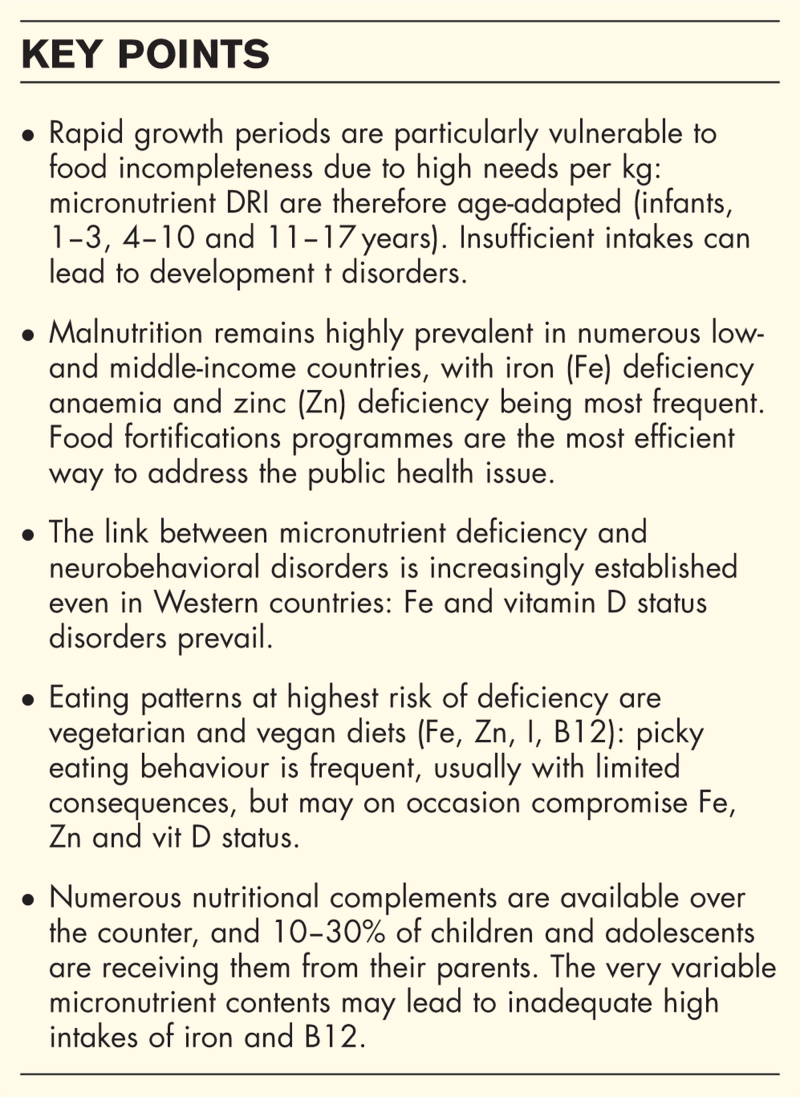
Purpose of review: The essential micronutrients are corner stones in the functional and physical development. Early deficiency has life-long consequences. While awareness about iron deficiency is relatively high, it remains lower for other micronutrients. This review aims at reporting on recent data and attracting attention to the high prevalence of micronutrient deficiencies in school-age and adolescent individuals.
Recent findings: Iron deficiency anaemia remains highly prevalent worldwide and the most frequent deficiency but can be corrected with simple tools ranging from food fortification, nutritional intervention, and to supplements. The link between micronutrient (MN) deficiency and neurobehavioral disorders is increasingly established and is worrying even in Western countries. Paediatric individuals are prone to imbalanced diets and picky eating behaviour, and their diets may then become incomplete: the highest risk for deficiency is observed for iron, zinc and vitamin D.
Summary: There is not much new information, but rather confirmation of the importance of health policies. Well conducted randomized controlled trials confirm that deficiencies can be corrected efficiently including with food fortification, and result in clinical benefits. Individual complementation should be considered in children and adolescents with proven deficiency.
Copyright © 2024 Wolters Kluwer Health, Inc. All rights reserved.
Conflict of interest statement
References
-
- Requirements Institute of Medicine (IOM). Child and Adult Care Food Program: Aligning Dietary Guidance for All. Washington (DC): National Academies Press (US); 2011. - PubMed
-
- EFSA. Overview on Dietary Reference Values for the EU population as derived by the EFSA Panel on Dietetic Products, Nutrition and Allergies (NDA). EFSA journal 2017. https://www.efsa.europa.eu/sites/default/files/assets/DRV_Summary_tables....
-
- World, Health, Organisation, WHO. Multiple micronutrient powders for point-of-use fortification of foods consumed by children 2–12 years of age. Geneva: WHO; Licence: CC BY-NC-SA 3.0 IGO; 2016.
Publication types
MeSH terms
Substances
LinkOut - more resources
Full Text Sources
Research Materials
