


Acute postoperative pain prevalence and intensity in the first 72 hour in Dessie Comprehensive Specialized Hospital, Ethiopia: a prospective single center observational study
- PMID: 38463044
- PMCID: PMC10923367
- DOI: 10.1097/MS9.0000000000001724
Acute postoperative pain prevalence and intensity in the first 72 hour in Dessie Comprehensive Specialized Hospital, Ethiopia: a prospective single center observational study
Abstract
Background: Postoperative pain is poorly studied in developing countries. Severe pain after surgery remains a major problem, occurring in 50-70% of the patients. Differences exist across countries. Despite numerous published studies, the degree of pain following many types of surgery in everyday clinical practice is unknown. To improve postoperative pain-treatment and develop procedure-specific, optimized pain-treatment protocols, the prevalence and severity of postoperative pain must first be identified.
Objective: This study aimed to determine the prevalence and intensity of acute postoperative pain and the practice of postoperative pain management.
Methods: A total of 180 patients were enrolled in the study, with 160 calculated using a single population proportion formula and a 10% attrition rate added, with proportionate stratification according to the size of each ward to obtain the number of participants from each specialty ward. A multistage sampling with stratified proportionate at the initial stages and a simple random sampling technique at the final stage was used. The patients completed a numerical pain rating scale for pain immediately after surgery for the first 72 h after surgery. The prevalence of mild, moderate, or severe pain was calculated. The evaluation was performed at eight time points including immediately after surgery: T2, T4, T8, T12, T24, T48, and T72.
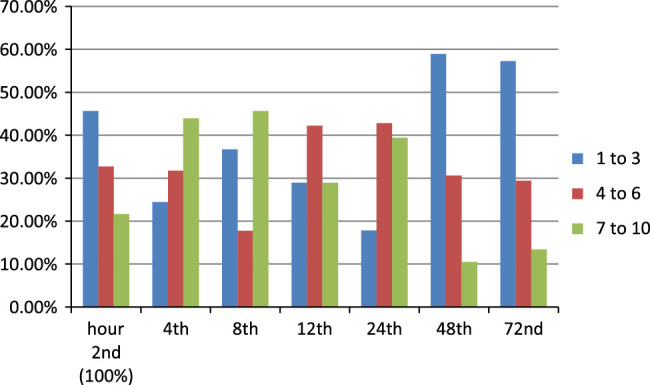
Result: The prevalence of severe pain in patients who underwent elective surgery in the study period measured by numeric rating scale was 21.6, 43.9, 45.6, 28.9, 39.4, 10.5, and 13.4% at 2nd, 4th, 8th, 12th, 24th, 48th and 72 h, respectively.
Conclusion: The prevalence of moderate-to-severe pain within 72 h postoperatively was slightly lower than that other studies conducted in Ethiopia reported. This was still high, indicating better pain management in the postoperative period. Involvement of the anesthetist in pain management is crucial for better patient management.
Keywords: DCSH; Dessie; Ethiopia; postoperative pain.
Copyright © 2024 The Author(s). Published by Wolters Kluwer Health, Inc.
Conflict of interest statement
There are no potential conflicts of interest with respect to the research, authorship, and/or publication of this article.Sponsorships or competing interests that may be relevant to content are disclosed at the end of this article.
Figures
References
-
- Andres J, Pogatzki-Zahn E, Huygen F, et al. Controlling acute pain to improve the quality of postoperative pain management: an update from the European Society of Regional Anesthesia meeting held in Maastricht (September 2016). Pain Manag 2017;7:513–522. - PubMed
-
- Haile M, Desalegn N, Akalu L. Practice of regional anesthesia and analgesia in Ethiopian hospital. Int J Med Med Sci 2015;7:130–138.
LinkOut - more resources
Full Text Sources