


A maternally derived complex small supernumerary marker chromosome involving chromosomes 8 and 14: case report and review of the literature
- PMID: 38463166
- PMCID: PMC10921356
- DOI: 10.3389/fgene.2024.1331676
A maternally derived complex small supernumerary marker chromosome involving chromosomes 8 and 14: case report and review of the literature
Abstract
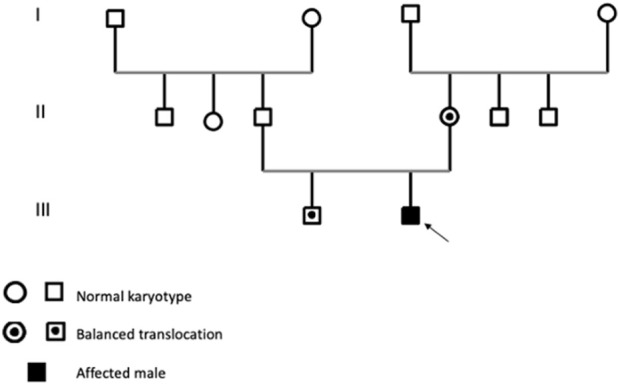
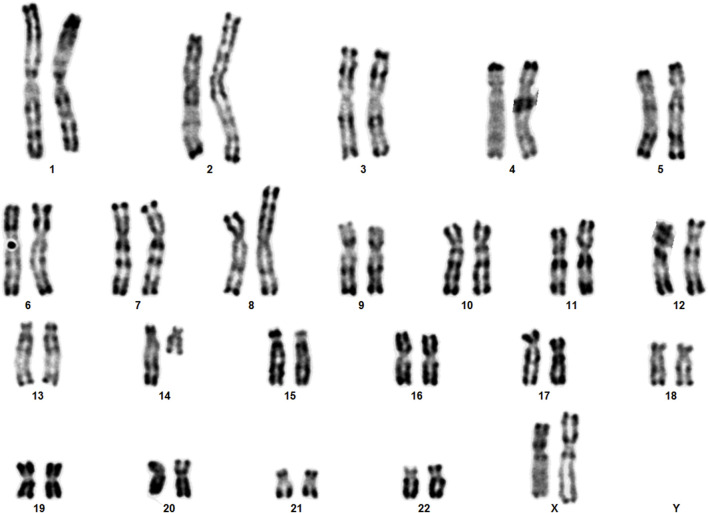
Introduction: The majority of small supernumerary marker chromosomes (sSMCs) are derived from one single chromosome. Complex sSMCs, on the other hand, consist of genetic material derived from more than one, normally two chromosomes. Complex sSMCs involving chromosomes 8 and 14 are rarely encountered. Case presentation: We present here a 14-month-old boy born from an unrelated couple. At birth, the baby was hypotonic and had a cleft lip and palate, as well as ocular involvement. Throughout the course of development, the baby experienced feeding difficulties, stunted growth, and delayed psychomotor development. Banding together with molecular cytogenetics revealed a balanced maternal translocation t(8;14)(p22.3;q21)mat, leading due to meiotic 3:1 segregation to a partial trisomy of chromosomes 8 and 14 in the affected boy. Discussion/Conclusion: This report highlights the importance of cytogenetics in diagnosis of rare genetic disorders, with impact on genetic counselling of patients and their families. There are three comparable cases in the literature involving both chromosomes 8 and 14, but with different breakpoints; the complex sSMC derived from chromosomes 8 and 14 in this case, characterized as der(14)t(8;14) (p22.3;q21)mat.
Keywords: chromosome 8 and 14; clinical features; complex small supernumerary marker chromosome (sSMC); molecular cytogenetics; partial trisomy.
Copyright © 2024 Ouboukss, El Amrani, Bouchahta, Ratbi, Sbiti, Liehr, Sefiani and Natiq.
Conflict of interest statement
The authors declare that the research was conducted in the absence of any commercial or financial relationships that could be construed as a potential conflict of interest. The author(s) declared that they were an editorial board member of Frontiers, at the time of submission. This had no impact on the peer review process and the final decision.
Figures



References
-
- Brunetti-Pierri N., Paciorkowski A. R., Ciccone R., Mina E. D., Bonaglia M. C., Borgatti R., et al. (2011). Duplications of FOXG1 in 14q12 are associated with developmental epilepsy, mental retardation, and severe speech impairment. Eur. J. Hum. Genet. 19 (1), 102–107. 10.1038/ejhg.2010.142 - DOI - PMC - PubMed
-
- Dutrillaux B., Couturier J. (1981). La Pratique de L’analyse Chromosomique. Paris: Masson.
-
- Faas B. H., Van D. D. J., Wunderink M. I., Merkx G., Brunner H. G. (2006). Multiple congenital abnormalities in a newborn with two supernumerary marker chromosomes derived from chromosome 14. Genet. Couns. 17, 349–357. - PubMed
Publication types
LinkOut - more resources
Full Text Sources
