


Rare, long-distance dispersal underpins genetic connectivity in the pink sea fan, Eunicella verrucosa
- PMID: 38463749
- PMCID: PMC10918604
- DOI: 10.1111/eva.13649
Rare, long-distance dispersal underpins genetic connectivity in the pink sea fan, Eunicella verrucosa
Abstract
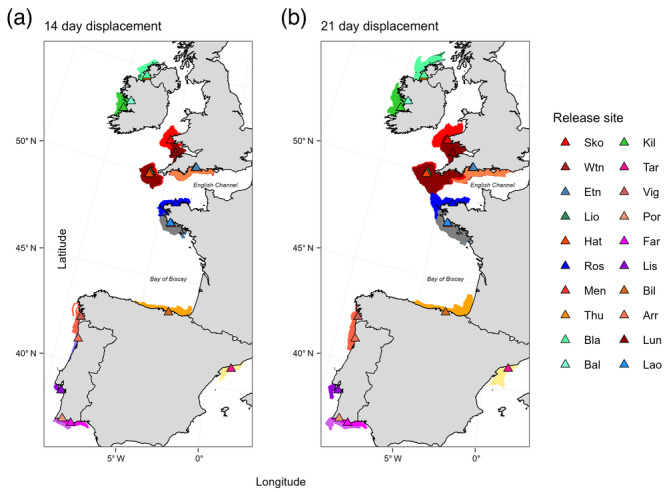
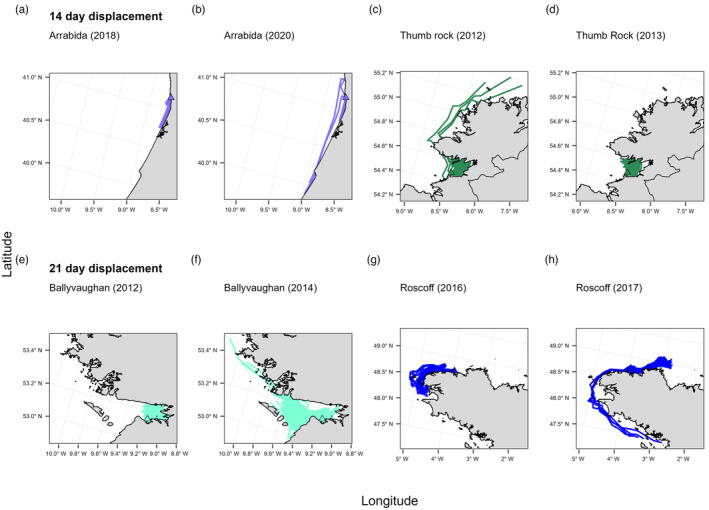
Characterizing patterns of genetic connectivity in marine species is of critical importance given the anthropogenic pressures placed on the marine environment. For sessile species, population connectivity can be shaped by many processes, such as pelagic larval duration, oceanographic boundaries and currents. This study combines restriction-site associated DNA sequencing (RADseq) and passive particle dispersal modelling to delineate patterns of population connectivity in the pink sea fan, Eunicella verrucosa, a temperate octocoral. Individuals were sampled from 20 sites covering most of the species' northeast Atlantic range, and a site in the northwest Mediterranean Sea to inform on connectivity across the Atlantic-Mediterranean transition. Using 7510 neutral SNPs, a geographic cline of genetic clusters was detected, partitioning into Ireland, Britain, France, Spain (Atlantic), and Portugal and Spain (Mediterranean). Evidence of significant inbreeding was detected at all sites, a finding not detected in a previous study of this species based on microsatellite loci. Genetic connectivity was characterized by an isolation by distance pattern (IBD) (r 2 = 0.78, p < 0.001), which persisted across the Mediterranean-Atlantic boundary. In contrast, exploration of ancestral population assignment using the program ADMIXTURE indicated genetic partitioning across the Bay of Biscay, which we suggest represents a natural break in the species' range, possibly linked to a lack of suitable habitat. As the pelagic larval duration (PLD) is unknown, passive particle dispersal simulations were run for 14 and 21 days. For both modelled PLDs, inter-annual variations in particle trajectories suggested that in a long-lived, sessile species, range-wide IBD is driven by rare, longer dispersal events that act to maintain gene flow. These results suggest that oceanographic patterns may facilitate range-wide stepping-stone genetic connectivity in E. verrucosa and highlight that both oceanography and natural breaks in a species' range should be considered in the designation of ecologically coherent MPA networks.
Keywords: RAD sequencing; genetic structure; oceanographic modelling; octocoral; single nucleotide polymorphism.
© 2024 The Authors. Evolutionary Applications published by John Wiley & Sons Ltd.
Conflict of interest statement
None declared.
Figures




References
-
- Aurelle, D. , Bavestrello, G. , Masmoudi, M. B. , Hammami, P. , Montefalcone, M. , Chaoui, L. , Haguenauer, A. , Kara, M. H. , & Cánovas‐Molina, A. (2018). From depth to regional spatial genetic differentiation of Eunicella cavolini in the NW Mediterranean. Comptes Rendus Biologies, 341, 421–432. 10.1016/j.crvi.2018.09.002 - DOI - PubMed
-
- Ayata, S. D. , Lazure, P. , & Thiébaut, É. (2010). How does the connectivity between populations mediate range limits of marine invertebrates? A case study of larval dispersal between the Bay of Biscay and the English Channel (North‐East Atlantic). Progress in Oceanography, 87, 18–36. 10.1016/j.pocean.2010.09.022 - DOI
Associated data
LinkOut - more resources
Full Text Sources
Research Materials
Miscellaneous
