[Preprint]. 2024 Feb 29:rs.3.rs-3931021.
doi: 10.21203/rs.3.rs-3931021/v1.

Immunogenicity and safety of inactivated SARS-CoV-2 vaccine (CoronaVac) using two-dose primary protocol in children and adolescents (Immunita-002, Brazil): A phase IV six-month follow up

Affiliations

Immunogenicity and safety of inactivated SARS-CoV-2 vaccine (CoronaVac) using two-dose primary protocol in children and adolescents (Immunita-002, Brazil): A phase IV six-month follow up

Camila Amormino Corsini et al. Res Sq. .

Update in

  • Immunogenicity and safety of CoronaVac vaccine in children and adolescents (Immunita-002, Brazil): A phase IV six-month follow up.
    Corsini CA, da Silva Martins PF, Filgueiras PS, Lourenço AJ, de Souza Lima AE, Gomes SVC, de Jesus Jeremias W, Alves PA, da Rocha Fernandes G, Castro LLME, Teixeira-Carvalho A, Azevedo ACC, De Almeida Leitao Curimbaba C, Lorencini DA, Junior EM, da Silva VM, Cervi MC, de Carvalho Borges M, Nogueira ML, Campos GRF, Correa PRL, Carvalho TML, Dos Reis JGAC, de Sousa Reis EV, Dos Reis Castilho L, de Lima PR, do Nascimento JPR, de Oliveira JG, Filho OAM; Immunita Team; Grenfell RFQE. Corsini CA, et al. Sci Rep. 2025 Jul 2;15(1):23040. doi: 10.1038/s41598-025-94596-9. Sci Rep. 2025. PMID: 40595400 Free PMC article. Clinical Trial.

Abstract

Introduction: Vaccines are essential for the prevention and control of several diseases, indeed, monitoring the immune response generated by vaccines is crucial. The immune response generated by vaccination against SARS-CoV-2 in children and adolescents is not well defined regarding to the intensity and medium to long-term duration of a protective immune response, which may point out the need of booster doses and might support the decisions in public health.

Objective: The study aims to evaluate the immunogenicity and safety of inactivated SARS-CoV-2 vaccine (CoronaVac) in a two-dose primary protocol in children and adolescent aging from 3 to 17 years old in Brazil.

Methods: Participants were invited to participate in the research at two public healthcare centers located in Serrana (São Paulo) and Belo Horizonte (Minas Gerais), Brazil. Participants underwent medical interviews to gather their medical history, including COVID-19 history and medical records. Physical exams were conducted, including weight, blood pressure, temperature, and pulse rate measurements. Blood samples were obtained from the participants before vaccination, 1 month after the first dose, and 1, 3, and 6 months after the second dose and were followed by a virtual platform for monitoring post-vaccination reactions and symptoms of COVID-19. SARS-CoV-2 genome from Swab samples of COVID-19 positive individuals were sequenced by NGS. Total antibodies were measured by ELISA and neutralizing antibodies to B.1 lineage and Omicron variant (BA.1) quantified by PRNT and VNT. The cellular immune response was evaluated by flow cytometry by the quantification of systemic soluble immune mediators.

Results: The follow-up of 640 participants showed that the CoronaVac vaccine (Sinovac/Butantan Institute) was able to significantly induce the production of total IgG antibodies to SARS-CoV-2 and the production of neutralizing antibodies to B.1 lineage and Omicron variant. In addition, a robust cellular immune response was observed with wide release of pro-inflammatory and regulatory mediators in the early post-immunization moments. Adverse events recorded so far have been mild and transient except for seven serious adverse events reported on VigiMed.

Conclusions: The results indicate a robust and sustained immune response induced by the CoronaVac vaccine in children and adolescents up to six months, providing evidences to support the safety and immunogenicity of this effective immunizer.

Keywords: COVID-19; CoronaVac; SARS-CoV-2; Vaccine; antibodies kinetics; cellular markers; neutralizing antibodies.


Conflict of interest statement

MLN has received research grants from Instituto Butantan, Janssen Vaccines and Prevention B.V., Medicago R&D Inc, and Pfizer/BioNTech SE. RFQG has received grants from Instituto Butantan.Additional Declarations: No competing interests reported.

Figures
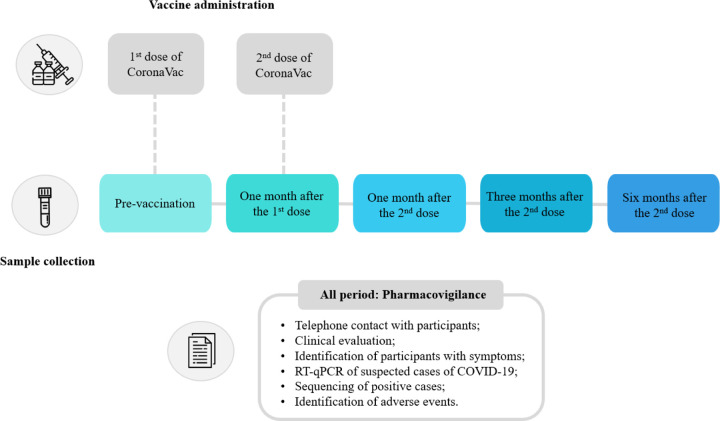
Figure 1.
Figure 1.
Schematic representation of the Immunita-002 study design.
Figure 2.
Figure 2.
Kinetics of anti-S IgG (A) and anti-N IgG (B) levels of SARS-CoV-2 at pre-vaccination, 1 month after the first dose, and 1 month, 3 months, and 6 months after receiving the second dose of the CoronaVac vaccine (Sinovac/Butantan Institute). The detection limit of 0.1508 in (A) and 0.1460 in (B) is represented by dashed lines. The black dots represent individual data points of optical density (450nm) for each vaccinated participant. The percentage values indicate the seropositivity rate. The geometric mean of IgG anti-S and anti-N antibody titers is represented by blue and green bars, respectively. Statistical differences defined by Kruskal-Wallis and Mann-Whitney methods are represented for comparisons over time.
Figure 3.
Figure 3.
Kinetics of total IgG anti-S (A) and anti-N (B) antibody levels to SARS-CoV-2 at pre-vaccination, 1 month after the first dose, and 1 month, 3 months, and 6 months after receiving the second dose of the CoronaVac vaccine (Sinovac/Butantan Institute) separately for age groups (3–5, 6–12, and 13–17 years old). The detection limit of 0.1508 in (A) and 0.1460 in (B) is represented by dashed lines. The colored dots represent the geometric mean of optical density (450nm) for each vaccinated age group.
Figure 4.
Figure 4.
(A) Neutralizing antibodies detected by PRNT to B.1 lineage of SARS-CoV-2 in children and adolescents vaccinated with CoronaVac (Sinovac/Butantan Institute). The cutoff for seropositivity definition of 20 is represented by dashed lines. The geometric mean antibody titer is represented by orange bars. The colored points represent the individual result of each participant at different follow-up times in the study. Statistical differences defined by Mann-Whitney are presented for comparisons over time. (B) Neutralizing antibodies detected by VNT50 to Omicron variant (BA.1) of SARS-CoV-2 in children and adolescents vaccinated with CoronaVac (Sinovac/Butantan Institute). The cutoff for seropositivity definition of 20 is represented by dashed lines. The geometric mean antibody titer is represented by red bars. The colored points represent the individual result of each participant at different follow-up times in the study. Statistical differences defined by Mann-Whitney are presented for comparisons over time.
Figure 5.
Figure 5.
(A) Neutralizing antibodies detected by PRNT to B.1 lineage of SARS-CoV-2 in children aged 3 to 11 years vaccinated with CoronaVac (Sinovac/Butantan Institute). The cutoff for seropositivity definition of 20 is represented by dashed lines. The geometric mean antibody titer is represented by orange bars. The colored points represent the individual result of each participant at different follow-up times in the study. Statistical differences defined by Mann-Whitney are presented for comparisons over time. (B) Neutralizing antibodies detected by PRNT to B.1 lineage of SARS-CoV-2 in adolescents aged 12 to 17 years vaccinated with CoronaVac (Sinovac/Butantan Institute).
Figure 6.
Figure 6.
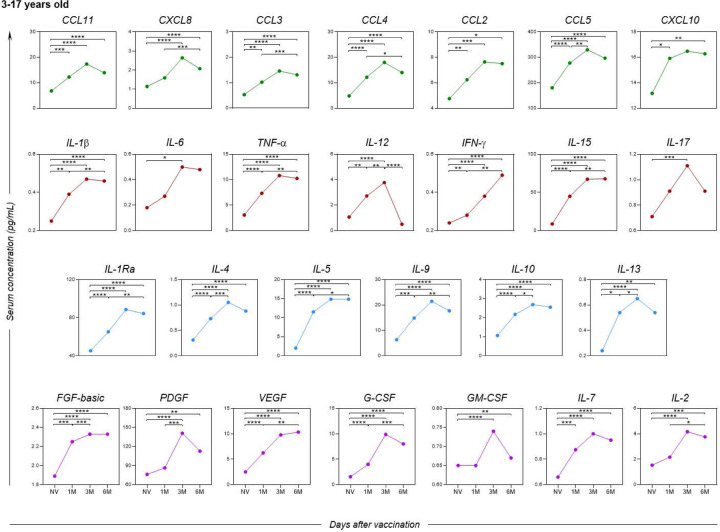
Kinetics of serum soluble mediators at one month (1M), three months (3M), and six months (6M) after receiving two doses of the CoronaVac vaccine in children and adolescents (3–17 years old) as compared to the pre-vaccination period (Not Vaccinated - NV). The biomarkers were individually presented for chemokines (CXCL8, CCL11, CCL3, CCL4, CCL2, CCL5 and CXCL10); pro-inflammatory cytokines (IL-1β, IL-6, TNF-α, IL-12, IFN-γ, IL-15 and IL-17); regulatory cytokines (IL-1Ra, IL-4, IL-5, IL-9, IL-10 and IL-13) and growth factors (FGF-basic, PDGF, VEGF, G-CSF, GM-CSF, IL-7 and IL-2). Statistical differences by Mann-Whitney and ANOVA with significance levels of p < 0.05 are denoted by (*) between groups.
Figure 7.
Figure 7.
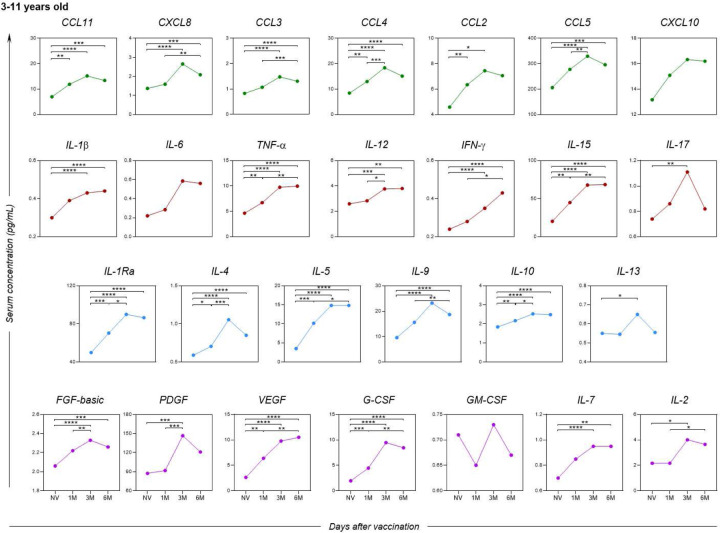
Kinetics of serum soluble mediators at one month (1M), three months (3M), and six months (6M) after receiving two doses of the CoronaVac vaccine in children (3–11 years old) as compared to the pre-vaccination period (Not Vaccinated - NV). The biomarkers were individually presented for chemokines (CXCL8, CCL11, CCL3, CCL4, CCL2, CCL5 and CXCL10); pro-inflammatory cytokines (IL-1β, IL-6, TNF-α, IL-12, IFN-γ, IL-15, IL-17); regulatory cytokines (IL-1Ra, IL-4, IL-5, IL-9, IL-10 and IL-13); and growth factors (FGF-basic, PDGF, VEGF, G-CSF, GM-CSF, IL-7 and IL-2). Statistical differences by Mann-Whitney and ANOVA with significance levels of p < 0.05 are denoted by (*) between groups.
Figure 8.
Figure 8.
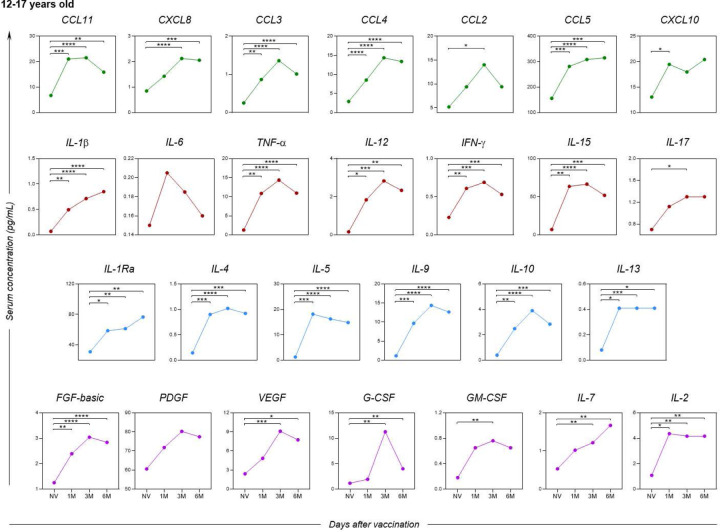
Kinetics of serum soluble mediators at one month (1M), three months (3M), and six months (6M) after receiving two doses of the CoronaVac vaccine in adolescents (12–17 years old) as compared to the pre-vaccination period (Not Vaccinated - NV). The biomarkers were individually presented for chemokines (CXCL8, CCL11, CCL3, CCL4, CCL2, CCL5 and CXCL10); pro-inflammatory cytokines (IL-1β, IL-6, TNF-α, IL-12, IFN-γ, IL-15, IL-17); regulatory cytokines (IL-1Ra, IL-4, IL-5, IL-9, IL-10 and IL-13); and growth factors (FGF-basic, PDGF, VEGF, G-CSF, GM-CSF, IL-7 and IL-2). Statistical differences by Mann-Whitney and ANOVA with significance levels of p < 0.05 are denoted by (*) between groups.
Figure 9.
Figure 9.
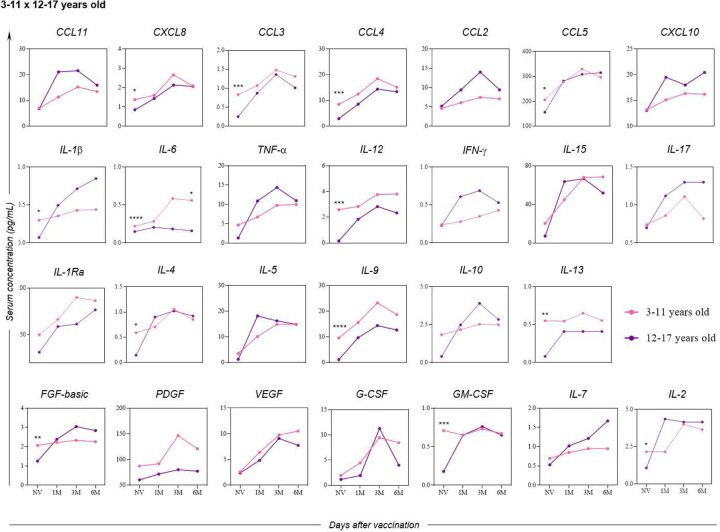
Differences in the kinetics of serum soluble mediators between children (3–11 years old) and adolescents (12–17 years old) at one month (1M), three months (3M), and six months (6M) after receiving two doses of the CoronaVac vaccine as compared to the pre-vaccination period (Not Vaccinated - NV). The biomarkers were individually presented for chemokines (CXCL8, CCL11, CCL3, CCL4, CCL2, CCL5 and CXCL10); pro-inflammatory cytokines (IL-1β, IL-6, TNF-α, IL-12, IFN-γ, IL-15, IL-17); regulatory cytokines (IL-1Ra, IL-4, IL-5, IL-9, IL-10 and IL-13); and growth factors (FGF-basic, PDGF, VEGF, G-CSF, GM-CSF, IL-7 and IL-2). Statistical differences by Mann-Whitney and ANOVA with significance levels of p < 0.05 are denoted by (*) between groups.

References

    1. ALVIM Renata GF et al. An affordable anti-SARS-COV-2 spike protein ELISA test for early detection of IgG seroconversion suited for large-scale surveillance studies in low-income countries. 2020.
    1. CAMPOS Guilherme RF et al. Booster dose of BNT162b2 after two doses of CoronaVac improves neutralization of SARS-CoV-2 Omicron variant. Communications medicine, v. 2, n. 1, p. 1–4, 2022. - PMC - PubMed
    1. CORMAN V. et al. Diagnostic detection of Wuhan coronavirus 2019 by real-time RT-PCR-protocol and preliminary evaluation as of Jan 13, 2020. Available from www.who.int/docs/default-source/coronaviruse/wuhan-virus-assay-v1991527e..., 2020.
    1. DEZORDI Filipe Zimmer et al. ViralFlow: A versatile automated workflow for SARS-CoV-2 genome assembly, lineage assignment, mutations and intrahost variant detection. Viruses, v. 14, n. 2, p. 217, 2022. - PMC - PubMed
    1. FERNANDES Eder Gatti et al. Safety and immunogenicity of an inactivated SARS-CoV-2 vaccine (CoronaVac) in inadvertently vaccinated healthy children. Revista do Instituto de Medicina Tropical de São Paulo, v. 63, p. e83, 2021. - PMC - PubMed

Publication types

LinkOut - more resources