


Targeting latent viral infection in EBV-associated lymphomas
- PMID: 38464537
- PMCID: PMC10920267
- DOI: 10.3389/fimmu.2024.1342455
Targeting latent viral infection in EBV-associated lymphomas
Abstract
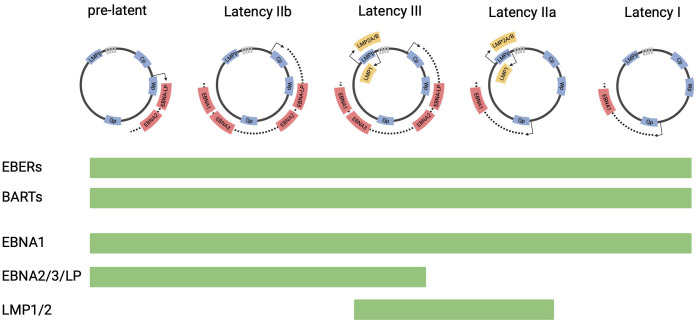
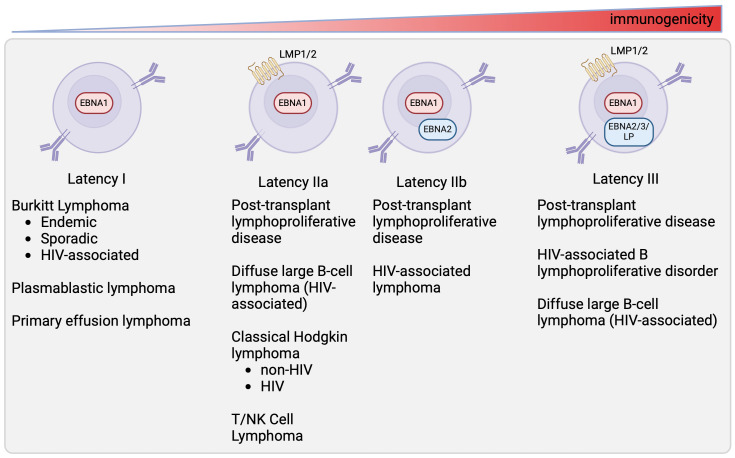
Epstein-Barr virus (EBV) contributes to the development of a significant subset of human lymphomas. As a herpes virus, EBV can transition between a lytic state which is required to establish infection and a latent state where a limited number of viral antigens are expressed which allows infected cells to escape immune surveillance. Three broad latency programs have been described which are defined by the expression of viral proteins RNA, with latency I being the most restrictive expressing only EBV nuclear antigen 1 (EBNA1) and EBV-encoded small RNAs (EBERs) and latency III expressing the full panel of latent viral genes including the latent membrane proteins 1 and 2 (LMP1/2), and EBNA 2, 3, and leader protein (LP) which induce a robust T-cell response. The therapeutic use of EBV-specific T-cells has advanced the treatment of EBV-associated lymphoma, however this approach is only effective against EBV-associated lymphomas that express the latency II or III program. Latency I tumors such as Burkitt lymphoma (BL) and a subset of diffuse large B-cell lymphomas (DLBCL) evade the host immune response to EBV and are resistant to EBV-specific T-cell therapies. Thus, strategies for inducing a switch from the latency I to the latency II or III program in EBV+ tumors are being investigated as mechanisms to sensitize tumors to T-cell mediated killing. Here, we review what is known about the establishment and regulation of latency in EBV infected B-cells, the role of EBV-specific T-cells in lymphoma, and strategies to convert latency I tumors to latency II/III.
Keywords: EBNA2; EBNA3; LMP1; T-cell; ebv; latency; lymphoma.
Copyright © 2024 Kong and Giulino-Roth.
Conflict of interest statement
LG-R: consultant for Merck, Roche; research funds from Seagen. The remaining author declare that the research was conducted in the absence of any commercial or financial relationships that could be constructed as a potential conflict of interest.
Figures
References
-
- Anwar N, Kingma DW, Bloch AR, Mourad M, Raffeld M, Franklin J, et al. The investigation of Epstein-Barr viral sequences in 41 cases of Burkitt’s lymphoma from Egypt: epidemiologic correlations. Cancer. (1995) 76:1245–52. doi: 10.1002/1097-0142(19951001)76:7<1245::aid-cncr2820760723>3.0.co;2-d - DOI - PubMed
Publication types
MeSH terms
Substances
Grants and funding
LinkOut - more resources
Full Text Sources
Research Materials
