


An Assessment of Trends in HIV-1 Prevalence and Incidence and Spatio-Temporal Analyses of HIV-1 Recent Infection Among MSM During the Surveillance Period Between 2018 and 2022 in Sichuan, China
- PMID: 38464995
- PMCID: PMC10924877
- DOI: 10.2147/HIV.S448096
An Assessment of Trends in HIV-1 Prevalence and Incidence and Spatio-Temporal Analyses of HIV-1 Recent Infection Among MSM During the Surveillance Period Between 2018 and 2022 in Sichuan, China
Abstract
Background: Men who have sex with men (MSM) is one main type of high-risk activities facilitating HIV-1 transmission in Sichuan province. Previous works on HIV-1 incidence and prevalence among MSM only concentrated before 2018, the situation after that is unknown. In addition, the distribution of hot-spots related to current HIV-1 epidemic is also rarely known among MSM in Sichuan.
Objective: To update trends of HIV-1 prevalence and incidence and to visualize hot-spots of ongoing transmission in Sichuan province during surveillance period among MSM between 2018 and 2022.
Methods: Limiting Antigen Avidity assay was performed to detect recent infection within new HIV-1 diagnoses founded during surveillance period among MSM. The HIV-1 prevalence and incidence were calculated according to an extrapolation method proposed by publications and guidelines. Trend tests were performed using χ2 tests with linear-by-linear association. The spatial analysis was conducted with ArcGIS 10.7 to figure hot-spots of HIV-1 recent infections among MSM.
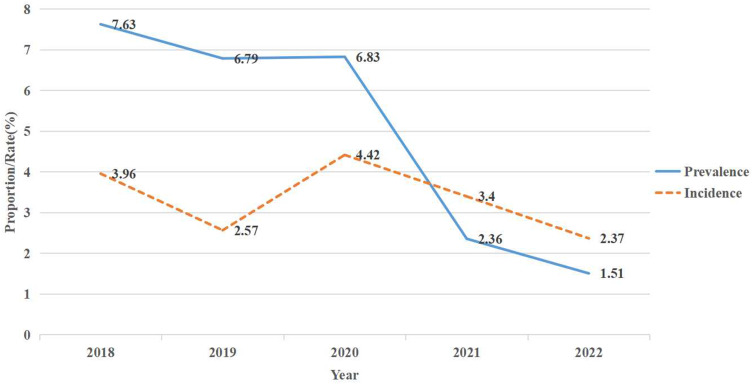
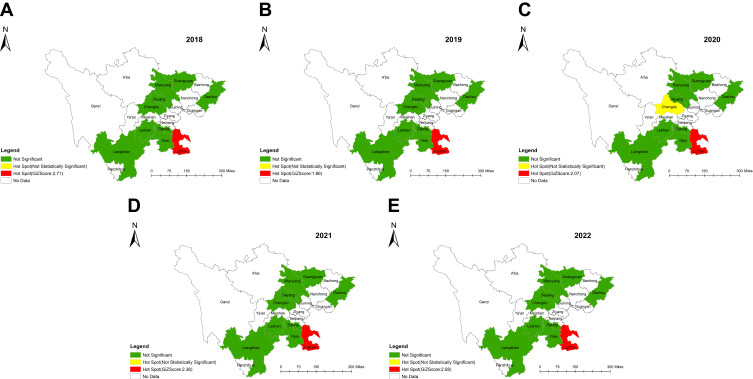
Results: Between 2018 and 2022, 16,697 individuals participated in HIV-1 MSM sentinel surveillance program, of which 449 samples (98.25%) were tested with LAg-Avidity EIA, and 230 samples were classified as recent infection. Respectively, the overall prevalence and incidence were 2.74% and 3.69% (95% CI: 3.21, 4.16) and both had significant declining trends (p < 0.001). Luzhou city had a highest HIV-1 incidence (10.74%, 95% CI: 8.39, 13.10) over the study period and was recognized as a hot-spot for recent HIV-1 infection among MSM.
Conclusion: During the surveillance period, both HIV-1 prevalence and incidence were declining. However, Luzhou city had an unusually high HIV-1 incidence and became an emerging hot-spot of recent HIV-1 infection among MSM. This finding suggested focused attention, cross-regional intervention strategies, and prevention programs are urgently required to curb the spread of ongoing transmission.
Keywords: HIV-1 recent infection; hot-spots; human immunodeficiency virus type 1; incidence; men who have sex with men.
© 2024 Yang et al.
Conflict of interest statement
The authors declare no conflicts of interest for this work.
Figures
References
LinkOut - more resources
Full Text Sources
