


Intensive Care Associated Experiences of Extremely Premature Infants Who Die
- PMID: 38465345
- PMCID: PMC10923598
- DOI: 10.29011/2577-2236.100161
Intensive Care Associated Experiences of Extremely Premature Infants Who Die
Abstract
Objective: Pain and quality of death are important considerations in treatment choices for children. Our objective is to assess the intensive care-associated experiences of 22-25 weeks gestational age (GA) infants who die despite intensive care treatment.
Study design: In a 1:1 case-control study, medical records were screened for all inborn 22-25 weeks GA infants who received intensive care treatments between 2014 and 2020. Cases were all infants who died. Each case was matched by GA and birth weight to an infant who survived to discharge (control). Data was collected on cases and controls for a matched timeframe based on the case's duration of intensive care treatment. Information collected included intensive care-associated negative experiences (invasive procedures, surgeries, use of pain medication) and positive experiences (enteral feedings, being held by family).
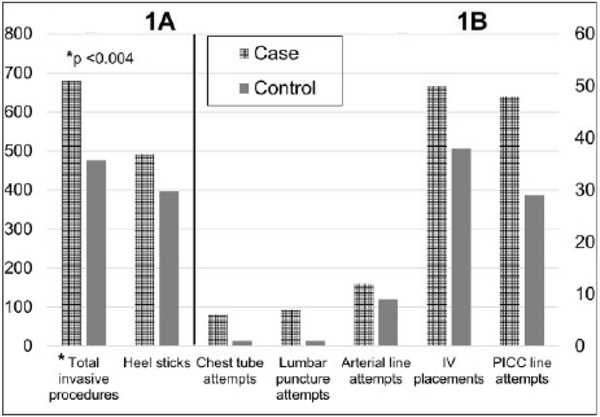
Results: The cases (n=20) survived for 0 to 93 days, with median (IQR) survival 8 (5, 24) days. The mean (SD) number of invasive procedures was higher for cases than controls, 34 (30) vs. 24 (22), p=0.004. Cases underwent 8 surgeries compared to 4 in the controls. Additionally, compared to controls, cases spent more time receiving pain medications (64% vs. 27%, p<0.001) and without being fed (54% vs. 39%, p<0.001). Half of cases were never held by parents until the day they died.
Conclusion: Extremely premature infants who die despite intensive care face more treatment burdens than the survivors. Larger studies are needed to confirm these findings and gather information necessary for informed decisions about intensive care treatment of these infants.
Keywords: Bioethics; Invasive Procedures; Periviable Birth; Premature Birth; Quality of Death; Treatment Burden.
Conflict of interest statement
Conflict of Interest: None declared.
Figures
References
-
- Raju TN, Mercer BM, Burchfield DJ, Joseph GF Jr (2014) Periviable birth: executive summary of a joint workshop by the Eunice Kennedy Shriver National Institute of Child Health and Human Development, Society for Maternal-Fetal Medicine, American Academy of Pediatrics, and American College of Obstetricians and Gynecologists. American journal of obstetrics and gynecology. 210: 406–417. - PubMed
-
- Leuthner SR (2014) Borderline viability: controversies in caring for the extremely premature infant. Clinics in perinatology. 41: 799–814. - PubMed
-
- Myrhaug HT, Brurberg KG, Hov L, Markestad T (2019) Survival and Impairment of Extremely Premature Infants: A Meta-analysis. Pediatrics. 143. - PubMed
-
- Harrison H (1993) The principles for family-centered neonatal care. Pediatrics. 92: 643–650. - PubMed
Grants and funding
LinkOut - more resources
Full Text Sources