


Visual snow syndrome: recent advances in understanding the pathophysiology and potential treatment approaches
- PMID: 38465699
- PMCID: PMC11064904
- DOI: 10.1097/WCO.0000000000001258
Visual snow syndrome: recent advances in understanding the pathophysiology and potential treatment approaches
Abstract
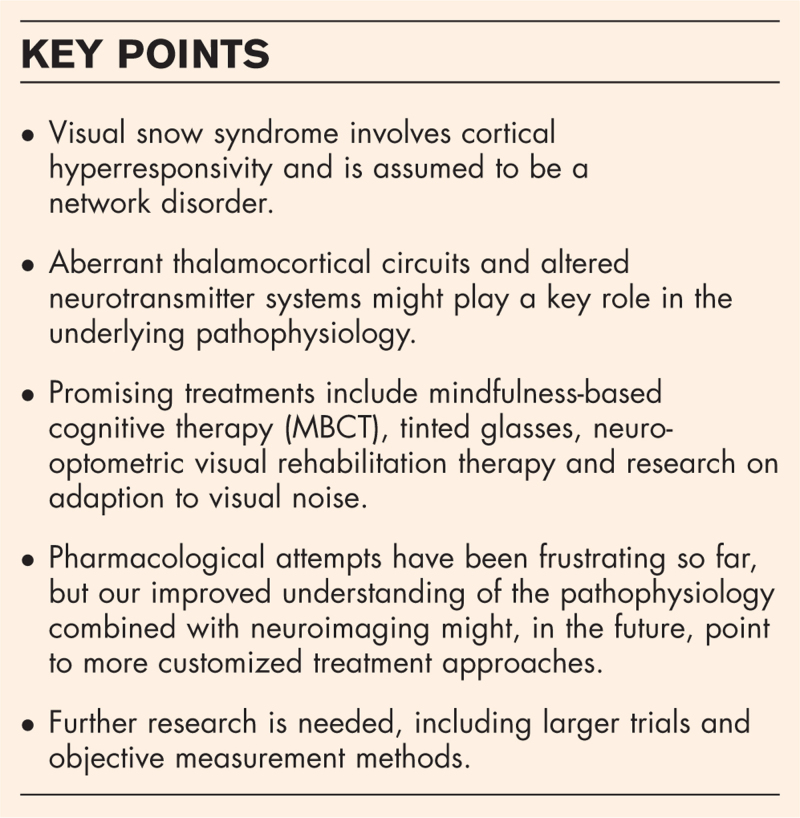
Purpose of review: Visual snow syndrome (VSS) is a disorder characterized by persistent visual disturbances, including the visual snow phenomenon, palinopsia, heightened perception of entoptic phenomena, impaired night vision, and photophobia. The purpose of this review is to provide an update on recent findings over the past 18 months in VSS research and to summarize the current state of treatment approaches.
Recent findings: Electrophysiological studies have revealed cortical hyperresponsivity in visual brain areas, imaging studies demonstrated microstructural and functional connectivity alterations in multiple cortical and thalamic regions and investigated glutamatergic and serotoninergic neurotransmission. These findings suggest that VSS might be a network disorder.Only few treatment studies are currently available demonstrating limited response to medication and even worsening or triggering of visual symptoms by certain antidepressants. Promising nonpharmacological treatments include mindfulness-based cognitive therapy, the use of chromatic filters, and research on visual noise adaption and neuro-optometric visual rehabilitation therapy (NORT). However, the level of evidence is still low and further research is needed including larger trials and involving objective measures of individual dysfunction.
Summary: Although there has been recent progress, we still have not fully understood the nature of VSS. Further research is needed on a clinical and pathophysiological level to successfully treat the condition.
Copyright © 2024 The Author(s). Published by Wolters Kluwer Health, Inc.
Conflict of interest statement
Figures

References
-
- Schankin CJ, Maniyar FH, Digre KB, Goadsby PJ. ‘Visual snow’ – a disorder distinct from persistent migraine aura. Brain 2014; 137:1419–1428. - PubMed
-
- Yildiz FG, Turkyilmaz U, Unal-Cevik I. The clinical characteristics and neurophysiological assessments of the occipital cortex in visual snow syndrome with or without migraine. Headache 2019; 59:484–494. - PubMed
-
- Eren O, Rauschel V, Ruscheweyh R, et al. . Evidence of dysfunction in the visual association cortex in visual snow syndrome: VEPs in Visual Snow. Ann Neurol 2018; 84:946–949. - PubMed
Publication types
MeSH terms
Supplementary concepts
LinkOut - more resources
Full Text Sources
Medical
Research Materials
Miscellaneous
