


Basic and translational evidence supporting the role of TM6SF2 in VLDL metabolism
- PMID: 38465912
- PMCID: PMC11168781
- DOI: 10.1097/MOL.0000000000000930
Basic and translational evidence supporting the role of TM6SF2 in VLDL metabolism
Abstract
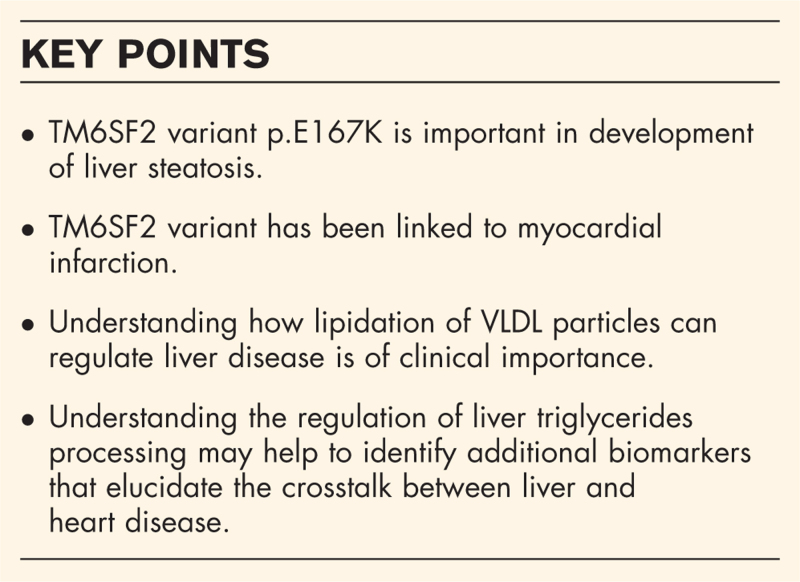
Purpose of review: Transmembrane 6 superfamily member 2 ( TM6SF2 ) gene was identified through exome-wide studies in 2014. A genetic variant from glutamic acid to lysine substitution at amino acid position 167 (NM_001001524.3:c.499G> A) (p.Gln167Lys/p.E167K, rs58542926) was discovered (p.E167K) to be highly associated with increased hepatic fat content and reduced levels of plasma triglycerides and LDL cholesterol. In this review, we focus on the discovery of TM6SF2 and its role in VLDL secretion pathways. Human data suggest TM6SF2 is linked to hepatic steatosis and cardiovascular disease (CVD), hence understanding its metabolic pathways is of high scientific interest.
Recent findings: Since its discovery, completed research studies in cell, rodent and human models have defined the role of TM6SF2 and its links to human disease. TM6SF2 resides in the endoplasmic reticulum (ER) and the ER-Golgi interface and helps with the lipidation of nascent VLDL, the main carrier of triglycerides from the liver to the periphery. Consistent results from cells and rodents indicated that the secretion of triglycerides is reduced in carriers of the p.E167K variant or when hepatic TM6SF2 is deleted. However, data for secretion of APOB, the main protein of VLDL particles responsible for triglycerides transport, are inconsistent.
Summary: The identification of genetic variants that are highly associated with human disease presentation should be followed by the validation and investigation into the pathways that regulate disease mechanisms. In this review, we highlight the role of TM6SF2 and its role in processing of liver triglycerides.
Copyright © 2024 Wolters Kluwer Health, Inc. All rights reserved.
Conflict of interest statement
References
-
- Nordestgaard BG, Langlois MR, Langsted A, et al. . Quantifying atherogenic lipoproteins for lipid-lowering strategies: consensus-based recommendations from EAS and EFLM. Atherosclerosis 2020; 294:46–61. - PubMed
-
- Wegermann K, Moylan C, Naggie S. Fatty liver disease: enter the metabolic era. Curr HIV/AIDS Rep 2023; 20:405–418. - PubMed
-
- Canivet CM, Faure S. [Diagnosis and evaluation of metabolic dysfunction associated steatotic liver disease (MASLD)]. Rev Med Interne 2024; 45:41–47. - PubMed
-
The new terminology of MASLD replaces NAFLD. The latter follows the principal to include mechanisms related to the accumulation of fat in the liver.
Publication types
MeSH terms
Substances
Grants and funding
LinkOut - more resources
Full Text Sources
Molecular Biology Databases
Research Materials
Miscellaneous
