Longitudinal adherence to surveillance for late effects of cancer treatment: a population-based study of adult survivors of childhood cancer
- PMID: 38467416
- PMCID: PMC10927290
- DOI: 10.1503/cmaj.231358
Longitudinal adherence to surveillance for late effects of cancer treatment: a population-based study of adult survivors of childhood cancer
Abstract
Background: Adult survivors of childhood cancer are at elevated risk of morbidity and mortality compared to the general population, but their adherence to lifelong periodic surveillance is suboptimal. We aimed to examine adherence to surveillance guidelines for high-yield tests and identify risk factors for nonadherence in adult survivors of childhood cancer.
Methods: In this retrospective, population-based cohort study, we used health care administrative data from Ontario, Canada, to identify adult survivors of childhood cancer diagnosed between 1986 and 2014 who were at elevated risk of therapy-related colorectal cancer, breast cancer, or cardiomyopathy. Using a Poisson regression framework, we assessed longitudinal adherence and predictors of adherence to the Children's Oncology Group surveillance guideline.
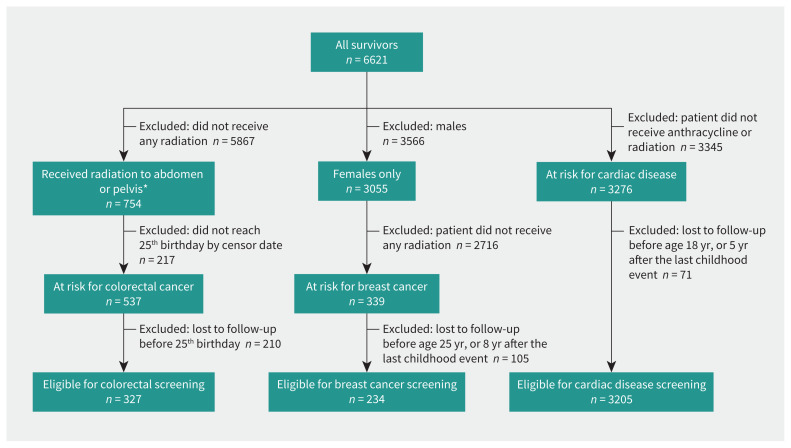
Results: Among 3241 survivors, 327 (10%), 234 (7%), and 3205 (99%) were at elevated risk for colorectal cancer, breast cancer, and cardiomyopathy, respectively. Within these cohorts, only 13%, 6%, and 53% were adherent to recommended surveillance as of February 2020. During a median follow-up of 7.8 years, the proportion of time spent adherent was 14% among survivors at elevated risk for colorectal cancer, 10% for breast cancer, and 43% for cardiomyopathy. Significant predictors of adherence varied across the risk groups, but higher comorbidity was associated with adherence to recommended surveillance.
Interpretation: Survivors of childhood cancer in Ontario are rarely up to date for recommended surveillance tests. Tailored interventions beyond specialized clinics are needed to improve surveillance adherence.
© 2024 CMA Impact Inc. or its licensors.
Conflict of interest statement
Competing interests:: Jennifer Shuldiner reports receiving a Canadian Institutes of Health Research (CIHR) Health System Impact Post-doctoral Fellowship, in support of the current manuscript. Noah Ivers is supported by a CIHR Tier 2 Canada Research Chair in Implementation of Evidence-based Practice (paid to institution). Paul Nathan is supported by a CIHR Foundation Grant and a grant from the United States Department of Defense (both paid to institution). No other competing interests were declared.
Figures
References
-
- Lipshultz SE, Adams MJ, Colan SD, et al. American Heart Association Congenital Heart Defects Committee of the Council on Cardiovascular Disease in the Young, Council on Basic Cardiovascular Sciences, Council on Cardiovascular and Stroke Nursing, Council on Cardiovascular Radiology and Intervention, Council on Clinical Cardiology, Council on Epidemiology and Prevention, and Council on Nutrition, Physical Activity and Metabolism. Long-term cardiovascular toxicity in children, adolescents, and young adults who receive cancer therapy: pathophysiology, course, monitoring, management, prevention, and research directions: a scientific statement from the American Heart Association. Circulation 2013;128:1927–95. - PubMed
-
- Bhatia S, Yasui Y, Robison LL, et al. Late Effects Study Group. High risk of subsequent neoplasms continues with extended follow-up of childhood Hodgkin’s disease: report from the Late Effects Study Group. J Clin Oncol 2003;21:4386–94. - PubMed
MeSH terms
LinkOut - more resources
Full Text Sources
Medical