


Changes in effective connectivity during the visual-motor integration tasks: a preliminary f-NIRS study
- PMID: 38468270
- PMCID: PMC10929220
- DOI: 10.1186/s12993-024-00232-3
Changes in effective connectivity during the visual-motor integration tasks: a preliminary f-NIRS study
Abstract
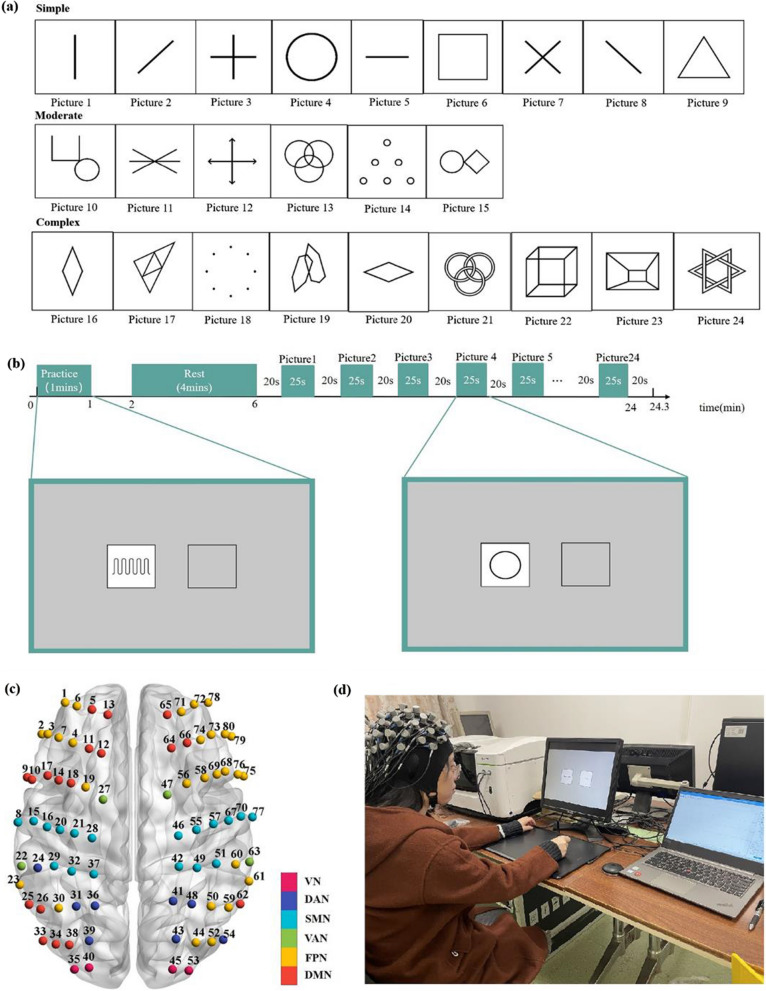
Background: Visual-motor integration (VMI) is an essential skill in daily life. The present study aimed to use functional near-infrared spectroscopy (fNIRS) technology to explore the effective connectivity (EC) changes among brain regions during VMI activities of varying difficulty levels.
Methods: A total of 17 healthy participants were recruited for the study. Continuous Performance Test (CPT), Behavior Rating Inventory of Executive Function-Adult Version (BRIEF-A), and Beery VMI test were used to evaluate attention performance, executive function, and VMI performance. Granger causality analysis was performed for the VMI task data to obtain the EC matrix for all participants. One-way ANOVA analysis was used to identify VMI load-dependent EC values among different task difficulty levels from brain network and channel perspectives, and partial correlation analysis was used to explore the relationship between VMI load-dependent EC values and behavioral performance.
Results: We found that the EC values of dorsal attention network (DAN) → default mode network (DMN), DAN → ventral attention network (VAN), DAN → frontoparietal network (FPN), and DAN → somatomotor network (SMN) in the complex condition were higher than those in the simple and moderate conditions. Further channel analyses indicated that the EC values of the right superior parietal lobule (SPL) → right superior frontal gyrus (SFG), right middle occipital gyrus (MOG) → left SFG, and right MOG → right postcentral gyrus (PCG) in the complex condition were higher than those in the simple and moderate conditions. Subsequent partial correlation analysis revealed that the EC values from DAN to DMN, VAN, and SMN were positively correlated with executive function and VMI performance. Furthermore, the EC values of right MOG → left SFG and right MOG → right PCG were positively correlated with attention performance.
Conclusions: The DAN is actively involved during the VMI task and thus may play a critical role in VMI processes, in which two key brain regions (right SPL, right MOG) may contribute to the EC changes in response to increasing VMI load. Meanwhile, bilateral SFG and right PCG may also be closely related to the VMI performance.
Keywords: Attention; Effective connectivity; Executive function; Visual-motor integration; f-NIRS.
© 2024. The Author(s).
Conflict of interest statement
The authors declare that they have no competing interests.
Figures

References
-
- Sutton GP, Barchard KA, Bello DT, Thaler NS, Ringdahl E, Mayfield J, et al. Beery-Buktenica developmental test of visual-motor integration performance in children with traumatic brain injury and attention-deficit/hyperactivity disorder. Psychol Assess. 2011;23:805–809. doi: 10.1037/a0023370. - DOI - PubMed
MeSH terms
Grants and funding
- 82271575/the National Natural Science Foundation of China
- 81571340/the National Natural Science Foundation of China
- 20220484061/Beijing Nova Program
- PKU2023LCXQ043/Clinical Medicine Plus X - Young Scholars Project, Peking University, the Fundamental Research Funds for the Central Universities
- CFH: 2024-2-4114/the Capital's Funds for Health Improvement and Research
LinkOut - more resources
Full Text Sources
Medical
Miscellaneous
