


Effectiveness of educational interventions for healthcare workers on vaccination dialogue with older adults: a systematic review
- PMID: 38468334
- PMCID: PMC10929108
- DOI: 10.1186/s13690-024-01260-1
Effectiveness of educational interventions for healthcare workers on vaccination dialogue with older adults: a systematic review
Erratum in
-
Correction: Effectiveness of educational interventions for healthcare workers on vaccination dialogue with older adults: a systematic review.Arch Public Health. 2024 Apr 11;82(1):47. doi: 10.1186/s13690-024-01278-5. Arch Public Health. 2024. PMID: 38605360 Free PMC article. No abstract available.
Abstract
Background: Healthcare workers (HCW) significantly influence older adults' vaccine acceptance. This systematic review aimed to identify effective educational interventions for HCWs that could enhance their ability to engage in a dialogue with older adults on vaccination.
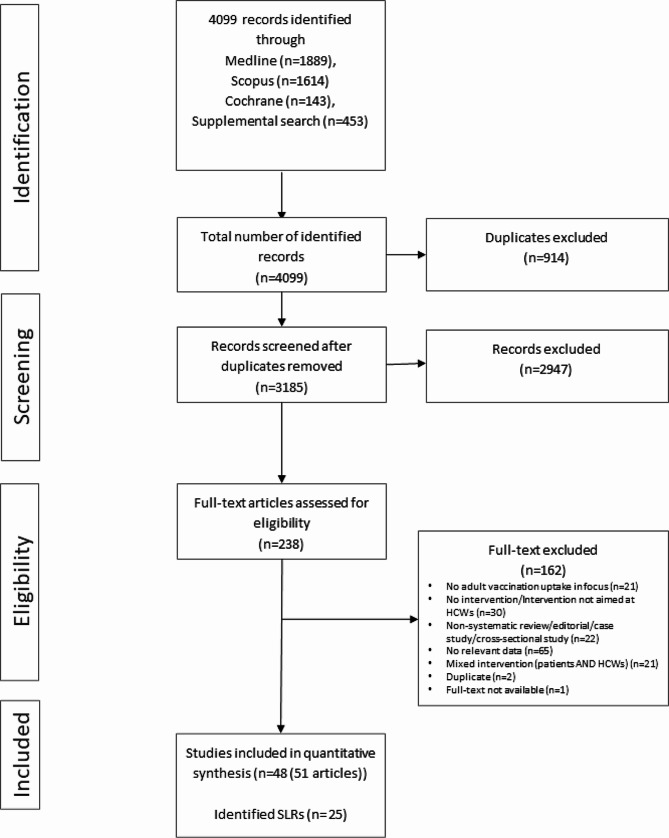
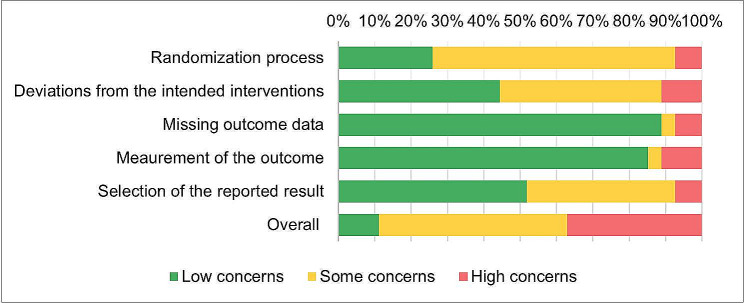
Methods: Medline, Scopus, Cochrane library and grey literature were searched for comparative studies investigating educational interventions concerning older adult vaccinations. The search encompassed all languages and publication years. Analysis was performed on the outcomes 'vaccines offered or ordered' and 'vaccination rates'. Whenever feasible, a sub-analysis on publication year was conducted. Methodological limitations were assessed using the RoB 2 for RCTs and the GRADE checklist for non-randomized studies. Study outcomes were categorized according to the four-level Kirkpatrick model (1996) for effectiveness: reaction, learning, behaviour, and results.
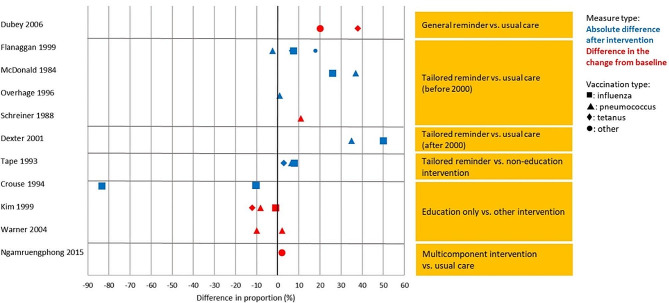
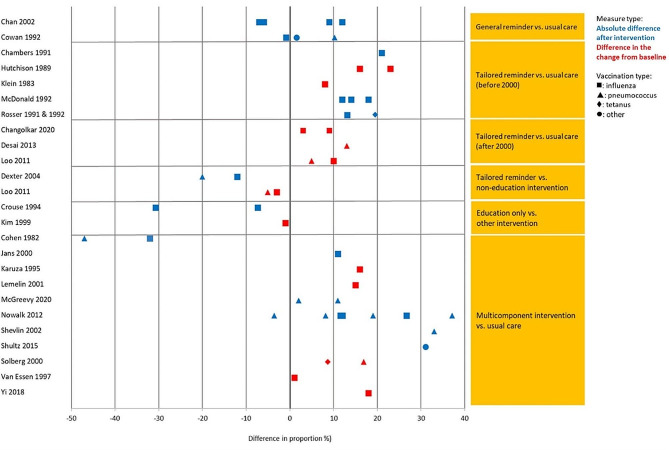
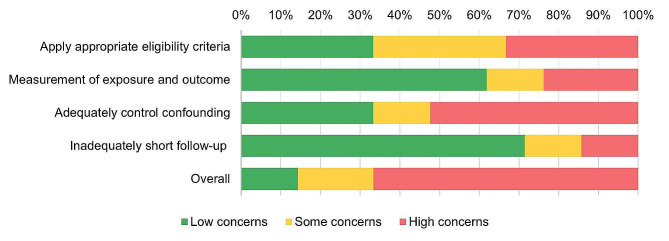
Results: In total, 48 studies met all inclusion criteria. Most studies included reminder systems signalling HCWs on patients due for vaccination. Other interventions included seminars, academic detailing and peer-comparison feedback. Four articles reporting on the reaction-level indicated that most HCWs had a favourable view of the intervention. Two of the six articles reporting on the learning-level observed positive changes in attitude or knowledge due to the intervention. Seventeen studies reported on the behaviour-level. An analysis on eleven out of seventeen studies focusing on vaccines 'ordered' or 'offered' outcomes suggested that tailored reminders, particularly those implemented before 2000, were the most effective. Out of 34 studies reporting on the result-level, 24 were eligible for analysis on the outcome 'vaccination rate', which showed that compared to usual care, multicomponent interventions were the most effective, followed by tailored reminders, especially those predating 2000. Nonetheless, tailored reminders often fell short compared to other interventions like standing orders or patient reminders. In both the behaviour-level and result-level 'education only' interventions frequently underperformed relative to other interventions. Seventeen out of the 27 RCTs, and seven of the 21 non-randomized studies presented a low-to-medium risk for bias in the studies' findings.
Conclusions: Tailored reminders and multicomponent interventions effectively assist HCWs in addressing vaccines with older adults. However, education-only interventions appear to be less effective compared to other interventions rates, attitude, knowledge.
Keywords: Education; Healthcare worker; Immunization; Intervention; Older adult; Vaccination.
© 2024. The Author(s).
Conflict of interest statement
The authors declare no competing interests.
Figures
References
-
- United Nations Department of Economic and Social Affairs, P.D., World Population Prospects 2022: Summary of Results. 2022, United Nations: New York.
-
- World Health Organization. Decade of healthy ageing: baseline report. Geneva; 2020. p. 203.
-
- Eurostat. Influenza statistics, in Statistics Explained. 2023, Eurostat.
Grants and funding
LinkOut - more resources
Full Text Sources
Miscellaneous
