


Restless legs syndrome after acute ıschemic stroke and ıts relation to lesion location
- PMID: 38468622
- PMCID: PMC10899909
- DOI: 10.1007/s41105-022-00401-9
Restless legs syndrome after acute ıschemic stroke and ıts relation to lesion location
Abstract
Purpose: We aimed to investigate the prevalence, clinical profiles and lesion location of Restless Legs Syndrome (RLS) developed after ischemic stroke.
Methods: This study prospectively included 244 patients with acute cerebral infarction. All patients were evaluated for RLS, and those who met all of the essential diagnostic criteria of the International RLS Study Group were diagnosed with RLS. The evaluation of lesion location was performed by magnetic resonance imaging. International Restless Legs Syndrome Rating Scale was performed 1 week, 1 month, and 3 months after the index stroke to determine the symptom severity of the patients and to observe the exacerbation or regression in follow-up.
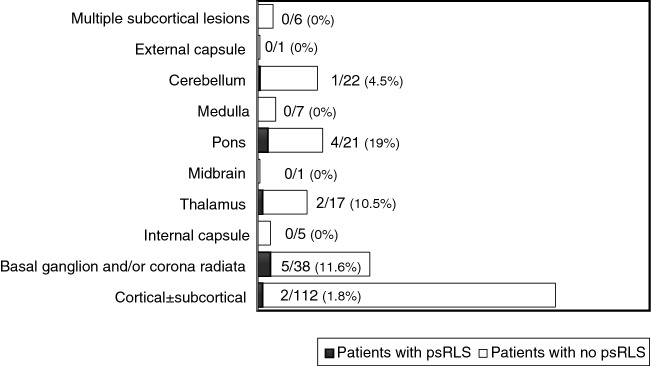
Results: A total of 14 patients (5.7%) had post-stroke RLS (psRLS). The psRLS group consisted mostly of males (9 males, 5 females). Among the patients with psRLS, 12 had a subcortical stroke (9.2%, 130 patients) whereas only 2 had a cortical stroke (1.8%, 114 patients) (p = 0.01). The subcortical lesion locations in the psRLS group were the pons, basal ganglia and/or corona radiata, thalamus, and cerebellum in order of decreasing frequency. Five patients had symptoms in both legs, and 9 patients had symptoms in unilateral legs (7 contralateral, 2 ipsilateral to the lesion). At follow-up, the symptoms of 6 patients resolved completely without medication, 5 patients responded well to pramipexole and 1 patient responded poorly. Only 2 patients who refused to take medication had worsened symptoms.
Conclusion: The subcortical ischemic lesions are associated with psRLS. Pons, basal ganglia and corona radiata are the structures more likely to cause RLS.
Keywords: Ischemic stroke; Lesion location; Prevalence; Restless legs syndrome.
© The Author(s), under exclusive licence to Japanese Society of Sleep Research 2022.
Conflict of interest statement
Conflict of interestThe authors declare that they have no conflict of interest.
Figures

References
-
- Allen RP, Picchietti D, Hening WA, et al. Restless legs syndrome: diagnostic criteria, special considerations, and epidemiology. A report from the restless legs syndrome diagnosis and epidemiology workshop at the National Institutes of Health. Sleep Med. 2003;4:101–119. doi: 10.1016/S1389-9457(03)00010-8. - DOI - PubMed
-
- Winkelman JW, Blackwell T, Stone K, et al. Associations of ıncident cardiovascular events with restless legs syndrome and periodic leg movements of sleep in older men, for the outcomes of sleep disorders in older men study (MrOS Sleep Study) Sleep. 2017 doi: 10.1093/sleep/zsx023. - DOI - PMC - PubMed
LinkOut - more resources
Full Text Sources
Miscellaneous