


Trueness of five different 3D printing systems including budget- and professional-grade printers: An In vitro study
- PMID: 38468926
- PMCID: PMC10925989
- DOI: 10.1016/j.heliyon.2024.e26874
Trueness of five different 3D printing systems including budget- and professional-grade printers: An In vitro study
Abstract
Problem: Several types of 3D printers with different techniques and prices are available on the market. However, results in the literature are inconsistent, and there is no comprehensive agreement on the accuracy of 3D printers of different price categories for dental applications.
Aim: This study aimed to investigate the accuracy of five different 3D printing systems, including a comparison of budget- and higher-end 3D printing systems, according to a standardized production and evaluation protocol.
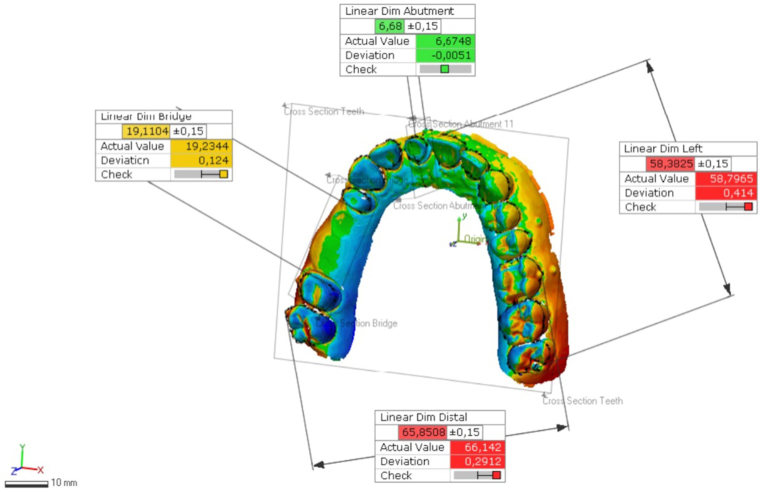
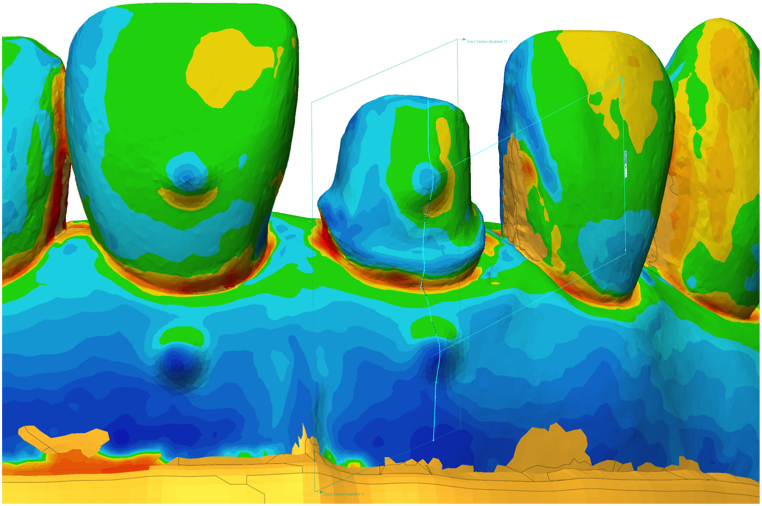
Material and methods: A maxillary reference model with prepared teeth was created using 16 half-ball markers with a diameter of 1 mm to facilitate measurements. A reference file was fabricated using five different 3D printers. The printed models were scanned and superimposed onto the original standard tesselation language (.stl) file, and digital measurements were performed to assess the 3-dimensional and linear deviations between the reference and test models.
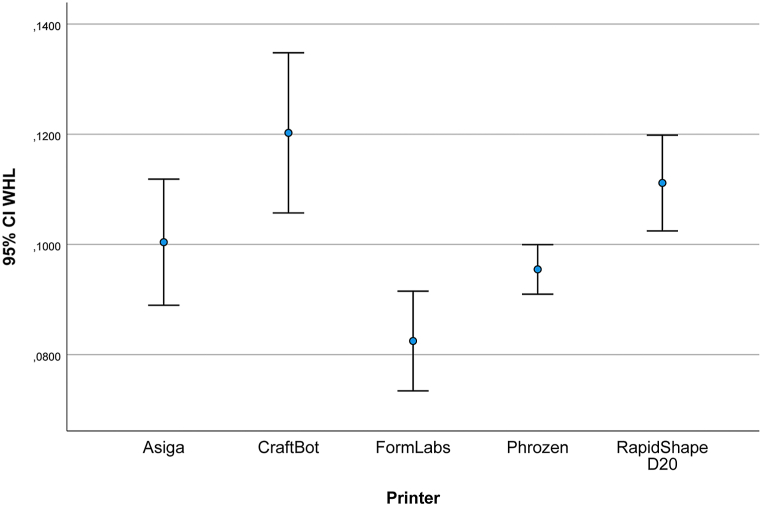
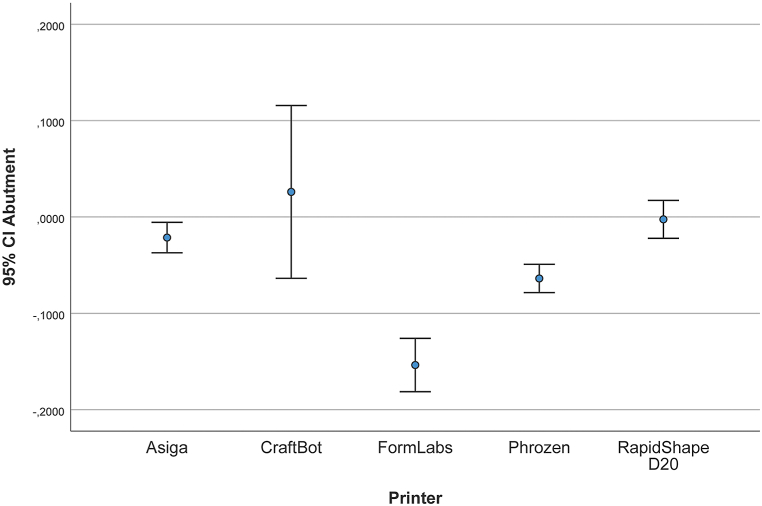
Results: After examining the entire surface of the models, we found that 3D printers using Fused filament fabrication (FFF) technology -120.2 (20.3) μm create models with high trueness but high distortion. Distortions along the z-axis were found to be the highest with the stereolithography (SLA)-type 3D printer at -153.7 (38.7) μm. For the 4-unit FPD, we found 201.9 (41.8) μm deviation with the digital light processing (DLP) printer. The largest deviation (-265.1 (55.4) μm) between the second molars was observed for the DLP printer. Between the incisor and the second molar, the best results were produced by the FFF printer with -30.5 (76.7) μm.
Conclusion: Budget-friendly 3D printers are comparable to professional-grade printers in terms of precision. In general, the cost of a printing system is not a reliable indicator of its level of accuracy.
Keywords: 3-D Printing; CAD-CAM; Digital dentistry; Model; Rapid prototyping.
© 2024 The Authors.
Conflict of interest statement
The authors declare that they have no known competing financial interests or personal relationships that could have appeared to influence the work reported in this paper.
Figures




References
-
- Massachusetts Institute of Technology (MIT). Standard Terminology for Additive Manufacturing Technologies. Available from: http://web.mit.edu/2.810/www/files/readings/AdditiveManufacturingTermino.....
-
- Liu Q., Leu M.C., Schmitt S.M. Rapid prototyping in dentistry: technology and application. Int. J. Adv. Manuf. Technol. 2005;29:317–335. doi: 10.1007/s00170-005-2523-2. - DOI
LinkOut - more resources
Full Text Sources
Miscellaneous
