


Intestinal mucosal barrier: a potential target for traditional Chinese medicine in the treatment of cardiovascular diseases
- PMID: 38469405
- PMCID: PMC10925767
- DOI: 10.3389/fphar.2024.1372766
Intestinal mucosal barrier: a potential target for traditional Chinese medicine in the treatment of cardiovascular diseases
Abstract
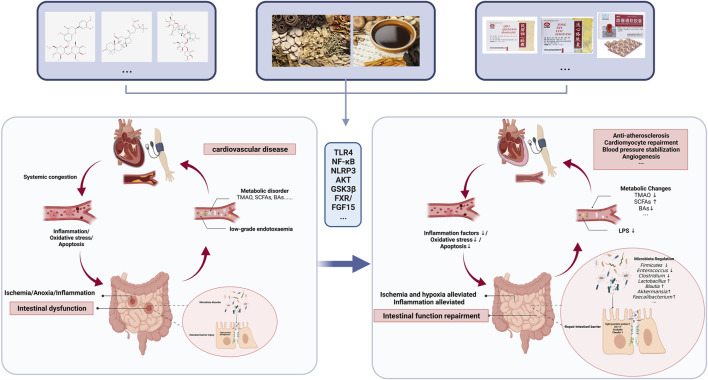
Cardiovascular disease (CVD) is a serious public health problem, and among non-communicable diseases, CVD is now the leading cause of mortality and morbidity worldwide. CVD involves multiple organs throughout the body, especially the intestinal tract is the first to be involved. The impairment of the intestinal mucosal barrier is considered a significant pathological alteration in CVD and also contributes to the accelerated progression of the disease, thereby offering novel insights for CVD prevention and treatment. The treatment of Chinese medicine is characterized by multi-metabolites, multi-pathways, and multi-targets. In recent years, the studies of Traditional Chinese Medicine (TCM) in treating CVD by repairing the intestinal mucosal barrier have gradually increased, showing great therapeutic potential. This review summarizes the studies related to the treatment of CVD by TCM (metabolites of Chinese botanical drugs, TCM formulas, and Chinese patent medicine) targeting the repair of the intestinal mucosal barrier, as well as the potential mechanisms. We have observed that TCM exerts regulatory effects on the structure and metabolites of gut microbiota, enhances intestinal tight junctions, improves intestinal dyskinesia, repairs intestinal tissue morphology, and preserves the integrity of the intestinal vascular barrier through its anti-inflammatory, antioxidant, and anti-apoptotic properties. These multifaceted attributes position TCM as a pivotal modulator of inhibiting myocardial fibrosis, and hypertrophy, and promoting vascular repairment. Moreover, there exists a close association between cardiovascular risk factors such as hyperlipidemia, obesity, and diabetes mellitus with CVD. We also explore the mechanisms through which Chinese botanical drugs impact the intestinal mucosal barrier and regulate glucose and lipid metabolism. Consequently, these findings present novel insights and methodologies for treating CVD.
Keywords: Chinese patent medicine; cardiovascular disease; gut microbiota; intestinal mucosal barrier; metabolites of Chinese botanical drugs; traditional Chinese medicine formulas.
Copyright © 2024 Liu, Wei, Wang, Zhang, Gao, Cheng and Chi.
Conflict of interest statement
The authors declare that the research was conducted in the absence of any commercial or financial relationships that could be construed as a potential conflict of interest.
Figures
References
-
- Arakawa K., Ishigami T., Nakai-Sugiyama M., Chen L., Doi H., Kino T., et al. (2019). Lubiprostone as a potential therapeutic agent to improve intestinal permeability and prevent the development of atherosclerosis in apolipoprotein E-deficient mice. PLoS ONE 14 (6), e0218096. 10.1371/journal.pone.0218096 - DOI - PMC - PubMed
Publication types
LinkOut - more resources
Full Text Sources
