


Pain Characteristics and Progression to Sarcopenia in Chinese Middle-Aged and Older Adults: A 4-Year Longitudinal Study
- PMID: 38469680
- PMCID: PMC11005774
- DOI: 10.1093/gerona/glae080
Pain Characteristics and Progression to Sarcopenia in Chinese Middle-Aged and Older Adults: A 4-Year Longitudinal Study
Abstract
Background: It is imperative for public health to identify the factors that contribute to the progression of sarcopenia among middle-aged and older adults. Our study aimed to investigate the association between pain characteristics and the progression to sarcopenia and its subcomponents among middle-aged and older adults in China.
Methods: We included 5 568 participants from the China Health and Retirement Longitudinal Study. All participants completed assessments for pain characteristics and sarcopenia. Pain assessment included pain status (baseline pain, incident pain, and pain persistence) and pain distribution (single-site pain and multisite pain) using a self-report questionnaire. Diagnosis of sarcopenia followed The Asian Working Group for Sarcopenia 2019 consensus. The odds ratios (ORs) and 95% confidence intervals (CIs) were obtained by logical regression analysis.
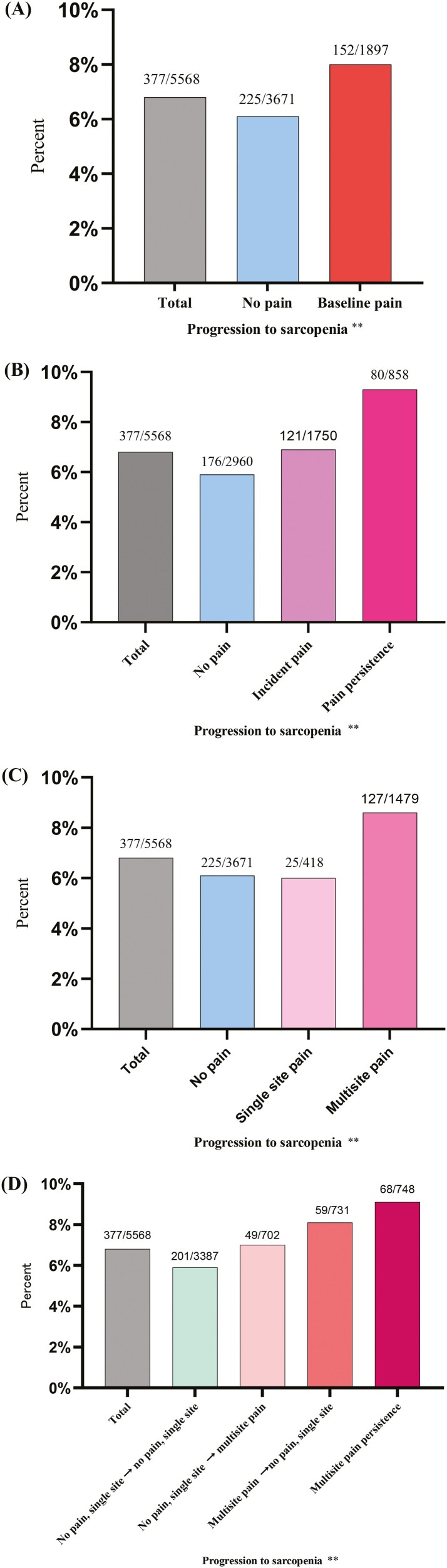
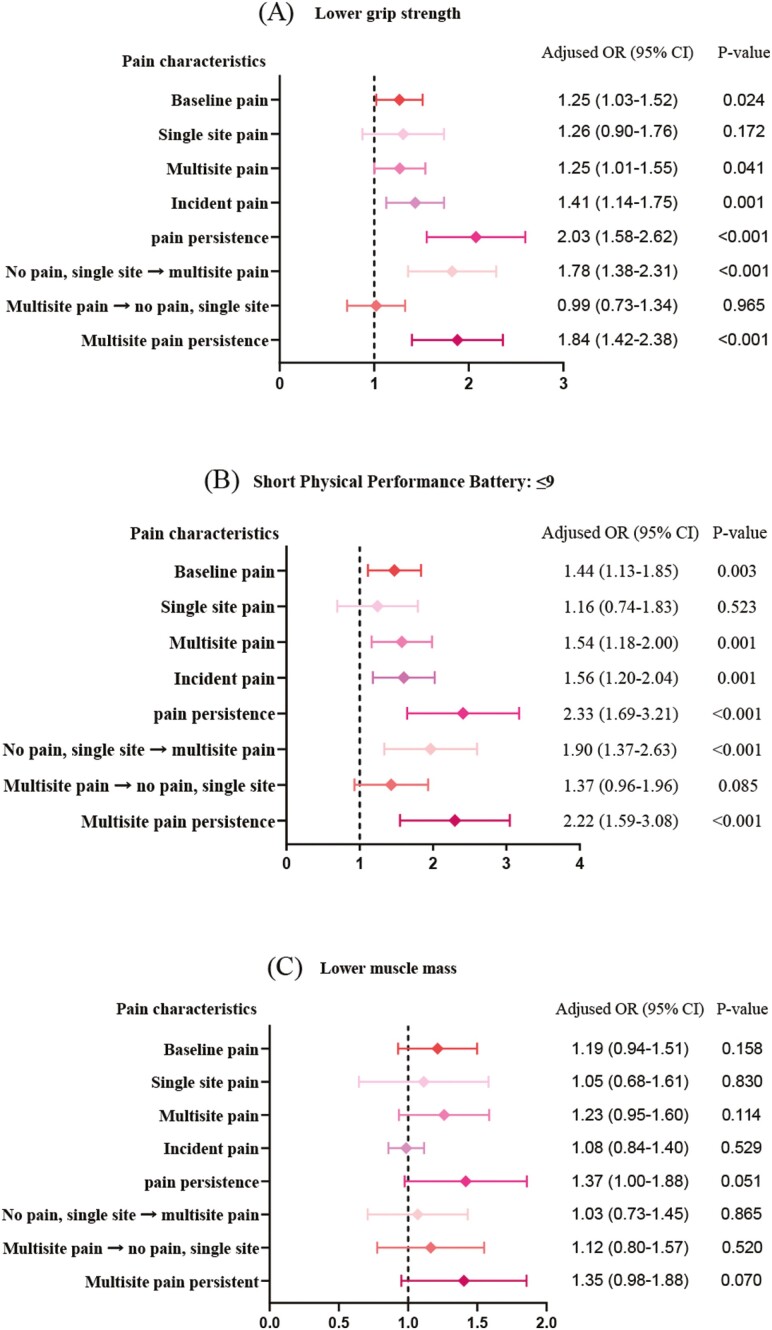
Results: Participants who reported baseline pain, multisite pain, pain persistence, or multisite pain persistence were more likely to progress to sarcopenia than those without pain, with ORs of 1.33 (95% CI: 1.08-1.65), 1.44 (95% CI: 1.15-1.80), 1.63 (95% CI: 1.23-2.14), and 1.59 (95% CI: 1.19-2.11), respectively. Even after adjusting for other covariates such as gender, age, residential area, education level, marital status, smoking, alcohol consumption, comorbidities, and falls, these associations remained significant. Additionally, pain persistence and multisite pain persistence were significantly associated with low grip strength and clinically meaningful Short Physical Performance Battery decline, but not with low muscle mass.
Conclusions: Our study showed that pain, especially pain persistence, was closely correlated to the increased risk of progression to sarcopenia in Chinese middle-aged and older adults.
Keywords: CHARLS; Pain characteristics; Sarcopenia.
© The Author(s) 2024. Published by Oxford University Press on behalf of The Gerontological Society of America.
Conflict of interest statement
None.
Figures
References
-
- Cruz-Jentoft AJ, Bahat G, Bauer J, et al. ; Writing Group for the European Working Group on Sarcopenia in Older People 2 (EWGSOP2), and the Extended Group for EWGSOP2. Sarcopenia: revised European consensus on definition and diagnosis. Age Ageing. 2019;48(1):16–31. 10.1093/ageing/afy169 - DOI - PMC - PubMed
-
- Veronese N, Demurtas J, Soysal P, et al. ; Special Interest Groups in Systematic Reviews and Meta-analyses for healthy ageing Sarcopenia and Frailty and resilience in older persons of the European Geriatric Medicine Society (EuGMS). Sarcopenia and health-related outcomes: an umbrella review of observational studies. Eur Geriatr Med. 2019;10(6):853–862. 10.1007/s41999-019-00233-w - DOI - PubMed
