


FlashPCR: Revolutionising qPCR by Accelerating Amplification through Low ∆T Protocols
- PMID: 38474020
- PMCID: PMC10932470
- DOI: 10.3390/ijms25052773
FlashPCR: Revolutionising qPCR by Accelerating Amplification through Low ∆T Protocols
Abstract
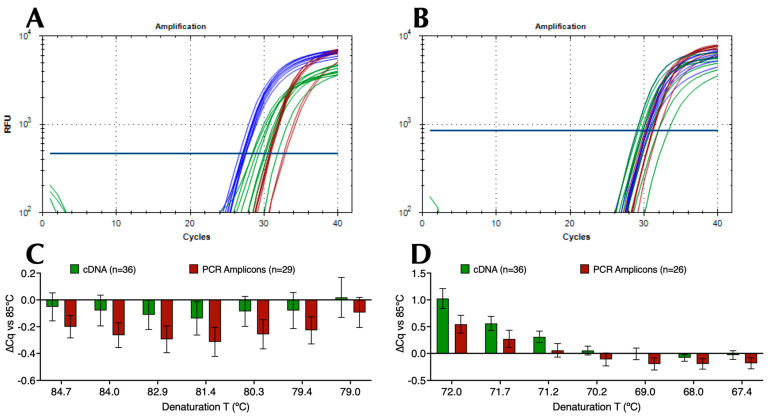
Versatility, sensitivity, and accuracy have made the real-time polymerase chain reaction (qPCR) a crucial tool for research, as well as diagnostic applications. However, for point-of-care (PoC) use, traditional qPCR faces two main challenges: long run times mean results are not available for half an hour or more, and the requisite high-temperature denaturation requires more robust and power-demanding instrumentation. This study addresses both issues and revises primer and probe designs, modified buffers, and low ∆T protocols which, together, speed up qPCR on conventional qPCR instruments and will allow for the development of robust, point-of-care devices. Our approach, called "FlashPCR", uses a protocol involving a 15-second denaturation at 79 °C, followed by repeated cycling for 1 s at 79 °C and 71 °C, together with high Tm primers and specific but simple buffers. It also allows for efficient reverse transcription as part of a one-step RT-qPCR protocol, making it universally applicable for both rapid research and diagnostic applications.
Keywords: COVID-19; molecular diagnostics; point of care; qPCR; reverse transcription.
Conflict of interest statement
Author G.L.S. owns his consulting business Shipley Consulting. G.L.S. and the remaining authors declare that the research was conducted in the absence of any commercial or financial relationships that could be construed as potential conflicts of interest. The funders had no role in the design of the study; in the collection, analyses, or interpretation of data; in the writing of the manuscript; or in the decision to publish the results.
Figures
References
-
- Higuchi R., Fockler C., Dollinger G., Watson R. Kinetic PCR analysis: Real-time monitoring of DNA amplification reactions. Bio/Technology. 1993;11:1026–1030. - PubMed
-
- Lopez M.M., Llop P., Olmos A., Marco-Noales E., Cambra M., Bertolini E. Are molecular tools solving the challenges posed by detection of plant pathogenic bacteria and viruses? Curr. Issues Mol. Biol. 2009;11:13–46. - PubMed
MeSH terms
LinkOut - more resources
Full Text Sources
