


Functional Characterization of the MsFKF1 Gene Reveals Its Dual Role in Regulating the Flowering Time and Plant Height in Medicago sativa L
- PMID: 38475501
- PMCID: PMC10934225
- DOI: 10.3390/plants13050655
Functional Characterization of the MsFKF1 Gene Reveals Its Dual Role in Regulating the Flowering Time and Plant Height in Medicago sativa L
Abstract
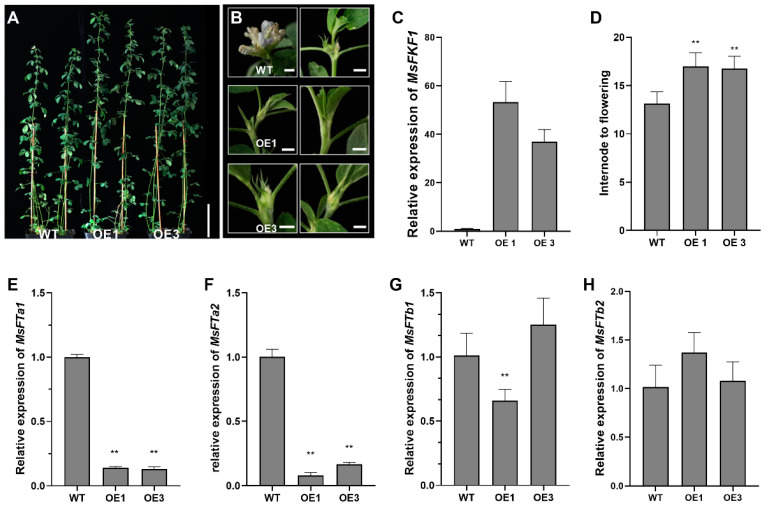
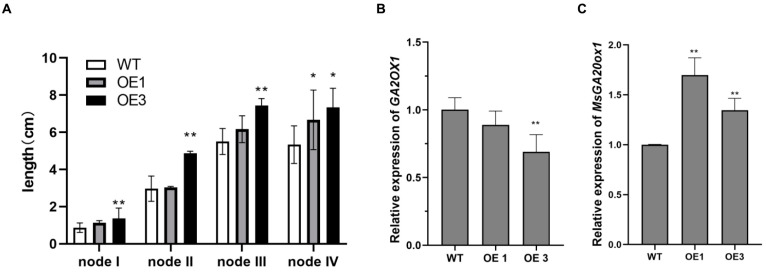
Alfalfa (M. sativa), a perennial legume forage, is known for its high yield and good quality. As a long-day plant, it is sensitive to changes in the day length, which affects the flowering time and plant growth, and limits alfalfa yield. Photoperiod-mediated delayed flowering in alfalfa helps to extend the vegetative growth period and increase the yield. We isolated a blue-light phytohormone gene from the alfalfa genome that is an ortholog of soybean FKF1 and named it MsFKF1. Gene expression analyses showed that MsFKF1 responds to blue light and the circadian clock in alfalfa. We found that MsFKF1 regulates the flowering time through the plant circadian clock pathway by inhibiting the transcription of E1 and COL, thus suppressing FLOWERING LOCUS T a1 (FTa1) transcription. In addition, transgenic lines exhibited higher plant height and accumulated more biomass in comparison to wild-type plants. However, the increased fiber (NDF and ADF) and lignin content also led to a reduction in the digestibility of the forage. The key genes related to GA biosynthesis, GA20OX1, increased in the transgenic lines, while GA2OX1 decreased for the inactive GA transformation. These findings offer novel insights on the function of MsFKF1 in the regulation of the flowering time and plant height in cultivated M. sativa. These insights into MsFKF1's roles in alfalfa offer potential strategies for molecular breeding aimed at optimizing flowering time and biomass yield.
Keywords: FKF1; alfalfa; blue light; circadian clock; flowering time.
Conflict of interest statement
The authors have no competing interests to declare that are relevant to the content of this article.
Figures



References
-
- Wolabu T.W., Mahmood K., Jerez I.T., Cong L., Yun J., Udvardi M., Tadege M., Wang Z., Wen J. Multiplex CRISPR/Cas9-mediated mutagenesis of alfalfa FLOWERING LOCUS Ta1 (MsFTa1) leads to delayed flowering time with improved forage biomass yield and quality. Plant Biotechnol. J. 2023;21:1383–1392. doi: 10.1111/pbi.14042. - DOI - PMC - PubMed
-
- Bao Q., Wolabu T.W., Zhang Q., Zhang T., Liu Z., Sun J., Wang Z.-Y. Application of CRISPR/Cas9 technology in forages. Grassland Res. 2022;1:244–251. doi: 10.1002/glr2.12036. - DOI
-
- Chen H., Zeng Y., Yang Y., Huang L., Tang B., Zhang H., Hao F., Liu W., Li Y., Liu Y., et al. Allele-aware chromosome-level genome assembly and efficient transgene-free genome editing for the autotetraploid cultivated alfalfa. Nat. Commun. 2020;11:2494. doi: 10.1038/s41467-020-16338-x. - DOI - PMC - PubMed
-
- Lorenzo C.D., García-Gagliardi P., Antonietti M.S., Sánchez-Lamas M., Mancini E., Dezar C.A., Vazquez M., Watson G., Yanovsky M.J., Cerdán P.D. Improvement of alfalfa forage quality and management through the down-regulation of MsFTa1. Plant Biotechnol. J. 2020;18:944–954. doi: 10.1111/pbi.13258. - DOI - PMC - PubMed
-
- Zhou C., Han L., Pislariu C., Nakashima J., Fu C., Jiang Q., Quan L., Blancaflor E.B., Tang Y., Bouton J.H., et al. From model to crop: Functional analysis of a STAY-GREEN gene in the model legume Medicago truncatula and effective use of the gene for alfalfa improvement. Plant Physiol. 2011;157:1483–1496. doi: 10.1104/pp.111.185140. - DOI - PMC - PubMed
Grants and funding
LinkOut - more resources
Full Text Sources
Research Materials
