


Effects of total gonadotropin dose on embryo quality and clinical outcomes with AMH stratification in IVF cycles: a retrospective analysis of 12,588 patients
- PMID: 38475829
- PMCID: PMC10929233
- DOI: 10.1186/s40001-024-01768-w
Effects of total gonadotropin dose on embryo quality and clinical outcomes with AMH stratification in IVF cycles: a retrospective analysis of 12,588 patients
Abstract
Background: Recent studies about the effect of gonadotropin (Gn) dose on the clinical outcomes of IVF are still controversial, and no studies have analyzed the relationship between Gn dose and embryo quality. Since AMH is a strong predictor of oocyte quality, we aim to evaluate the relationship between total Gn dose and embryo quality and clinical outcomes at different AMH levels in IVF cycles.
Methods: A total of 12,588 patients were enrolled in the retrospective study. The included cycles were categorized by serum AMH levels (AMH ≤ 1 ng/ml, 1 ng/ml < AMH ≤ 3 ng/ml, 3 ng/ml < AMH ≤ 5 ng/ml, AMH > 5 ng/ml), total Gn dosage (< 1875 IU, 1875-3750 IU and ≥ 3750 IU) and female age (< 35 years and 35-42 years). The embryo quality and clinical outcomes were the measure outcomes.
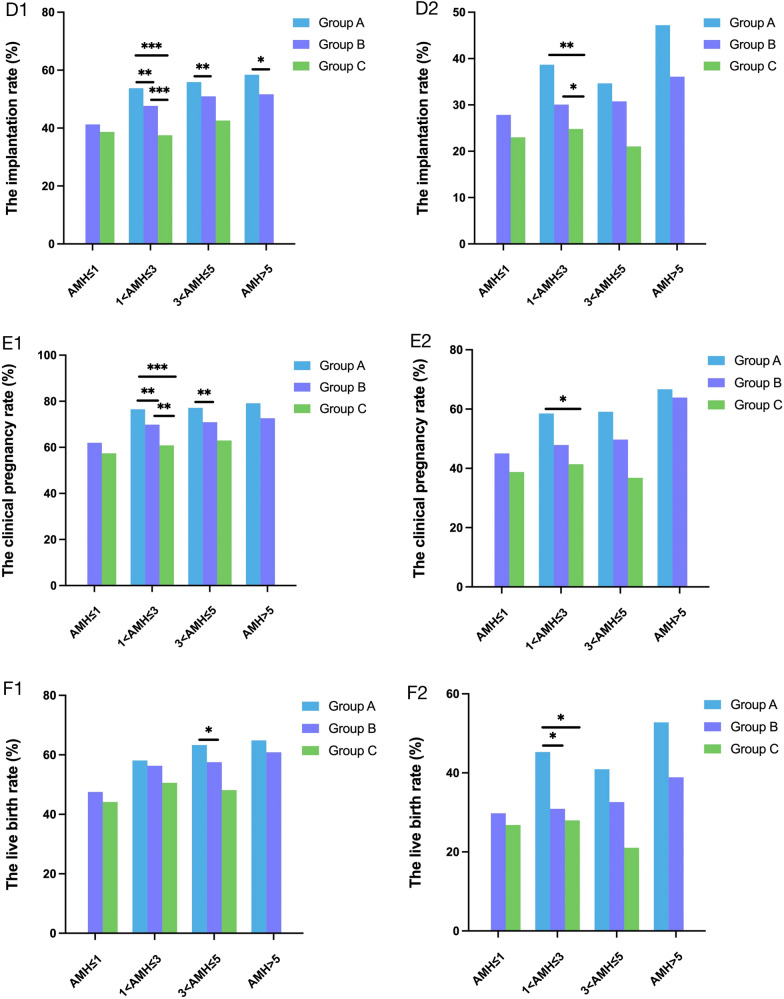
Results: The top-day3 embryos rate decreased with the increase of total Gn dose in nearly all age and AMH subgroups, but this trend was not obvious in the AMH > 5 ng/ml group and AMH ≤ 1 ng/ml group. The blastocyst formation rate and high-quality blastulation rate had a negative relationship with Gn does for women aged < 35 years in the AMH ≤ 5 ng/ml groups, except for the AMH > 5 ng/ml group (P < 0.001). However, when women were 35-42 years old, regardless of AMH levels, the blastocyst formation rate and high-quality blastulation rate decreased as Gn dose increased. Clinical outcomes (implantation rate, clinical pregnancy rate and live birth rate) decreased with the increase of Gn dose in all ages and AMH stratifications.
Conclusions: The total dose of Gn may have different effects on embryo quality at different serum AMH levels, and the negative effects of total dose of Gn on clinical outcomes may be realized by impairing both embryo quality and endometrium.
Keywords: Anti-Müllerian hormone; Clinical outcomes; Embryo quality; Gonadotropin; In vitro fertilization.
© 2024. The Author(s).
Conflict of interest statement
The authors declare that they have no competing interests.
Figures


References
-
- Ishihara O, Klein BM, Arce J-C, Kuramoto T, Yokota Y, Mukaida T, et al. Randomized, assessor-blind, antimüllerian hormone–stratified, dose-response trial in Japanese in vitro fertilization/intracytoplasmic sperm injection patients undergoing controlled ovarian stimulation with follitropin delta. Fertil Steril. 2021;115:1478–1486. doi: 10.1016/j.fertnstert.2020.10.059. - DOI - PubMed
MeSH terms
Substances
Grants and funding
LinkOut - more resources
Full Text Sources
