


Medicinal Plants Used by Oromo Community in Kofale District, West-Arsi Zone, Oromia Regional State, Ethiopia
- PMID: 38476311
- PMCID: PMC10929209
- DOI: 10.2147/JEP.S449496
Medicinal Plants Used by Oromo Community in Kofale District, West-Arsi Zone, Oromia Regional State, Ethiopia
Abstract
Purpose: The purpose of this study was to record the utilization of medicinal plants by the Oromo people in the Kofale District, Oromia Regional State, Ethiopia, to control human and animal health problems.
Methods: Data regarding the use of medicinal plants were collected using ethnobotanical methods from 84 traditional medicine practitioners and 304 general informants sampled employing purposive and systematic random sampling methods, respectively, in the Kofale District. Data were analyzed using different indices, including a preference ranking exercise, informant consensus factor (ICF), fidelity level (FL) and relative popularity level (RPL).
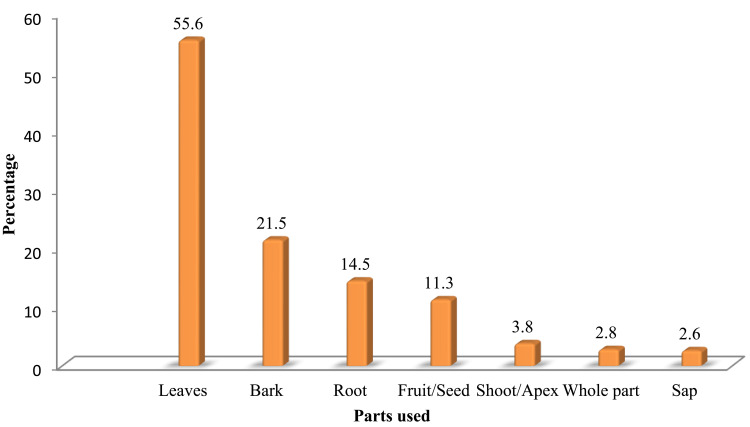
Results: In the district, 106 medicinal plants were claimed to be used for the treatment of 43 human and 18 livestock illnesses, of which 75 (71%) were used to manage human health problems, 23 (21.5%) were used to treat both human and livestock ailments and eight (7.5%) were utilized to treat manage livestock health problems. Most (76.4%) plants were harvested from the wild. Leaves were the most commonly used plant part (55.6%) in remedy preparations. Skin diseases scored the highest ICF value (0.97), followed by gastrointestinal disorders (ICF = 0.95), cancer (ICF = 0.93), and hemorrhoids (ICF = 0.91). Medicinal plants that record the highest fidelity level (FL) (100%) and rank order priority (ROP) (100%) values included Justicia schimperiana, Embelia schimperi, Ekebergia capensis and Datura stramonium, which have been used to treat liver disorders, tapeworm infections, babesiosis, and rabies, respectively. There were significant differences (p<0.05) in the mean numbers of medicinal plants claimed by different social groups: older, illiterate, and traditional medicine practitioners reported higher mean numbers of medicinal plants than younger, literate, and general informants, respectively.
Conclusion: This study indicated the richness of medicinal plant species in Kofale District. Medicinal plants with the highest FL and ROP values and those used to treat disease categories with the highest ICF values should be prioritized in future phytochemical and pharmacological investigations.
Keywords: ethnobotanical study; herbal medicine practitioners; traditional knowledge; traditional medicine.
© 2024 Nuro et al.
Conflict of interest statement
The authors report no conflicts of interest in this work.
Figures
References
-
- World Health Organization. The World Health Report 2000: Health Systems: Improving Performance. World Health Organization; 2000.
-
- Alves FS, Cruz JN, de Farias Ramos IN, Do Nascimento Brandão DL, Queiroz RN. Evaluation of antimicrobial activity and cytotoxicity effects of extracts of piper nigrum L. and piperine. Separations. 2022;10(1):21. doi:10.3390/separations10010021 - DOI
Grants and funding
LinkOut - more resources
Full Text Sources
