. 2024 Feb 27:15:1359226.
doi: 10.3389/fpls.2024.1359226. eCollection 2024.

Physical seed dormancy in pea is genetically separable from seed coat thickness and roughness

Affiliations

Physical seed dormancy in pea is genetically separable from seed coat thickness and roughness

Owen R Williams et al. Front Plant Sci. .

Abstract

Introduction: The seeds of wild pea (Pisum) exhibit marked physical dormancy due to impermeability of the seed coat to water, and the loss of this dormancy is thought to have been critical for domestication. Wild pea seed coats are also notably thick and rough, traits that have also reduced during domestication and are anecdotally linked to increased permeability. However, how these traits specifically interact with permeability is unclear.

Methods: To investigate this, we examined the genetic control of differences in seed coat characteristics between wild P. sativum ssp. humile and a non-dormant domesticated P. s. sativum accession in a recombinant inbred population. QTL effects were confirmed and their locations refined in segregating F4/5 populations.

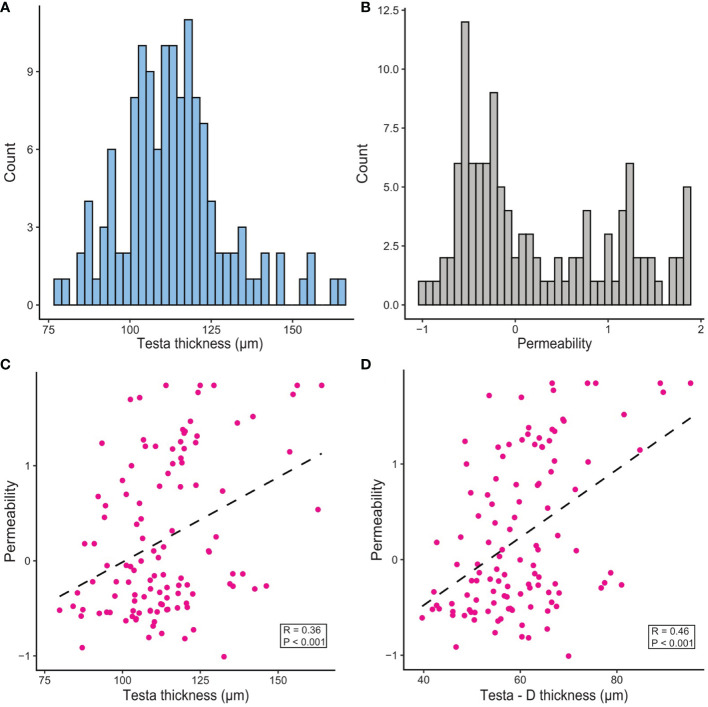
Results: In this population we found a moderate correlation between testa thickness and permeability, and identified loci that affect them independently, suggesting no close functional association. However, the major loci affecting both testa thickness and permeability collocated closely with Mendel's pigmentation locus A, suggesting flavonoid compounds under its control might contribute significantly to both traits. We also show that seed coat roughness is oligogenic in this population, with the major locus independent of both testa thickness and permeability, suggesting selection for smooth seed was unlikely to be due to effects on either of these traits.

Discussion: Results indicate loss of seed coat dormancy during domestication was not primarily driven by reduced testa thickness or smooth seededness. The close association between major permeability and thickness QTL and Mendel's 'A' warrant further study, particularly regarding the role of flavonoids.

Keywords: Pisum; domestication; flavonoid; gritty; permeability; seed coat; seed dormancy.


Conflict of interest statement

The authors declare that the research was conducted in the absence of any commercial or financial relationships that could be construed as a potential conflict of interest.

Figures

Figure 1
Figure 1
Comparison of seed coat traits in wild and domesticated pea. (A) Wild P. s. humile line JI1794 seed and testa section with visible roughness and domesticated P. s. sativum cultivar NGB5839 seed and testa section. Scale bars = 0.1 mm. (B) Time to fully imbibe in water for young (1 month old mature dried) and old (2 year old mature dried) seed from both wild and domesticated pea. Wild young seed had not imbibed within 100 days, after which point the experiment was concluded. (C) Effect of seed age on the ability of JI1794 seed to imbibe within 24h. All seed was mature and dry.
Figure 2
Figure 2
Distribution and correlation of dormancy-related phenotypes in the RIL F2 population. (A) Testa thickness. (B) Permeability (measured as log10[time to fully imbibe in days]). (C) Correlation of testa thickness with permeability. (D) Correlation of testa section D thickness (see Supplementary Figure 1 ) with permeability.
Figure 3
Figure 3
QTL discovered for seed physical characteristics and dormancy-related traits in the Pisum sativum RIL F8 population. Scale is in cM. QTL nomenclature follows Tables 1 and 2 . Box and whiskers represent 1-LOD and 2-LOD intervals, respectively, around each QTL peak. Colors indicate broad trait categories, with permeability in green, seed coat roughness (GRITTY) in orange, testa thickness in blue and other physical characteristics in black. Previously discovered pigmentation loci ( Table 1 ) are indicated at the position of their QTL peaks in this analysis.
Figure 4
Figure 4
QTL6 impacts on testa thickness and permeability in advanced populations. (A) LOD profile of permeability, testa thickness (full) and testa section D thickness QTL near the Mendel’s A locus, which is marked with a dashed line. (B) Fine mapping of the Mendel’s A region on chromosome 6, showing the region (green) where there is significant effect of the genes on permeability and testa thickness (C) Effect of genotype at the Mendel’s A locus on testa thickness and permeability in an advanced F4 & F5 populations respectively. The * indicates significant differences between genotypes a/h and b (P < 0.01). (D) Effect of genotype of the NAD gene on permeability in advanced F5 population when the region of Mendel’s A is fixed. Data in C & D populations were fixed for the wild allele at RPS27 and CWF. Full segregation data is available in Supplementary Figure S4 .
Figure 5
Figure 5
Genetic separation of seed coat roughness from permeability. (A) LOD profile of seed coat roughness QTL on chromosome 1 and the position of three markers FULa, AGO1 and CABB. (B) Mapping of the GRITTY region, showing the position of key markers on chromosome 1 and the region (in green) within which GRITTY has been mapped. (C) Effect of genotype at the AGO1 locus on permeability in an advanced F4 population.

References

    1. Abbo S., Rachamim E., Zehavi Y., Zezak I., Lev-Yadun S., Gopher A. (2011). Experimental growing of wild pea in Israel and its bearing on Near Eastern plant domestication. Ann. Bot. 107, 1399–1404. doi: 10.1093/aob/mcr081 - DOI - PMC - PubMed
    1. Balarynová J., Klčová B., Sekaninová J., Kobrlová L., Cechová M. Z., Krejčí P., et al. . (2022). The loss of polyphenol oxidase function is associated with hilum pigmentation and has been selected during pea domestication. New Phytol. 235, 1807–1821. doi: 10.1111/nph.18256 - DOI - PubMed
    1. Blixt S. (1962). Studies in induced mutations in peas. Acta Hort Genet. Landskrona 20, 95–110.
    1. Blixt S. (1972). Mutation genetics in Pisum. Agri Hortique Genetica 30, 1–293.
    1. Bordat A., Savois V., Nicolas M., Salse J., Chauveau A., Bourgeois M., et al. . (2011). Translational genomics in legumes allowed placing in silico 5460 unigenes on the pea functional map and identified candidate genes in Pisum sativum L. G3: Genes| Genomes| Genet. 1, 93–103. doi: 10.1534/g3.111.000349 - DOI - PMC - PubMed

LinkOut - more resources