


Fracture risk based on high-resolution peripheral quantitative computed tomography measures does not vary with age in older adults-the bone microarchitecture international consortium prospective cohort study
- PMID: 38477737
- PMCID: PMC11205894
- DOI: 10.1093/jbmr/zjae033
Fracture risk based on high-resolution peripheral quantitative computed tomography measures does not vary with age in older adults-the bone microarchitecture international consortium prospective cohort study
Abstract
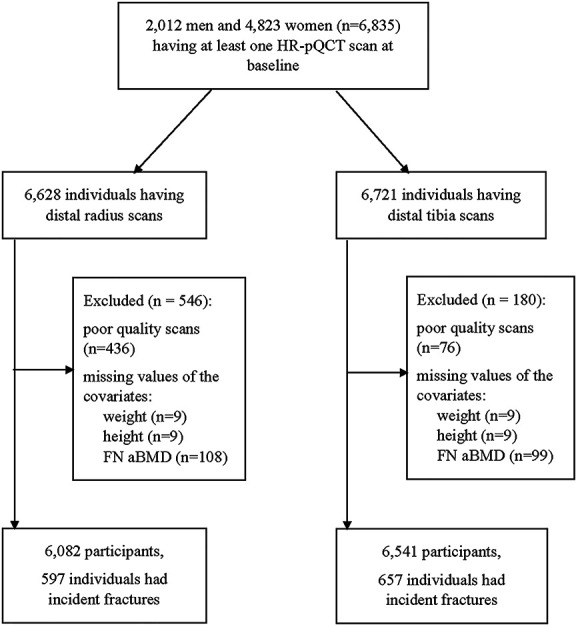
Fracture risk increases with lower areal bone mineral density (aBMD); however, aBMD-related estimate of risk may decrease with age. This may depend on technical limitations of 2-dimensional (2D) dual energy X-ray absorptiometry (DXA) which are reduced with 3D high-resolution peripheral quantitative computed tomography (HR-pQCT). Our aim was to examine whether the predictive utility of HR-pQCT measures with fracture varies with age. We analyzed associations of HR-pQCT measures at the distal radius and distal tibia with two outcomes: incident fractures and major osteoporotic fractures. We censored follow-up time at first fracture, death, last contact or 8 years after baseline. We estimated hazard ratios (HR) and 95%CI for the association between bone traits and fracture incidence across age quintiles. Among 6835 men and women (ages 40-96) with at least one valid baseline HR-pQCT scan who were followed prospectively for a median of 48.3 months, 681 sustained fractures. After adjustment for confounders, bone parameters at both the radius and tibia were associated with higher fracture risk. The estimated HRs for fracture did not vary significantly across age quintiles for any HR-pQCT parameter measured at either the radius or tibia. In this large cohort, the homogeneity of the associations between the HR-pQCT measures and fracture risk across age groups persisted for all fractures and for major osteoporotic fractures. The patterns were similar regardless of the HR-pQCT measure, the type of fracture, or the statistical models. The stability of the associations between HR-pQCT measures and fracture over a broad age range shows that bone deficits or low volumetric density remain major determinants of fracture risk regardless of age group. The lower risk for fractures across measures of aBMD in older adults in other studies may be related to factors which interfere with DXA but not with HR-pQCT measures.
Keywords: cohort study; fracture risk; high resolution peripheral quantitative computed tomography; osteoporosis.
© The Author(s) 2024. Published by Oxford University Press on behalf of the American Society for Bone and Mineral Research. All rights reserved. For permissions, please email: journals.permissions@oup.com.
Conflict of interest statement
None declared.
Figures
References
Publication types
MeSH terms
Grants and funding
- 50564/Hospices Civils de Lyon
- Merck Sharp & Dohme
- R01AR061445/National Institute of Arthritis Musculoskeletal and Skin Diseases of the National Institutes of Health
- R01 AG065299/AG/NIA NIH HHS/United States
- E1482.042/Abondement ANVAR
- HHSN268201500001I/HL/NHLBI NIH HHS/United States
- Geneva University Hospitals & Faculty of Medicine Clinical Research Centre
- Geneva University Hospitals Private Foundation
- HHSN268201500001C/HL/NHLBI NIH HHS/United States
- ANR-07-PHYSIO-023/Agence Nationale de la Recherche
- Amgen Inc
- N01-HC-25195/National Heart, Lung, and Blood Institute Framingham Heart Study
- R01 AR027065/AR/NIAMS NIH HHS/United States
- CIHR 158975/CAPMC/ CIHR/Canada
