


Equivalence trial of proposed denosumab biosimilar GP2411 and reference denosumab in postmenopausal osteoporosis: the ROSALIA study
- PMID: 38477751
- PMCID: PMC11338045
- DOI: 10.1093/jbmr/zjae016
Equivalence trial of proposed denosumab biosimilar GP2411 and reference denosumab in postmenopausal osteoporosis: the ROSALIA study
Erratum in
-
Correction to: Equivalence trial of proposed denosumab biosimilar GP2411 and reference denosumab in postmenopausal osteoporosis: the ROSALIA study.J Bone Miner Res. 2024 Aug 5;39(7):1042. doi: 10.1093/jbmr/zjae077. J Bone Miner Res. 2024. PMID: 38775660 Free PMC article. No abstract available.
Abstract
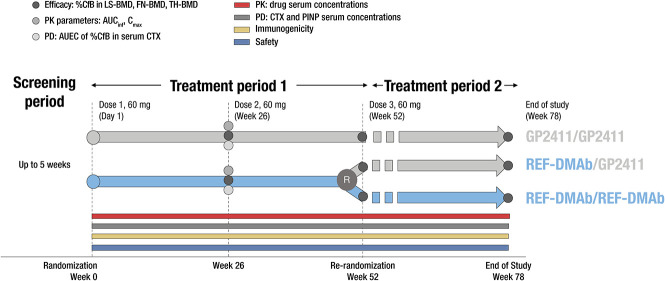
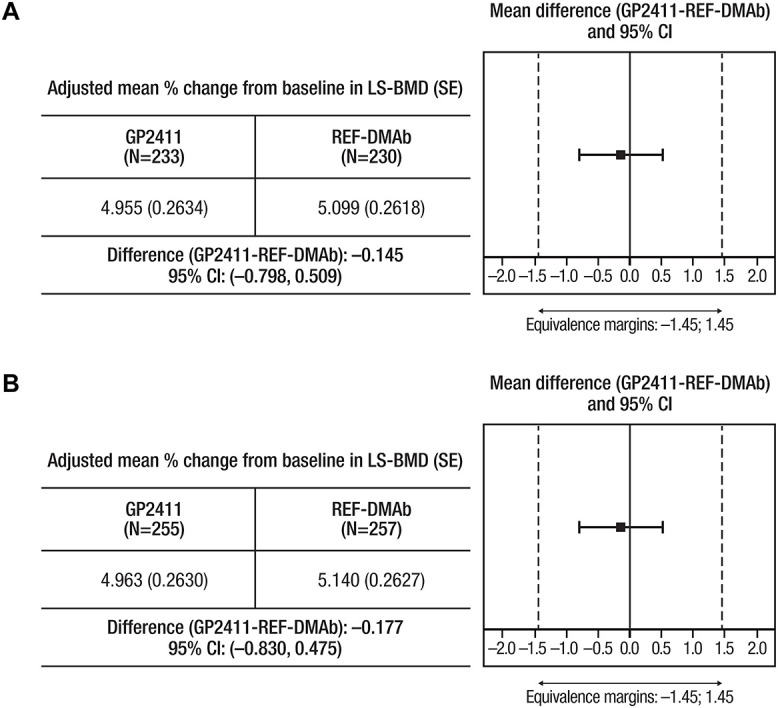
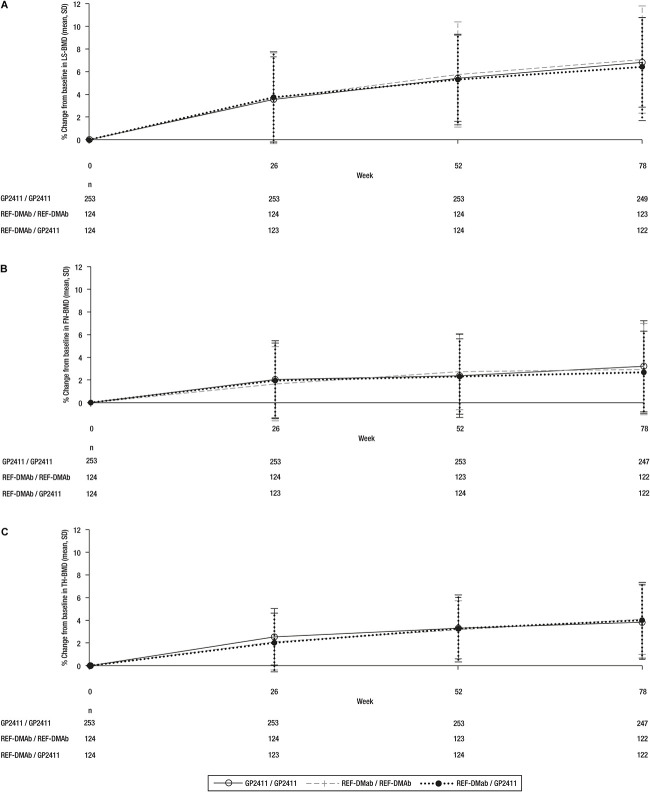
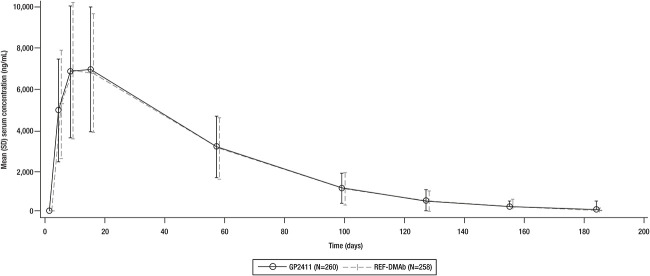
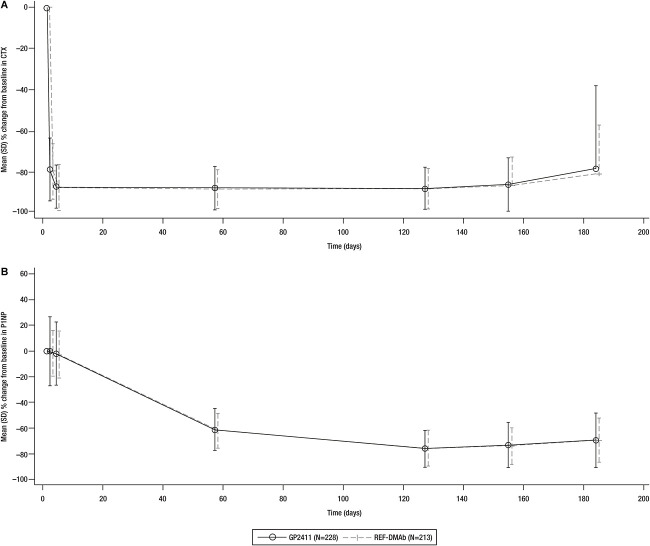
Denosumab is a monoclonal antibody used to reduce risk of fractures in osteoporosis. ROSALIA was a multicenter, double-blind, randomized, integrated phase I/phase III study comparing the efficacy, pharmacokinetics (PK), pharmacodynamics (PD), immunogenicity, and safety of proposed biosimilar denosumab GP2411 with reference denosumab (REF-DMAb) (Prolia®; Amgen). Postmenopausal women with osteoporosis were randomized 1:1 to 2 60-mg doses of GP2411 or REF-DMAb, one at study start and one at week 26. At week 52, the REF-DMAb group was re-randomized 1:1 to a third dose of REF-DMAb or switch to GP2411. The primary efficacy endpoint was percentage change from baseline (%CfB) in LS-BMD at week 52. Secondary efficacy endpoints were %CfB in LS-BMD, FN-BMD, and TH-BMD at weeks 26 and 78 (and week 52 for FN-BMD and TH-BMD). Primary PK and PD endpoints were the area under the serum concentration-time curve extrapolated to infinity and maximum drug serum concentration at week 26, and the area under the effect-time curve of the %CfB in serum CTX at week 26. Secondary PK and PD endpoints included drug serum concentrations and %CfB in serum CTX and P1NP during the study period. Similar efficacy was demonstrated at week 52, with 95% CIs of the difference in %CfB in LS-BMD between treatment groups fully contained within prespecified equivalence margins. Similarity in PK and PD was demonstrated at week 26. Immunogenicity was similar between groups and was not impacted by treatment switch. The rate of new vertebral fractures was comparable. Treatment-emergent adverse events were comparable between groups (63.6% [GP2411/GP2411]; 76.0% [REF-DMAb/REF-DMAb]; 76.6% [REF-DMAb/GP2411]). In conclusion, ROSALIA showed similar efficacy, PK and PD, and comparable safety and immunogenicity of GP2411 to REF-DMAb in postmenopausal osteoporosis.
Keywords: bone modeling and remodeling: biochemical markers of bone turnover; clinical trials; diseases and disorders of/related to bone: osteoporosis.
Plain language summary
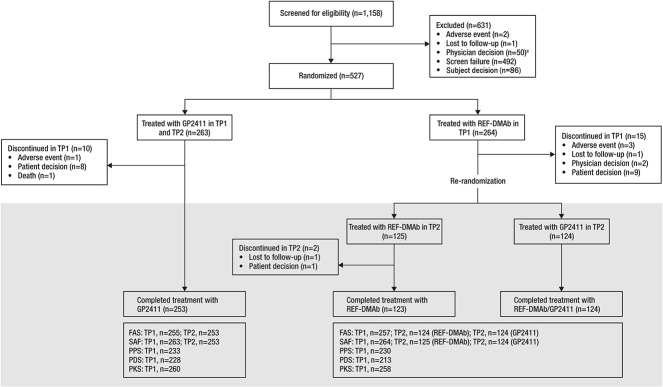
Denosumab is a biologic treatment that stops bone breakdown. This clinical trial evaluated how similar GP2411 (a denosumab biosimilar in development) is compared with European-approved reference denosumab in women with post-menopausal osteoporosis. Biosimilars are highly similar to the original treatment (‘reference denosumab’) and may have a lower price. 263 patients were randomly assigned to receive GP2411 and 264 to reference denosumab. Treatment was given at the study beginning, at Week 26 and at Week 52. 124 patients were re-assigned at Week 52 to test the effect of changing from reference denosumab to GP2411. The study showed similarity in how the body interacts with the treatments, what effects the treatment has (both measured over 26 weeks), and bone mineral density (measured over 78 weeks). Antibody responses to GP2411 were detected in similar proportions of patients on each treatment. Reported adverse events were similar between treatments before Week 52, and from Week 52 to 78, and <5% of patients experienced serious adverse events. A change of treatment from reference denosumab to GP2411 did not affect outcomes. These results showed similarity between GP2411 and reference denosumab in this population. In future, GP2411 may enable more patients to benefit from denosumab.
© The Author(s) 2024. Published by Oxford University Press on behalf of the American Society for Bone and Mineral Research.
Conflict of interest statement
J.S. has received lecturer and speaker fees from UCB, Gilead, AbbVie, Eli Lilly, Novartis, Pfizer, Sandoz, Jansen, Medac, Egis, and Sobi.
E.D. has received grant/research support from AbbVie, Eli Lilly, GSK, Novartis, Pfizer, UCB Biopharma SPRL, Sanofi, Gilead, Janssen-Cilag, and Galapagos NV.
A.K. has received consulting fees from Horizon, Frescenius Kabi, Pfizer, GSK, Janssen, Selecta, Genzyme, Gilead, Synact, Takeda, and Grunenthal, payment or honoraria for lectures, presentations, speakers bureaus, manuscript writing or educational events from GSK. Eli Lilly, Pfizer, AbbVie, Amgen, and UCB, has been part of a board or advisory board for Horizon, Janssen, Chemocentryx, Princeton Biopartners, UCB, and Novartis and has stock or stock options in Pfizer, GSK, Gilead, Novartis, and Amgen.
P.Z. has received speaker fees from Sandoz.
R.E. has received consultancy funding from Immunodiagnostic Systems, Sandoz, Samsung, CL Bio, Biocon, Takeda, UCB; speaker bureau fees for Pharmacosmos, Alexion, UCB and Amgen; and grant funding from Alexion.
J.J.B. has received consultancy funding or lecture fees from Amgen, Cole Pharma, UCB; and grant funding from UCB.
A.S., B.V., J.P., N.K., S.B., and S.S. are employees of Hexal AG (a Sandoz company).
Figures
References
-
- Prolia® (Denosumab). European Medicines Agency SmPC. 2022. Breda, The Netherlands: Amgen Europe B.V.; 2022.
-
- Prolia® (Denosumab) [Package Insert]. 2023. Thousand Oaks, CA: Amgen Inc.; 2023.
-
- Xgeva® (Denosumab) [Package Insert]. 2022. Thousand Oaks, CA: Amgen Inc.; 2022.
-
- Xgeva® (Denosumab). European Medicines Agency SmPC. 2020. Breda, The Netherlands: Amgen Europe B.V; 2020.
Publication types
MeSH terms
Substances
Grants and funding
LinkOut - more resources
Full Text Sources
Medical
Miscellaneous
