


Circulating Osteopontin Predicts Clinical and Radiological Response in First-Line Treatment of Advanced Non-Small Cell Lung Cancer
- PMID: 38480620
- PMCID: PMC11009777
- DOI: 10.1007/s00408-024-00675-5
Circulating Osteopontin Predicts Clinical and Radiological Response in First-Line Treatment of Advanced Non-Small Cell Lung Cancer
Abstract
Purpose: Pembrolizumab-based regimens are conditioned by the expression of PD-L1, but durable response rate is limited by innate and acquired resistance mechanisms. Here, we focus on osteopontin (OPN), an upfront biomarker of senescence, which closely associated with natural history of non-small cell lung cancer (NSCLC).
Methods: Seventy-nine patients eligible to pembrolizumab regimens-alone or in combination with chemotherapy-as first-line treatment of advanced NSCLC were enrolled. Predictive value of OPN toward iRECIST progression disease (PD) was set as first outcome. Secondary ones included performance status (ECOG) at baseline, early (first and best) responses, and overall survival (OS).
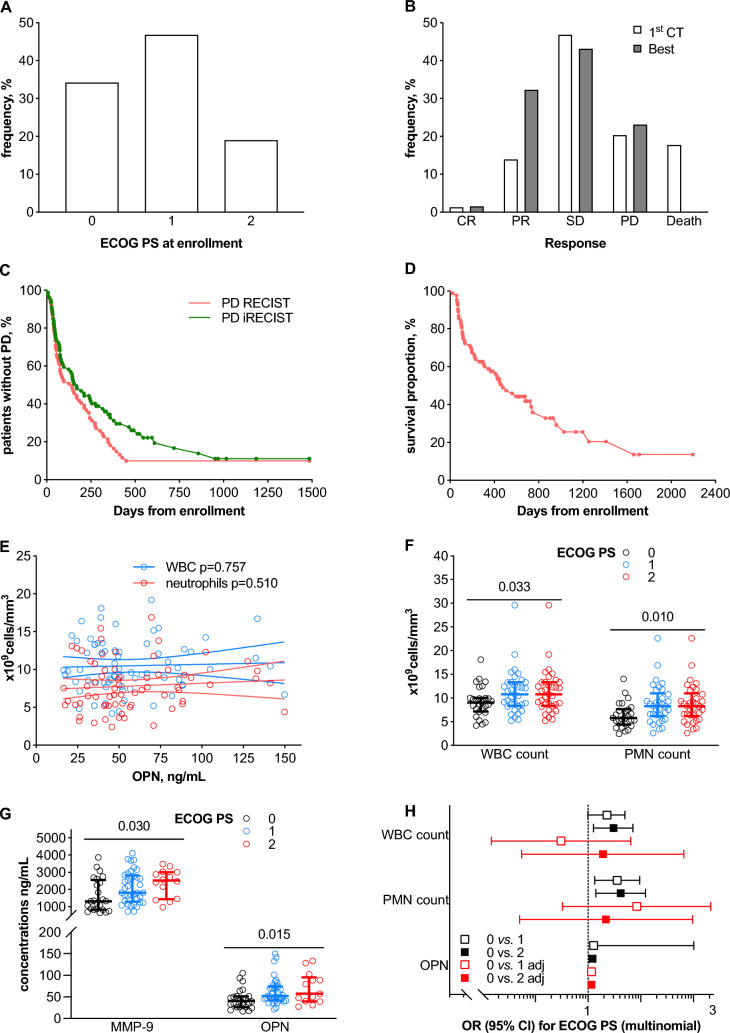
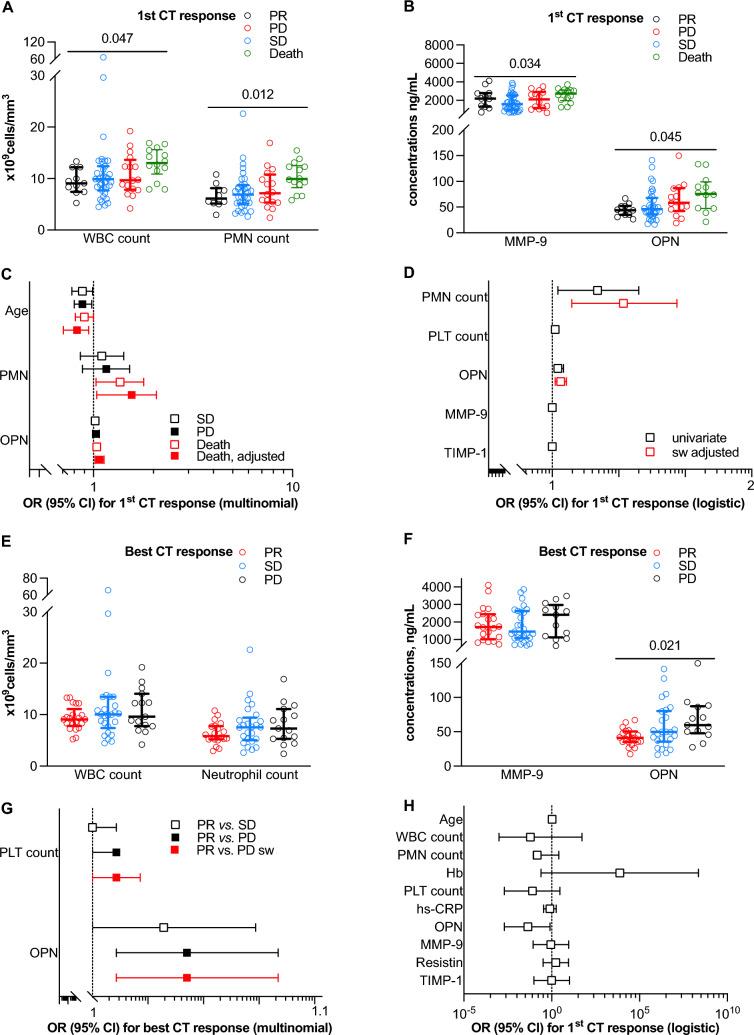
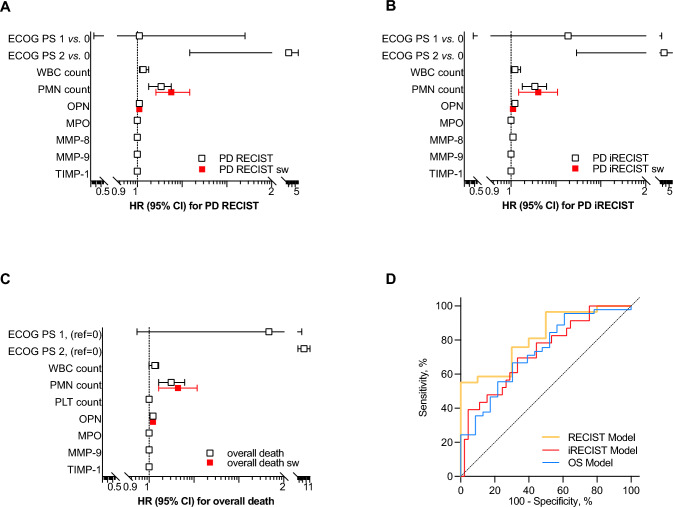
Results: High Serum OPN characterized patients with worse ECOG-PS (p = 0.015) at baseline and subjects experienced PD/death at first (OR 1.17 [1.02 to 1.35]; p = 0.030) and best responses (0.04 [0.00 to 0.81]; p = 0.035). OPN was associated with time-to-progression (B -2.74 [-4.46 to -1.01]) and time-to death (-0.13 [-0.20 to -0.05]). Cox regression models unveil a predictive value for iRECIST-PD (HR 1.01 [1.00 to 1.02]; p = -0.005), RECIST-PD (HR 1.01 [1.00 to 1.02]; p = 0.017), and OS (HR 1.02 [1.01 to 1.03]; p = 0.001). These models were internally validated through bootstrap resampling and characterized by relevant discrimination ability at ROC curve analyses.
Conclusion: Baseline levels of serum OPN is closely associated with performance status and short/long term outcomes in patients with advanced NSCLC, which are candidate to pembrolizumab-based regimens. As upfront biomarker of senescence, OPN may pave the way for future studies focusing on senescence patterns in NSCLC.
Keywords: Immunotherapy; Lung cancer; Mortality; Osteopontin; Pembrolizumab; Progression-free survival.
© 2024. The Author(s).
Conflict of interest statement
Carlo Genova declares honoraria from Astra Zeneca, Bristol Myers Squibb, Eli Lilly, Merck-Sharp-Dohme, Novartis, Roche, Sanofi, Takeda. Luca Liberale is co-inventor on the international patent WO/2020/226993 filed in April 2020. The patent relates to the use of antibodies which specifically bind IL-1α to reduce various sequelae of ischaemia–reperfusion injury to the central nervous system. Luca Liberale reports speaker fees from Daiichi-Sankyo outside the submitted work, he is counsellor of the European Society for Clinical Investigation and has received fundings from the Novartis Foundation for Medical-biological Research, the Swiss Heart Foundation, the Italian Ministry of Health (unrelated to this work). The other authors declare they have no conflict of interest.
Figures
References
-
- Boyero L, Sanchez-Gastaldo A, Alonso M, Noguera-Ucles JF, Molina-Pinelo S, Bernabe-Caro R. Primary and acquired resistance to immunotherapy in lung cancer: unveiling the mechanisms underlying of immune checkpoint blockade therapy. Cancers (Basel) 2020 doi: 10.3390/cancers12123729. - DOI - PMC - PubMed
Publication types
MeSH terms
Substances
Grants and funding
LinkOut - more resources
Full Text Sources
Medical
Research Materials
