The minimum effective concentration (MEC90) of bupivacaine for an ultrasound-guided suprainguinal fascia iliaca compartment block for analgesia in knee surgery: a dose-finding study
- PMID: 38480982
- PMCID: PMC11150113
- DOI: 10.4097/kja.23710
The minimum effective concentration (MEC90) of bupivacaine for an ultrasound-guided suprainguinal fascia iliaca compartment block for analgesia in knee surgery: a dose-finding study
Abstract
Background: In recent years, the suprainguinal fascia iliaca compartment block (SFICB) has become more common in clinical practice. This assessor-blinded dose-finding study aimed to determine the minimum effective concentration (MEC90, MEC95) of bupivacaine for a single-injection SFICB in patients undergoing arthroscopic anterior cruciate ligament repair.
Methods: This prospective study was conducted at a tertiary hospital (postoperative recovery room and ward). The SFICB was performed as a postsurgical intervention after spinal anesthesia. Seventy patients were allocated using the biased-coin design up-and-down sequential method. The ultrasound-guided SFICB was performed using different bupivacaine concentrations, and standard multimodal analgesia was administered to all patients. Block success was defined as the absence of pain or presence of only tactile sensation during the pinprick test conducted on the anterior and lateral regions of the mid-thigh six hours postoperatively.
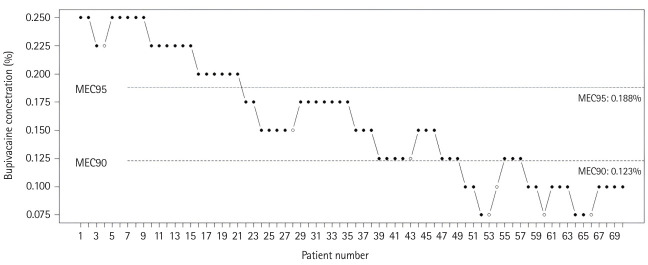
Results: According to isotonic regression and bootstrap CIs, the MEC90 value of bupivacaine for a successful SFICB was 0.123% (95% CI [0.098, 0.191]) and the MEC95 value was 0.188% (95% CI [0.113, 0.223]).
Conclusions: Our study showed that the MEC90 and MEC95 values for bupivacaine administered via an SFICB for analgesia were 0.123% and 0.188%, respectively. One advantage of using lower concentrations of bupivacaine is the associated reduction in quadriceps weakness.
Keywords: Analgesia; Bupivacaine; Local anesthetics; Nerve block; Pain management; Regional anesthesia..
Conflict of interest statement
No potential conflict of interest relevant to this article was reported.
Figures
References
-
- Vermeylen K, Soetens F, Leunen I, Hadzic A, Van Boxtael S, Pomés J, et al. The effect of the volume of supra-inguinal injected solution on the spread of the injectate under the fascia iliaca: a preliminary study. J Anesth. 2018;32:908–13. - PubMed
-
- Dalens B, Vanneuville G, Tanguy A. Comparison of the fascia iliaca compartment block with the 3-in-1 block in children. Anesth Analg. 1989;69:705–13. Erratum in: Anesth Analg 1990; 70: 474. - PubMed
-
- Kumar K, Pandey RK, Bhalla AP, Kashyap L, Garg R, Darlong V, et al. Comparison of conventional infrainguinal versus modified proximal suprainguinal approach of fascia iliaca compartment block for postoperative analgesia in total hip arthroplasty. A prospective randomized study. Acta Anaesthesiol Belg. 2015;66:95–100. - PubMed
-
- Wallace JB, Andrade JA, Christensen JP, Osborne LA, Pellegrini JE. Comparison of fascia iliaca compartment block and 3-in-1 block in adults undergoing knee arthroscopy and meniscal repair. AANA J. 2012;80(4 Suppl):S37–44. - PubMed
MeSH terms
Substances
LinkOut - more resources
Full Text Sources