. 2024 Mar 26;58(12):5500-5511.
doi: 10.1021/acs.est.3c10375. Epub 2024 Mar 14.

Bioretention Design Modifications Increase the Simulated Capture of Hydrophobic and Hydrophilic Trace Organic Compounds

Affiliations

Bioretention Design Modifications Increase the Simulated Capture of Hydrophobic and Hydrophilic Trace Organic Compounds

Timothy F M Rodgers et al. Environ Sci Technol. .

Abstract

Stormwater rapidly moves trace organic contaminants (TrOCs) from the built environment to the aquatic environment. Bioretention cells reduce loadings of some TrOCs, but they struggle with hydrophilic compounds. Herein, we assessed the potential to enhance TrOC removal via changes in bioretention system design by simulating the fate of seven high-priority stormwater TrOCs (e.g., PFOA, 6PPD-quinone, PAHs) with log KOC values between -1.5 and 6.74 in a bioretention cell. We evaluated eight design and management interventions for three illustrative use cases representing a highway, a residential area, and an airport. We suggest two metrics of performance: mass advected to the sewer network, which poses an acute risk to aquatic ecosystems, and total mass advected from the system, which poses a longer-term risk for persistent compounds. The optimized designs for each use case reduced effluent loadings of all but the most polar compound (PFOA) to <5% of influent mass. Our results suggest that having the largest possible system area allowed bioretention systems to provide benefits during larger events, which improved performance for all compounds. To improve performance for the most hydrophilic TrOCs, an amendment like biochar was necessary; field-scale research is needed to confirm this result. Our results showed that changing the design of bioretention systems can allow them to effectively capture TrOCs with a wide range of physicochemical properties, protecting human health and aquatic species from chemical impacts.

Keywords: 6PPD-quinone; PAHs; PFOA; TCEP; benzotriazole; bioretention; persistent mobile and toxic substances; stormwater; trace organic compounds.


Conflict of interest statement

The authors declare no competing financial interest.

Figures

Figure 1
Figure 1
Schematic diagram of the bioretention Blues model showing each of the tested interventions (as explained in the main text). Contaminant transport and fate processes are represented by D values. Solid arrows represent mass transfer; dashed lines represent transformation reactions (DR). Mass flux in and out of the system is shown as the flow rate Q (m3 h–1) into the system (in), out through the underdrain (pipe), and over the weir (W) or exfiltrated (exf) multiplied by the activity capacity Z (m3 m–3) and the activity a (mol m–3) for each compartment; compartment subscripts are shown in the legend. See the Methods section for the full details on each intervention.
Figure 2
Figure 2
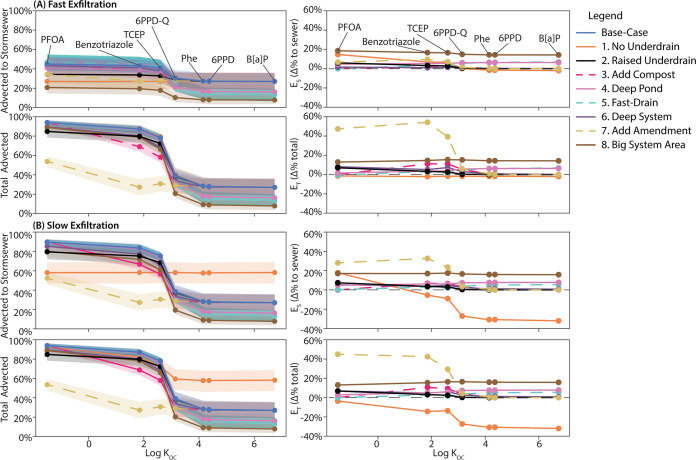
Mean and 95% confidence interval of mass advected with single interventions (left) and mean overall effect (E) of interventions as the change in the percent of influent mass advected to either the storm sewer (ES) or in total (ET) relative to the base case (right) vs the organic carbon–water distribution coefficient (log KOC) in the (A) fast-exfiltration and (B) slow-exfiltration contexts. Note that as described in the main text, the effects (right) represent an average across all possible systems, including combined interventions, while the mass advected (left) represents single interventions for a specific system, and so the two may not perfectly align. The same legend colors apply to both the left- and right-hand panels.
Figure 3
Figure 3
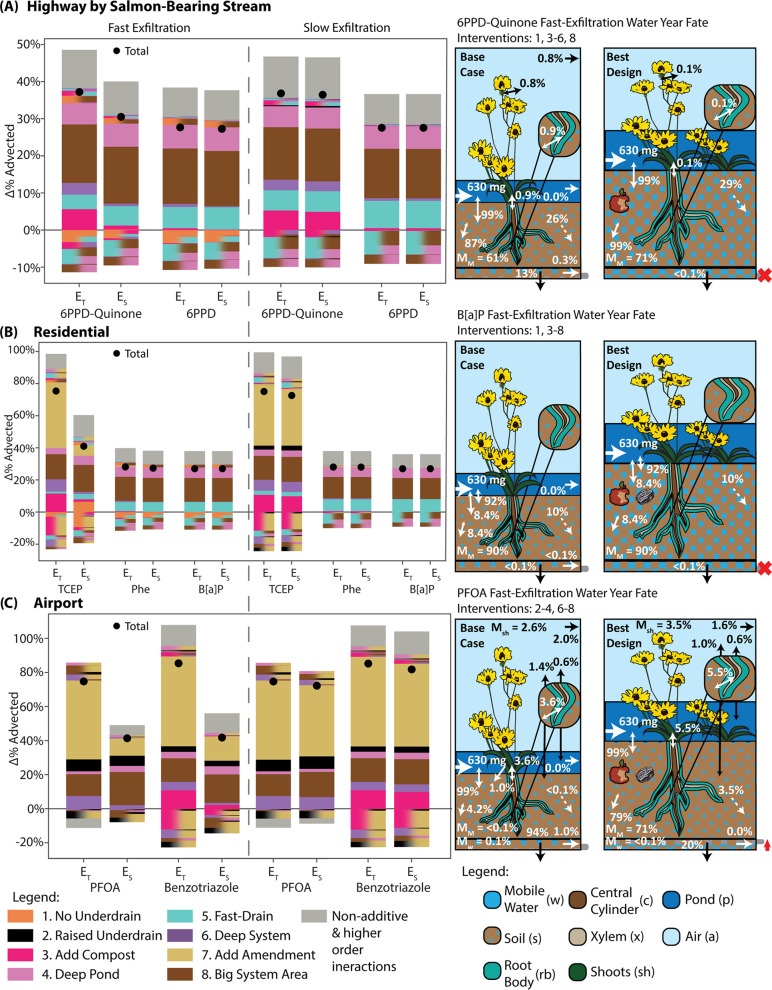
Left: contribution of each intervention (shown by a color) and of the secondary interactions between interventions (combinations of colors) to the overall average change in mass advected (black dots, percent of influent mass) for both the total mass advected (ET) and the mass advected to the sewer network (ES) across the 28 simulated design storms. Right: schematic diagrams showing the fate across a synthetic water year of representative compounds for the (A) highway (6PPD-quinone), (B) residential (B[a]P), and (C) airport (PFOA) use cases under the as-built fast-exfiltration context with the base-case and best-design scenarios. The selected interventions are shown graphically for the best design; Table 1 lists the interventions for the fast- and slow-exfiltration contexts. The mass influx (mg) is shown into the ponding zone; solid and dashed lines represent mass transport and transformation, respectively, as a proportion (%) of the mass influx for the processes shown in Figure 1. Table S1 shows all effects; additional fate diagrams are in S1 Figures S1–S6.

References

    1. Peter K. T.; Lundin J. I.; Wu C.; Feist B. E.; Tian Z.; Cameron J. R.; Scholz N. L.; Kolodziej E. P. Characterizing the Chemical Profile of Biological Decline in Stormwater-Impacted Urban Watersheds. Environ. Sci. Technol. 2022, 56 (5), 3159–3169. 10.1021/acs.est.1c08274. - DOI - PubMed
    1. Reemtsma T.; Berger U.; Arp H. P. H.; Gallard H.; Knepper T. P.; Neumann M.; Quintana J. B.; Voogt P. D. Mind the Gap: Persistent and Mobile Organic Compounds - Water Contaminants That Slip Through. Environ. Sci. Technol. 2016, 50, 10308.10.1021/acs.est.6b03338. - DOI - PubMed
    1. Lapointe M.; Rochman C. M.; Tufenkji N. Sustainable Strategies to Treat Urban Runoff Needed. Nat. Sustain 2022, 5 (5), 366–369. 10.1038/s41893-022-00853-4. - DOI
    1. Mahler B. J.; Metre P. C. V.; Crane J. L.; Watts A. W.; Scoggins M.; Williams E. S. Coal-Tar-Based Pavement Sealcoat and PAHs: Implications for the Environment, Human Health, and Stormwater Management. Environ. Sci. Technol. 2012, 46 (6), 3039–3045. 10.1021/es203699x. - DOI - PMC - PubMed
    1. Giger W.; Schaffner C.; Kohler H. P. E. Benzotriazole and Tolyltriazole as Aquatic Contaminants. 1. Input and Occurrence in Rivers and Lakes. Environ. Sci. Technol. 2006, 40, 7186.10.1021/es061565j. - DOI - PubMed

Substances