Repetitive peripheral magnetic stimulation for preventing shoulder subluxation after stroke: a randomized controlled trial
- PMID: 38483332
- PMCID: PMC11114152
- DOI: 10.23736/S1973-9087.24.08264-9
Repetitive peripheral magnetic stimulation for preventing shoulder subluxation after stroke: a randomized controlled trial
Abstract
Background: Shoulder subluxation caused by paralysis after stroke is a serious issue affecting shoulder pain and functional prognosis. However, its preventive treatment has not been fully investigated.
Aim: To investigate the effects of repetitive peripheral magnetic stimulation (rPMS) on the prevention of shoulder subluxation.
Design: A single-center, parallel-group, prospective randomized, open-blinded, end-point study.
Setting: Convalescent rehabilitation ward.
Population: We included 50 inpatients in the convalescent rehabilitation ward with post-stroke, having upper limb paralysis, and the acromio-humeral interval (AHI) was within 1/2 finger-breadth.
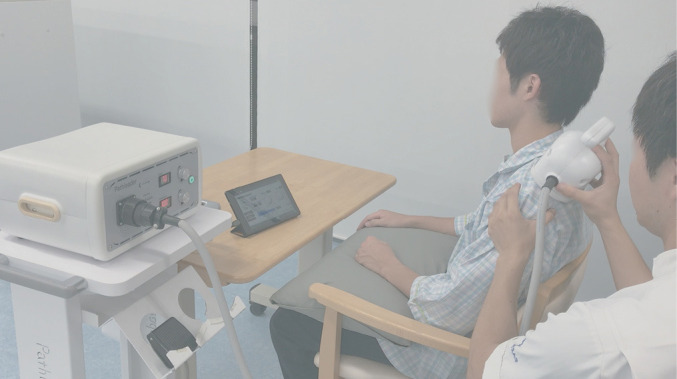
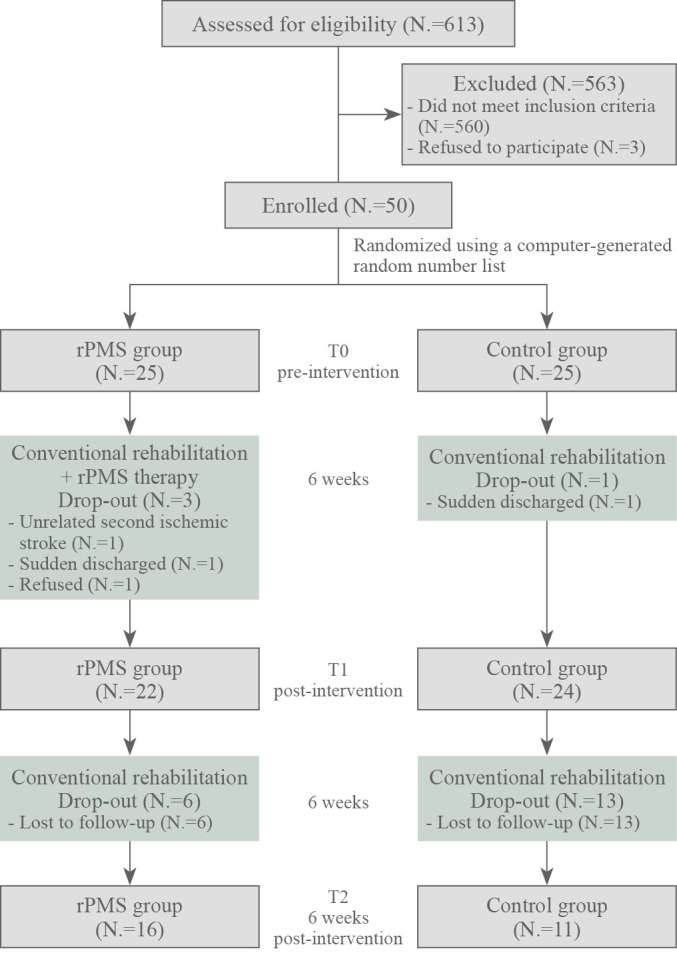
Methods: A blinded computer-based allocation system was used to randomly assign patients into two groups: 1) conventional rehabilitation plus rPMS therapy (rPMS group, N=25); and 2) conventional rehabilitation alone (control group, N=25). Blinded assessors evaluated the patients before the intervention (T0), 6 weeks after (T1), and 12 weeks after (T2). The primary outcome was the change in AHIs from T0 to T1 between the groups. In contrast, the secondary outcomes were shoulder pain, spasticity, active range of motion, and Fugl-Meyer Assessment upper extremity (FMA-UE) score.
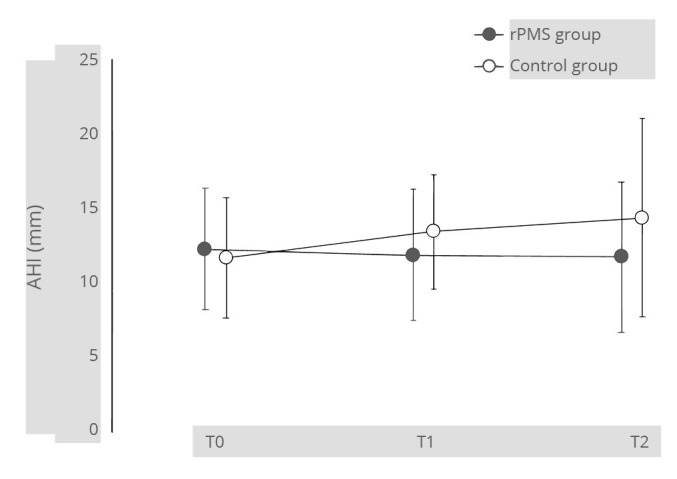
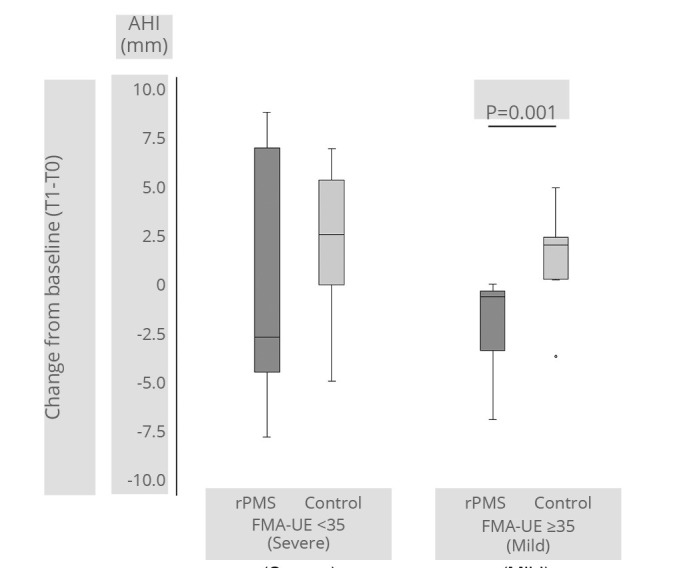
Results: Twenty-two patients in the rPMS group and 24 in the control group completed T1, whereas 16 in the rPMS group and 11 in the control group completed T2. The change in AHI was significantly lower in the rPMS group than in the control group ([95% CI, -5.15 to -0.390], P=0.023). Within-group analysis showed that AHI in the rPMS group did not change significantly, whereas it increased in the control group (P=0.004). There were no significant differences between T1 and T2 within or between the groups. Moreover, AHI did not show differences in patients with severe impairment but decreased in the rPMS group in patients with mild impairment (P=0.001).
Conclusions: The rPMS may be a new modality for preventing shoulder subluxation. The association between motor impairment and the sustained effect needs to be further examined.
Clinical rehabilitation impact: Applying rPMS to the muscles of the paralyzed shoulder after a stroke may prevent shoulder subluxation.
Conflict of interest statement
Figures
References
-
- Griffin C. Management of the hemiplegic shoulder complex. Top Stroke Rehabil 2014;21:316–8. https://www.ncbi.nlm.nih.gov/entrez/query.fcgi?cmd=Retrieve&db=PubMed&l... 10.1310/tsr2104-316 - DOI - PubMed
-
- Li Y, Yang S, Cui L, Bao Y, Gu L, Pan H, et al. Prevalence, risk factor and outcome in middle-aged and elderly population affected by hemiplegic shoulder pain: an observational study. Front Neurol 2023;13:1041263. https://www.ncbi.nlm.nih.gov/entrez/query.fcgi?cmd=Retrieve&db=PubMed&l... 10.3389/fneur.2022.1041263 - DOI - PMC - PubMed
-
- Aras MD, Gokkaya NK, Comert D, Kaya A, Cakci A. Shoulder pain in hemiplegia: results from a national rehabilitation hospital in Turkey. Am J Phys Med Rehabil 2004;83:713–9. https://www.ncbi.nlm.nih.gov/entrez/query.fcgi?cmd=Retrieve&db=PubMed&l... 10.1097/01.PHM.0000138739.18844.88 - DOI - PubMed
-
- Barlak A, Unsal S, Kaya K, Sahin-Onat S, Ozel S. Poststroke shoulder pain in Turkish stroke patients: relationship with clinical factors and functional outcomes. Int J Rehabil Res 2009;32:309–15. https://www.ncbi.nlm.nih.gov/entrez/query.fcgi?cmd=Retrieve&db=PubMed&l... 10.1097/MRR.0b013e32831e455f - DOI - PubMed
-
- Faghri PD, Rodgers MM, Glaser RM, Bors JG, Ho C, Akuthota P. The effects of functional electrical stimulation on shoulder subluxation, arm function recovery, and shoulder pain in hemiplegic stroke patients. Arch Phys Med Rehabil 1994;75:73–9. https://www.ncbi.nlm.nih.gov/entrez/query.fcgi?cmd=Retrieve&db=PubMed&l... https://doi.org/10.1016/0003-9993(94)90341-7 - DOI - PubMed
Publication types
MeSH terms
LinkOut - more resources
Full Text Sources
Medical