


Seasonal and Ecological Determinants of Wild Boar Rooting on Priority Protected Grasslands
- PMID: 38483578
- PMCID: PMC11227453
- DOI: 10.1007/s00267-024-01952-y
Seasonal and Ecological Determinants of Wild Boar Rooting on Priority Protected Grasslands
Abstract
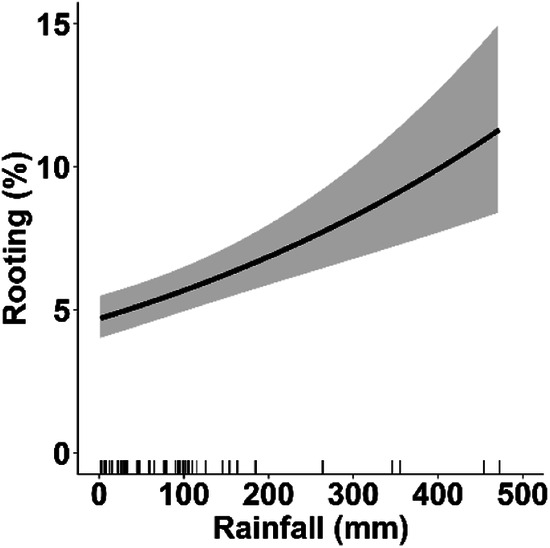
Wild ungulates can influence various trophic levels, regulating carnivore abundance and affecting habitat structure. Conservation problems can arise when high ungulate densities threaten species or habitats with conservation concern. Assessing factors influencing the intensity of their impact is important to identify appropriate measures enhancing habitat conservation. We assessed factors influencing wild boar Sus scrofa pressure on EU protected grasslands in three protected areas of central Italy, by modelling the effects of environmental variables and wild boar density on rooting activity. We seasonally estimated rooting in 126 sampling plots from spring 2019 to spring 2021, and we used faeces counts to estimate summer wild boar densities. Estimates of density and rooting varied from 3.5 to 22.2 individuals/km2 and from 1.1 to 19.2%, respectively. We detected a clear seasonal trend in rooting activity, that peaked in autumn and winter. We also found a strongly positive correlation between spring-summer rooting and summer density, across sites. Rooting intensity was negatively related to the local extent of rock cover and increased with the 1 month-cumulative rainfall, the perimeter of the grassland patch, and the forest cover around plots. These results emphasise the tendency of wild boar to exploit feeding sites in ecotonal areas, i.e., at the interface between forest and meadows, which maximises security and ease of finding food resources. Actions aiming at the protection of focal plants in grassland habitats, as well as reducing wild boar presence, are supported (e.g. fencing and/or targeting population control at vulnerable patches).
Keywords: Sus scrofa; Foraging activity; Wild pigs; habitat conservation; habitat-wildlife relationships; soil erosion.
© 2024. The Author(s).
Conflict of interest statement
The authors declare no competing interests.
Figures




References
-
- Acevedo P, Farfán MÁ, Márquez AL, Delibes-Mateos M, Real R, Vargas JM. Past, present and future of wild ungulates in relation to changes in land use. Landsc Ecol. 2011;26:19–31. doi: 10.1007/s10980-010-9538-2. - DOI
-
- Adams PJ, Fontaine JB, Huston RM, Fleming PA. Quantifying efficacy of feral pig (Sus scrofa) population management. Wildl Res. 2019;46:587–598. doi: 10.1071/WR18100. - DOI
-
- Amici A, Serrani F, Rossi CM, Primi R. Increase in crop damage caused by wild boar (Sus scrofa L.): The “refuge effect”. Agron Sustain Dev. 2012;32:683–692. doi: 10.1007/s13593-011-0057-6. - DOI
-
- Anderson SJ, Stone CP. Snaring to control feral pigs Sus scrofa in a remote Hawaiian rain forest. Biol Conserv. 1993;63:195–201. doi: 10.1016/0006-3207(93)90712-A. - DOI
MeSH terms
LinkOut - more resources
Full Text Sources
