


Country uptake of WHO recommendations on differentiated HIV testing services approaches: a global policy review
- PMID: 38485173
- PMCID: PMC10941124
- DOI: 10.1136/bmjopen-2021-058098
Country uptake of WHO recommendations on differentiated HIV testing services approaches: a global policy review
Abstract
Objectives: In 2015 and 2016, WHO issued guidelines on HIV testing services (HTS) highlighting recommendations for a strategic mix of differentiated HTS approaches. The policy review examines the uptake of differentiated HTS approaches recommendations in national policies.
Methods: Data were extracted from national policies published between January 2015 and June 2019. The WHO-recommended HTS approaches included facility-based testing, community-based testing, HIV self-testing and provider-assisted referral (or assisted partner notification). Other supportive recommendations include pre-test information, post-test counselling, lay provider testing and rapid testing. Descriptive analyses were conducted to examine inclusion of recommendations in national policies.
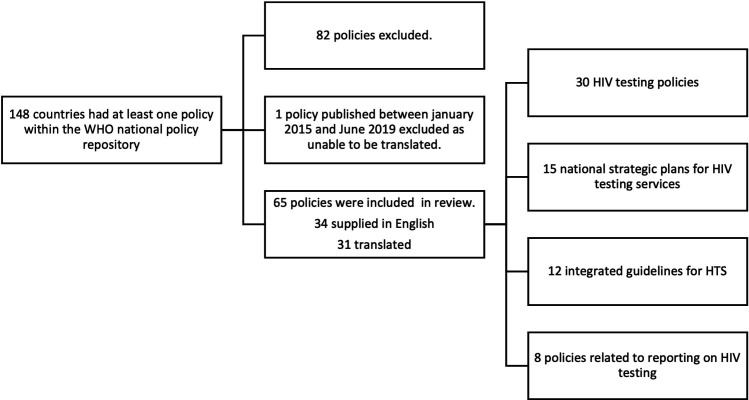
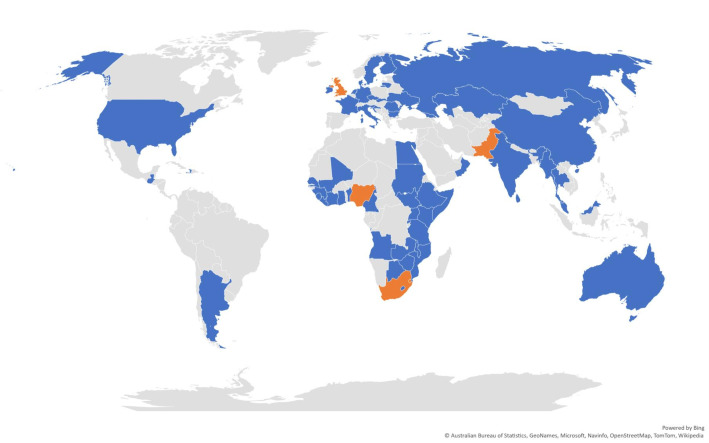
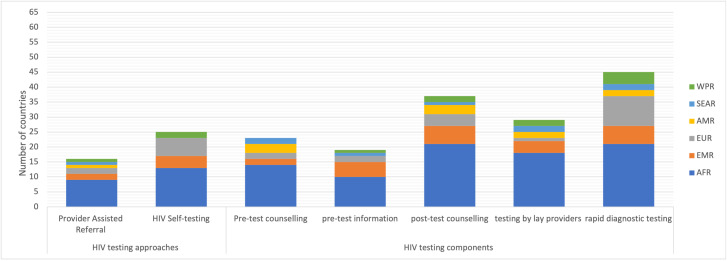
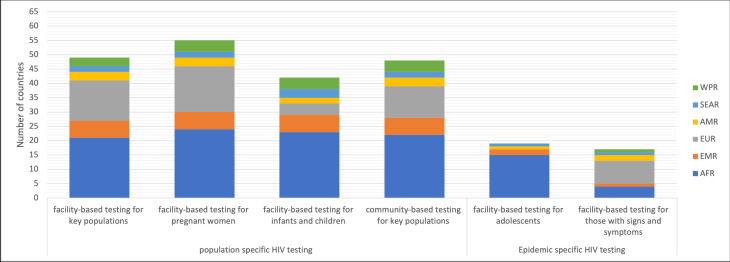
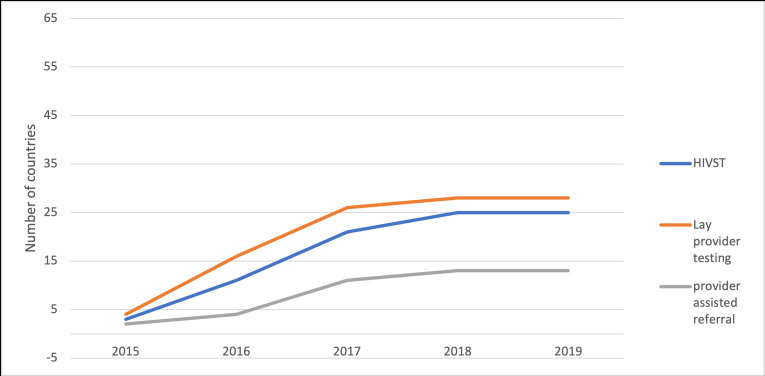
Results: Of 194 countries worldwide, 65 published policies were identified; 24 WHO Africa region (AFR) countries (51%, 24/47), 21 WHO European region (EUR) (40%, 21/53), 6 WHO Eastern Mediterranean region (EMR) (29%, 6/21), 5 Pan-American region (AMR) (14%, 5/35), 5 Western Pacific Region (WPR) (19%, 5/27) and 4 WHO South East Asia Region (SEAR) (36%, 4/11). Only five countries included all recommendations. 63 included a minimum of one. 85% (n=55) included facility-based testing for pregnant women, 75% (n=49) facility-based testing for key populations, 74% (n=48) community-based testing for key populations, 69% (n=45) rapid testing, 57% (n=37) post-test counselling, 45% (n=29) lay provider testing, 38% (n=25) HIV self-testing, 29% (n=19) pre-test information and 25% (n=16) provider-assisted referral. The proportion in each region that included at least one recommendation were: 100% AFR (24/47), 100% EMR (6/6), 100% AMR (5/5), 100% WPR (5/5), 100% SEAR (4/4) and 95% EUR (20/21). AFR followed by EMR included the highest number of reccomendations.
Conclusion: There was substantial variability in the uptake of the WHO-differentiated HTS recommendations. Those in EMR included the most WHO-differentiated HTS recommendation followed by AFR. Countries within AMR included the least number of recommendations. Ongoing advocacy and efforts are needed to support the uptake of the WHO-differentiated HTS recommendations in country policies as well as their implementation.
Keywords: HIV & AIDS; health policy; public health.
© Author(s) (or their employer(s)) 2024. Re-use permitted under CC BY-NC. No commercial re-use. See rights and permissions. Published by BMJ.
Conflict of interest statement
Competing interests: None declared.
Figures
References
-
- UNAIDS . Fact sheet 2022. UNAIDS, 2022.
-
- UNAIDS . 2021 global AIDS update: confronting inequalities. 2021. Available: https://www.unaids.org/sites/default/files/media_asset/2021-global-aids-...
-
- UNAIDS . Aids targets: putting people living with HIV and communities at risk at the centre 2021. 2025. Available: https://aidstargets2025.unaids.org/ [Accessed 23 Feb 2022].
-
- UNAIDS . Fast-track strategy to end the AIDS epidemic by 2030. UNAIDS, 2014.
-
- WHO . Progress report on HIV, viral hepatitis and sexually transmitted infections, 2019 accountability for the global health sector strategies, 2016–2021. Geneva, Switzerland: WHO, 2019.
Publication types
MeSH terms
Grants and funding
LinkOut - more resources
Full Text Sources
Medical
