


Out-of-pocket expenditures associated with double disease burden in Pakistan: a quantile regression analysis
- PMID: 38486277
- PMCID: PMC10938732
- DOI: 10.1186/s12889-024-18320-4
Out-of-pocket expenditures associated with double disease burden in Pakistan: a quantile regression analysis
Abstract
Background: Pakistan is currently experiencing a double burden of disease. Families with members having both communicable and noncommunicable diseases are at a greater risk of impoverishment due to enormous out-of-pocket payments. This study examines the percentile distribution of the determinants of the out-of-pocket expenditure on the double disease burden.
Method: The study extracted a sample of 6,775 households with at least one member experiencing both communicable and noncommunicable diseases from the Household Integrated Economic Survey 2018-19. The dataset is cross-sectional and nationally representative. Quantile regression was used to analyze the association of various socioeconomic factors with the OOP expenditure associated with double disease burden.
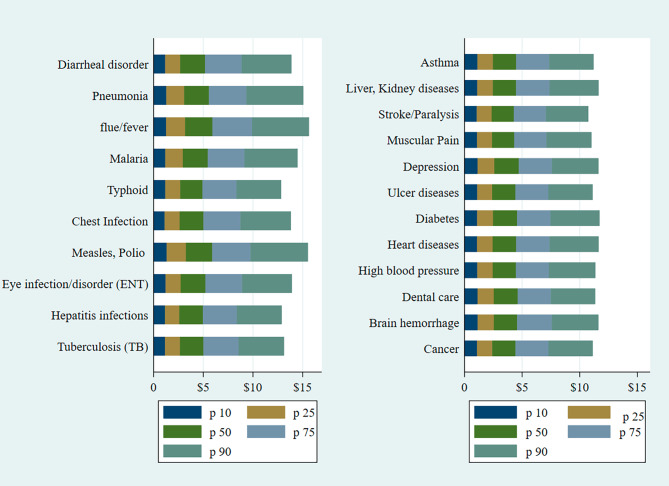
Results: Overall, 28.5% of households had double disease in 2018-19. The households with uneducated heads, male heads, outpatient healthcare, patients availing public sector healthcare services, and rural and older members showed a significant association with the prevalence of double disease. The out-of-pocket expenditure was higher for depression, liver and kidney disease, hepatitis, and pneumonia in the upper percentiles. The quantile regression results showed that an increased number of communicable and noncommunicable diseases was associated with higher monthly OOP expenditure in the lower percentiles (10th percentile, coefficient 312, 95% CI: 92-532), and OOP expenditure was less pronounced among the higher percentiles (75th percentile, coefficient 155, 95% CI: 30-270). The households with older members were associated with higher OOP expenditure at higher tails (50th and 75th percentiles) compared to lower (10th and 25th percentiles). Family size was associated with higher OOPE at lower percentiles than higher ones.
Conclusion: The coexistence of communicable and noncommunicable diseases is associated with excessive private healthcare costs in Pakistan. The results call for addressing the variations in financial costs associated with double diseases.
Keywords: Double Disease Burden; Out-of-pocket expenditures; Outpatient Healthcare; Quantile regression.
© 2024. The Author(s).
Conflict of interest statement
The authors declare no competing interests.
Figures

References
-
- Abbafati C, Abbas KM, Abbasi-Kangevari M, Abd-Allah F, Abdelalim A, Abdollahi M, et al. Global burden of 369 diseases and injuries in 204 countries and territories, 1990–2019: a systematic analysis for the global burden of Disease Study 2019. Lancet. 2020;396:1204–22. doi: 10.1016/S0140-6736(20)30925-9. - DOI - PMC - PubMed
-
- WHO. Fact sheet: Non communicable Diseases. 2022.
-
- Asian Development Bank. Development Asia. 2011.
MeSH terms
LinkOut - more resources
Full Text Sources
Miscellaneous
