


Late-stage modification of bioactive compounds: Improving druggability through efficient molecular editing
- PMID: 38487004
- PMCID: PMC10935128
- DOI: 10.1016/j.apsb.2023.11.021
Late-stage modification of bioactive compounds: Improving druggability through efficient molecular editing
Abstract
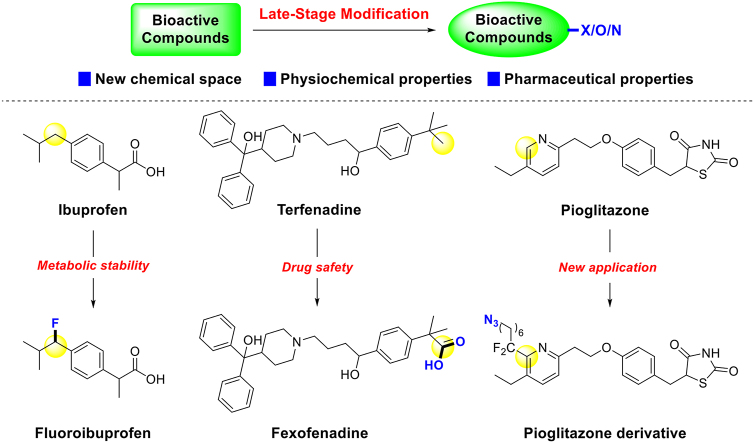
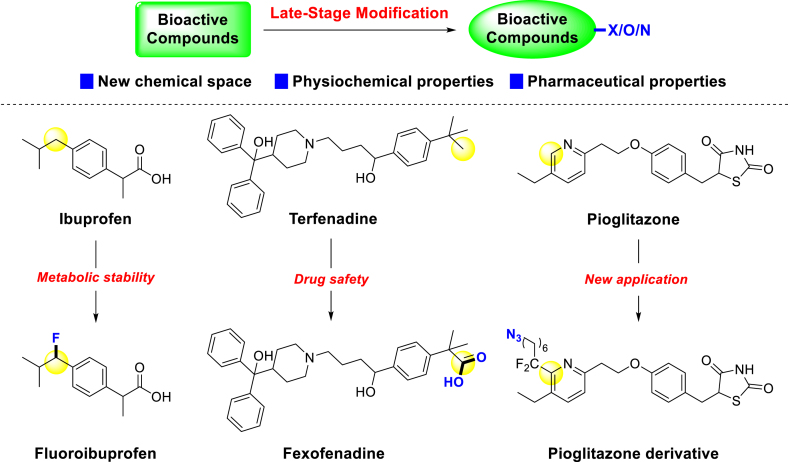
Synthetic chemistry plays an indispensable role in drug discovery, contributing to hit compounds identification, lead compounds optimization, candidate drugs preparation, and so on. As Nobel Prize laureate James Black emphasized, "the most fruitful basis for the discovery of a new drug is to start with an old drug"1. Late-stage modification or functionalization of drugs, natural products and bioactive compounds have garnered significant interest due to its ability to introduce diverse elements into bioactive compounds promptly. Such modifications alter the chemical space and physiochemical properties of these compounds, ultimately influencing their potency and druggability. To enrich a toolbox of chemical modification methods for drug discovery, this review focuses on the incorporation of halogen, oxygen, and nitrogen-the ubiquitous elements in pharmacophore components of the marketed drugs-through late-stage modification in recent two decades, and discusses the state and challenges faced in these fields. We also emphasize that increasing cooperation between chemists and pharmacists may be conducive to the rapid discovery of new activities of the functionalized molecules. Ultimately, we hope this review would serve as a valuable resource, facilitating the application of late-stage modification in the construction of novel molecules and inspiring innovative concepts for designing and building new drugs.
Keywords: Drug space; Halogenation; Late-stage modification; Nitrogenation; Oxygenation; Synthetic chemistry.
© 2024 The Authors.
Conflict of interest statement
The authors declare no conflicts of interest.
Figures
References
-
- Raju T.N.K. The nobel chronicles. Lancet. 2000;356:436. - PubMed
-
- Guillemard L., Kaplaneris N., Ackermann L., Johansson M.J. Late-stage C–H functionalization offers new opportunities in drug discovery. Nat Rev Chem. 2021;5:522–545. - PubMed
-
- Lasso J.D., Castillo Pazos D.J., Li C.J. Green chemistry meets medicinal chemistry: a perspective on modern metal-free late-stage functionalization reactions. Chem Soc Rev. 2021;50:10955–10982. - PubMed
-
- Lombardino J.G., Lowe J.A., 3rd The role of the medicinal chemist in drug discovery—then and now. Nat Rev Drug Discov. 2004;3:853–862. - PubMed
-
- Moir M., Danon J.J., Reekie T.A., Kassiou M. An overview of late-stage functionalization in today's drug discovery. Expet Opin Drug Discov. 2019;14:1137–1149. - PubMed
Publication types
LinkOut - more resources
Full Text Sources
Research Materials
