


Can large language models reason about medical questions?
- PMID: 38487804
- PMCID: PMC10935498
- DOI: 10.1016/j.patter.2024.100943
Can large language models reason about medical questions?
Abstract
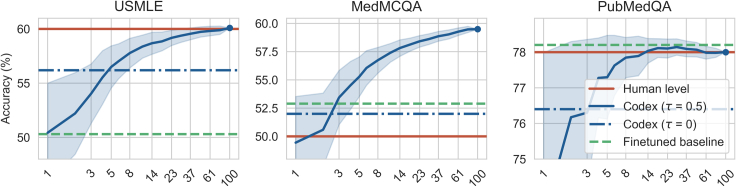
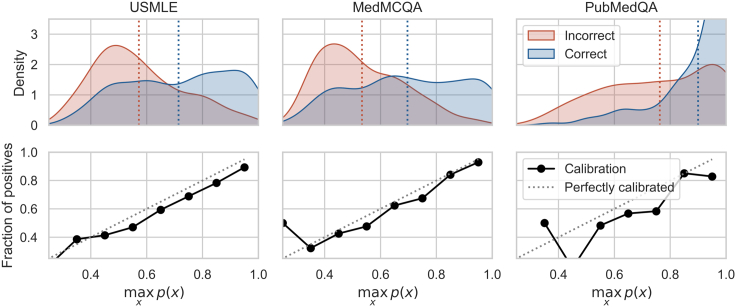
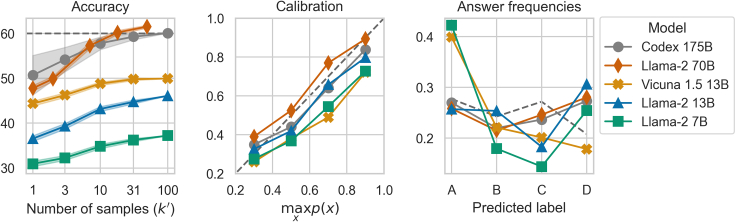
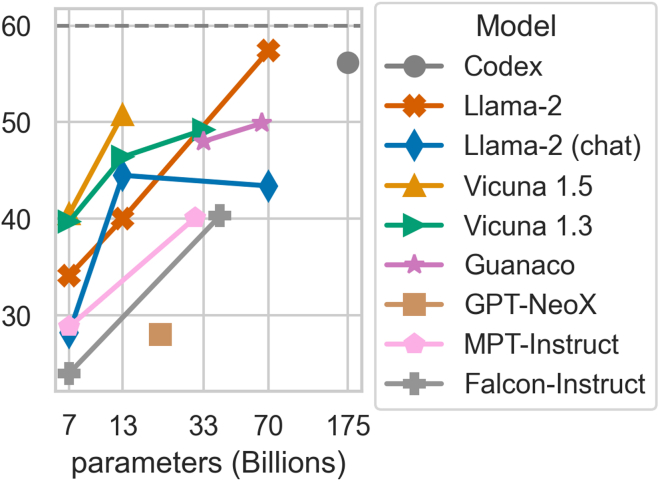
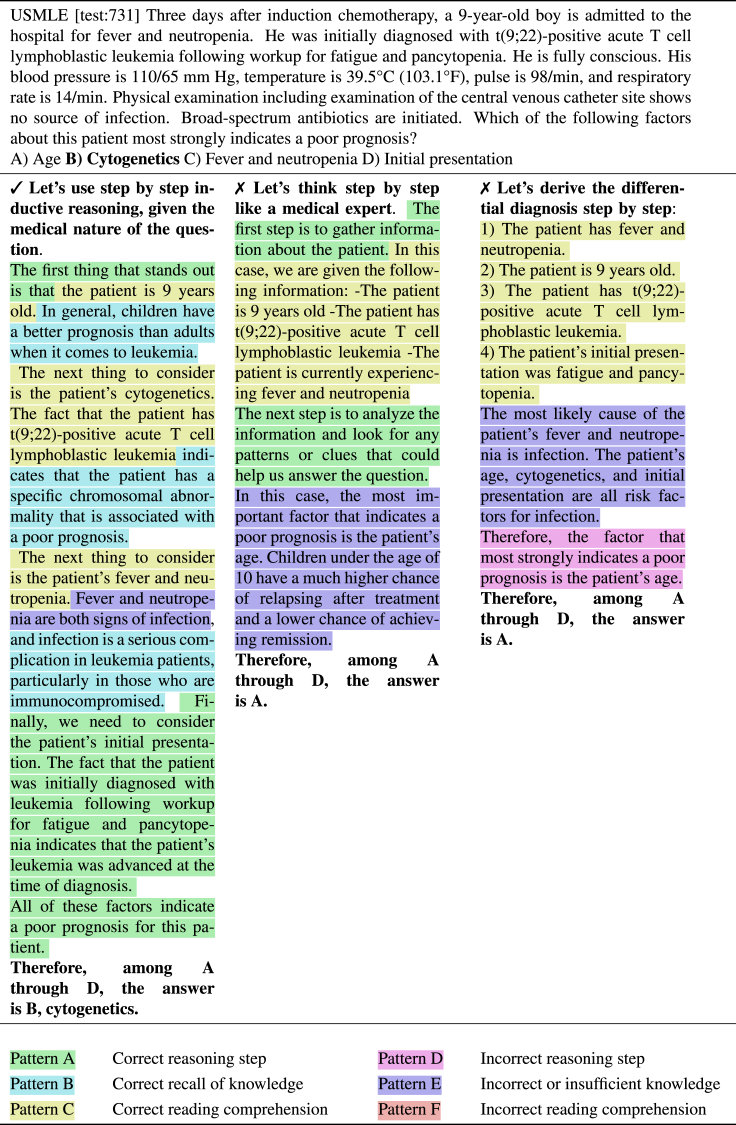
Although large language models often produce impressive outputs, it remains unclear how they perform in real-world scenarios requiring strong reasoning skills and expert domain knowledge. We set out to investigate whether closed- and open-source models (GPT-3.5, Llama 2, etc.) can be applied to answer and reason about difficult real-world-based questions. We focus on three popular medical benchmarks (MedQA-US Medical Licensing Examination [USMLE], MedMCQA, and PubMedQA) and multiple prompting scenarios: chain of thought (CoT; think step by step), few shot, and retrieval augmentation. Based on an expert annotation of the generated CoTs, we found that InstructGPT can often read, reason, and recall expert knowledge. Last, by leveraging advances in prompt engineering (few-shot and ensemble methods), we demonstrated that GPT-3.5 not only yields calibrated predictive distributions but also reaches the passing score on three datasets: MedQA-USMLE (60.2%), MedMCQA (62.7%), and PubMedQA (78.2%). Open-source models are closing the gap: Llama 2 70B also passed the MedQA-USMLE with 62.5% accuracy.
Keywords: GPT-3.5; Llama 2; MedQA; large language models; machine learning; medical; open source; prompt engineering; question answering; uncertainty quantification.
© 2024 The Authors.
Figures

References
-
- Mikolov T., Sutskever I., Chen K., Corrado G.S., Dean J. Distributed representations of words and phrases and their compositionality. Adv. Neural Inf. Process. Syst. 2013;26
-
- Pennington J., Socher R., Manning C. Proceedings of the 2014 Conference on Empirical Methods in Natural Language Processing (EMNLP) Association for Computational Linguistics; 2014. GloVe: Global vectors for word representation; pp. 1532–1543. - DOI
-
- Peters M.E., Neumann M., Iyyer M., Gardner M., Clark C., Lee K., Zettlemoyer L. Deep contextualized word representations. arXiv. 2018 doi: 10.48550/arXiv.1802.05365. Preprint at. - DOI
-
- Vaswani A., Shazeer N., Parmar N., Uszkoreit J., Jones L., Gomez A.N., Kaiser Ł., Polosukhin I. Attention is all you need. Adv. Neural Inf. Process. Syst. 2017;30
-
- Devlin J., Chang M., Lee K., Toutanova K. BERT: Pre-training of Deep Bidirectional Transformers for Language Understanding. arXiv. 2018 doi: 10.04805/arXiv.1810.04805. Preprint at. - DOI
LinkOut - more resources
Full Text Sources
Miscellaneous
