


A Closed-Loop Digital Health Tool to Improve Depression Care in Multiple Sclerosis: Iterative Design and Cross-Sectional Pilot Randomized Controlled Trial and its Impact on Depression Care
- PMID: 38488827
- PMCID: PMC10980989
- DOI: 10.2196/52809
A Closed-Loop Digital Health Tool to Improve Depression Care in Multiple Sclerosis: Iterative Design and Cross-Sectional Pilot Randomized Controlled Trial and its Impact on Depression Care
Abstract
Background: People living with multiple sclerosis (MS) face a higher likelihood of being diagnosed with a depressive disorder than the general population. Although many low-cost screening tools and evidence-based interventions exist, depression in people living with MS is underreported, underascertained by clinicians, and undertreated.
Objective: This study aims to design a closed-loop tool to improve depression care for these patients. It would support regular depression screening, tie into the point of care, and support shared decision-making and comprehensive follow-up. After an initial development phase, this study involved a proof-of-concept pilot randomized controlled trial (RCT) validation phase and a detailed human-centered design (HCD) phase.
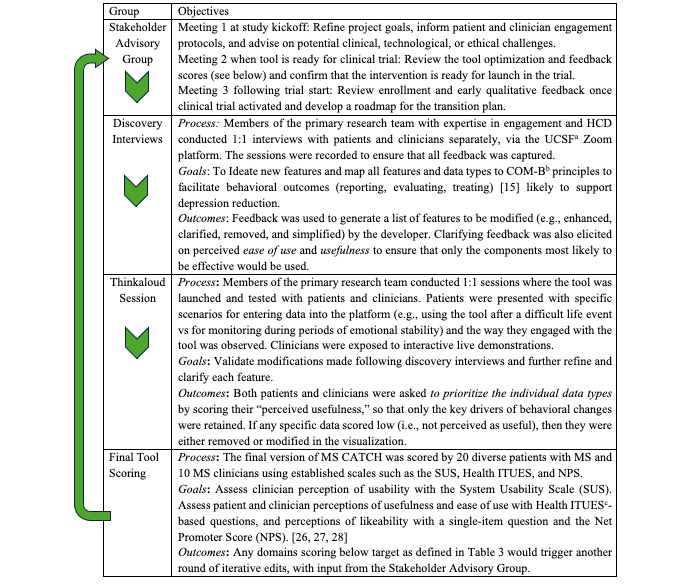
Methods: During the initial development phase, the technological infrastructure of a clinician-facing point-of-care clinical dashboard for MS management (BRIDGE) was leveraged to incorporate features that would support depression screening and comprehensive care (Care Technology to Ascertain, Treat, and Engage the Community to Heal Depression in people living with MS [MS CATCH]). This linked a patient survey, in-basket messages, and a clinician dashboard. During the pilot RCT phase, a convenience sample of 50 adults with MS was recruited from a single MS center with 9-item Patient Health Questionnaire scores of 5-19 (mild to moderately severe depression). During the routine MS visit, their clinicians were either asked or not to use MS CATCH to review their scores and care outcomes were collected. During the HCD phase, the MS CATCH components were iteratively modified based on feedback from stakeholders: people living with MS, MS clinicians, and interprofessional experts.
Results: MS CATCH links 3 features designed to support mood reporting and ascertainment, comprehensive evidence-based management, and clinician and patient self-management behaviors likely to lead to sustained depression relief. In the pilot RCT (n=50 visits), visits in which the clinician was randomized to use MS CATCH had more notes documenting a discussion of depressive symptoms than those in which MS CATCH was not used (75% vs 34.6%; χ21=8.2; P=.004). During the HCD phase, 45 people living with MS, clinicians, and other experts participated in the design and refinement. The final testing round included 20 people living with MS and 10 clinicians including 5 not affiliated with our health system. Most scoring targets for likeability and usability, including perceived ease of use and perceived effectiveness, were met. Net Promoter Scale was 50 for patients and 40 for clinicians.
Conclusions: Created with extensive stakeholder feedback, MS CATCH is a closed-loop system aimed to increase communication about depression between people living with MS and their clinicians, and ultimately improve depression care. The pilot findings showed evidence of enhanced communication. Stakeholders also advised on trial design features of a full year long Department of Defense-funded feasibility and efficacy trial, which is now underway.
Trial registration: ClinicalTrials.gov NCT05865405; http://tinyurl.com/4zkvru9x.
Keywords: bring your own device; clinical trial; closed-loop; depression; mHealth; multiple sclerosis; quality of life.
©Kyra Henderson, Jennifer Reihm, Kanishka Koshal, Jaeleene Wijangco, Narender Sara, Nicolette Miller, Marianne Doyle, Alicia Mallory, Judith Sheridan, Chu-Yueh Guo, Lauren Oommen, Katherine P Rankin, Stephan Sanders, Anthony Feinstein, Christina Mangurian, Riley Bove. Originally published in JMIR Formative Research (https://formative.jmir.org), 15.03.2024.
Conflict of interest statement
Conflicts of Interest: The authors report no disclosures relevant to this clinical trial. KH, JR, KK, JW, NS, NM, MD, AM, JS, LO, and KPR had no conflicts of interest to disclose. CYG reports personal advisory board or consulting fees from Genentech and Horizon. AF received grant support from Multiple Sclerosis (MS) Society of Canada, Canadian Institutes of Health Research, book royalties from Johns Hopkins University Press, and speaker’s honoraria from Novartis. CM is supported by several grants from the National Institutes of Health (NIH; National Institute of Mental Health, National Institute on Minority Health and Health Disparities, National Institute of Allergy and Infectious Diseases, and National Institute on Drug Abuse), Health Resources and Services Administration, Doris Duke Charitable Foundation, California Health Care Foundation, Genentech, Gilead, and United Health Group. RB received research support from NIH, Department of Defense, National Multiple Sclerosis Harry Weaver Award, Biogen, Novartis, and Hoffman-La Roche. RB has received personal advisory board or consulting fees from EMD Serono, Horizon, Janssen, and TG Therapeutics. SS receives research funding from BioMarin Pharmaceutical.
Figures

References
-
- Fiest KM, Walker JR, Bernstein CN, Graff LA, Zarychanski R, Abou-Setta AM, Patten SB, Sareen J, Bolton JM, Marriott JJ, Fisk JD, Singer A, Marrie RA. Systematic review and meta-analysis of interventions for depression and anxiety in persons with multiple sclerosis. Mult Scler Relat Disord. 2016 Jan;5:12–26. doi: 10.1016/j.msard.2015.10.004. https://linkinghub.elsevier.com/retrieve/pii/S2211-0348(15)30011-0 S2211-0348(15)30011-0 - DOI - PubMed
Associated data
LinkOut - more resources
Full Text Sources
Medical
Miscellaneous
