. 2024 Mar 15;166(1):138.
doi: 10.1007/s00701-024-06025-x.

Multiple surgical resections for progressive IDH wildtype glioblastoma-is it beneficial?

Affiliations

Multiple surgical resections for progressive IDH wildtype glioblastoma-is it beneficial?

Susan Isabel Honeyman et al. Acta Neurochir (Wien). .

Abstract

Purpose: The role of repeat resection for recurrent glioblastoma (rGB) remains equivocal. This study aims to assess the overall survival and complications rates of single or repeat resection for rGB.

Methods: A single-centre retrospective review of all patients with IDH-wildtype glioblastoma managed surgically, between January 2014 and January 2022, was carried out. Patient survival and factors influencing prognosis were analysed, using Kaplan-Meier and Cox regression methods.

Results: Four hundred thirty-two patients were included, of whom 329 underwent single resection, 83 had two resections and 20 patients underwent three resections. Median OS (mOS) in the cohort who underwent a single operation was 13.7 months (95% CI: 12.7-14.7 months). The mOS was observed to be extended in patients who underwent second or third-time resection, at 22.9 months and 44.7 months respectively (p < 0.001). On second operation achieving > 95% resection or residual tumour volume of < 2.25 cc was significantly associated with prolonged survival. There was no significant difference in overall complication rates between primary versus second (p = 0.973) or third-time resections (p = 0.312). The use of diffusion tensor imaging (DTI) guided resection was associated with reduced post-operative neurological deficit (RR 0.37, p = 0.002), as was use of intraoperative ultrasound (iUSS) (RR 0.45, p = 0.04).

Conclusions: This study demonstrates potential prolongation of survival for rGB patients undergoing repeat resection, without significant increase in complication rates with repeat resections. Achieving a more complete repeat resection improved survival. Moreover, the use of intraoperative imaging adjuncts can maximise tumour resection, whilst minimising the risk of neurological deficit.

Keywords: Glioblastoma; Recurrent; Repeat; Surgical resection.


Conflict of interest statement

The authors declare no competing interests.

Figures
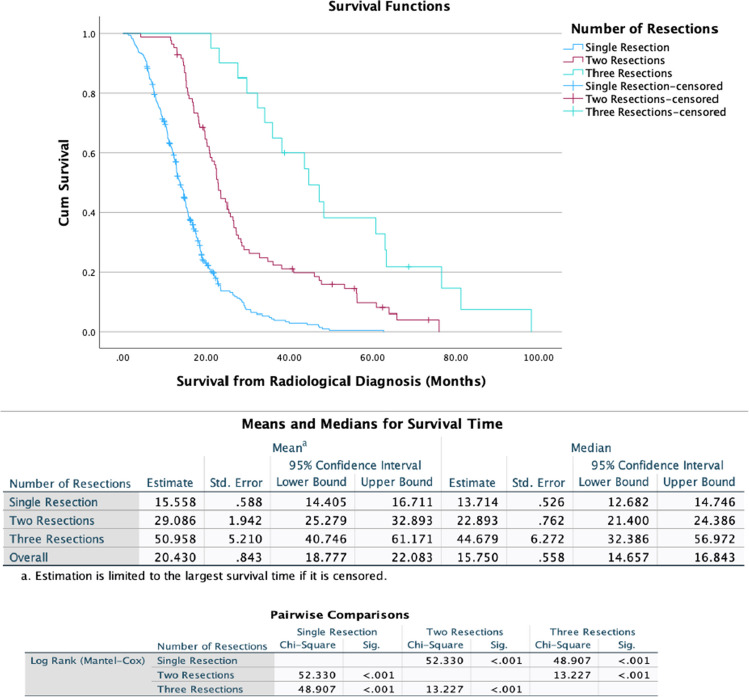
Fig. 1
Fig. 1
Kaplan–Meier Curves demonstrating overall survival in patients who underwent either single, two- or three-time resections for glioblastoma
Fig. 2
Fig. 2
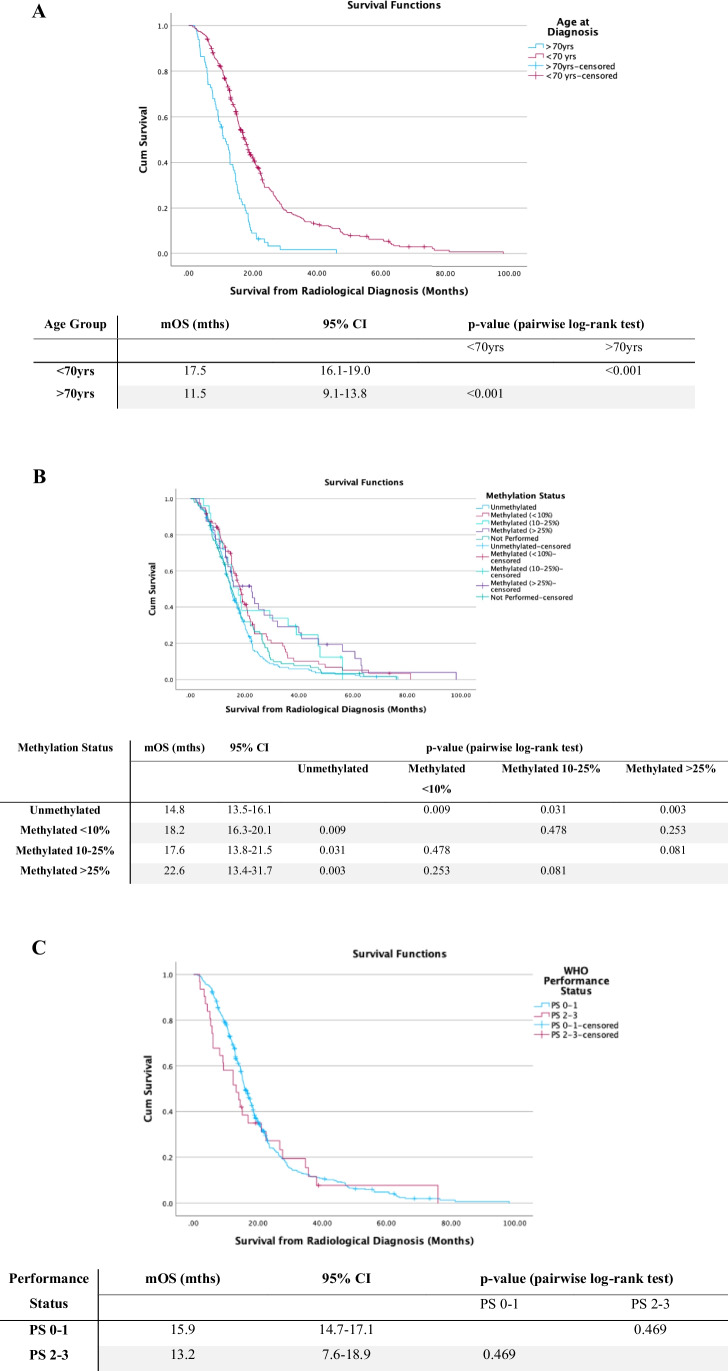
Kaplan–Meier curves for survival from radiological diagnosis. A Stratified for age > 70 years or < 70 years. B Stratified by MGMT status and C stratified for baseline WHO performance status. Survival distributions were compared using pairwise log-rank test. mOS median overall survival, 95%CI 95% confidence intervals
Fig. 3
Fig. 3
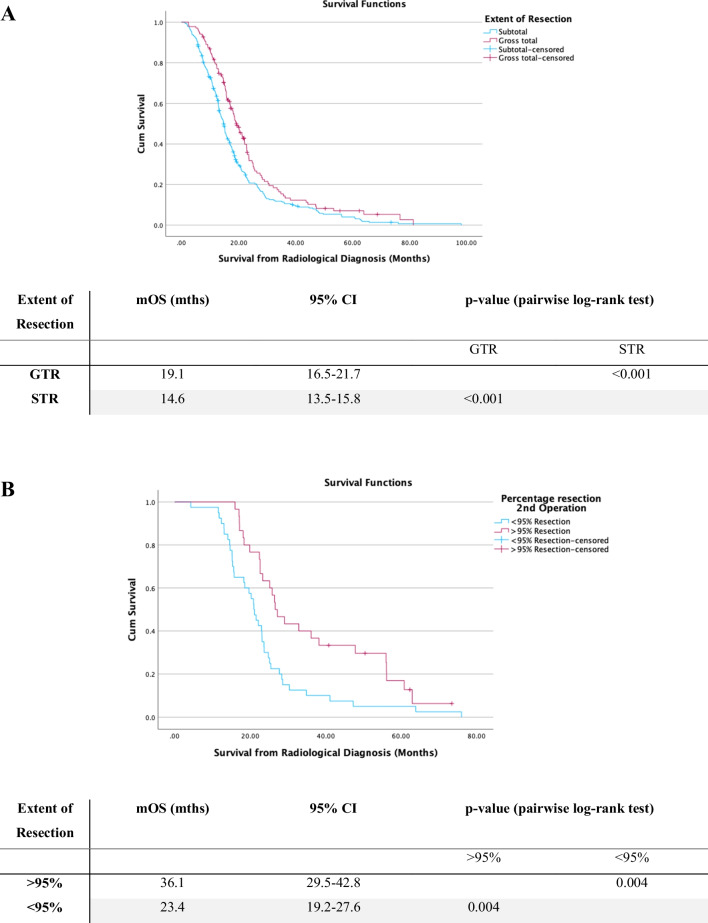
Kaplan–Meier curves for survival from radiological diagnosis. A Stratified by extent of resection of primary operation. B Stratified by extent of resection on second operation. C Kaplan–Meier demonstrating time to repeat operation in days stratified by extent of resection on primary operation. D survival from radiological diagnosis stratified for chemoradiotherapy regimen. Survival distributions were compared using pairwise log-rank test. mOS, median overall survival; 95%CI, 95% confidence intervals
Fig. 3
Fig. 3
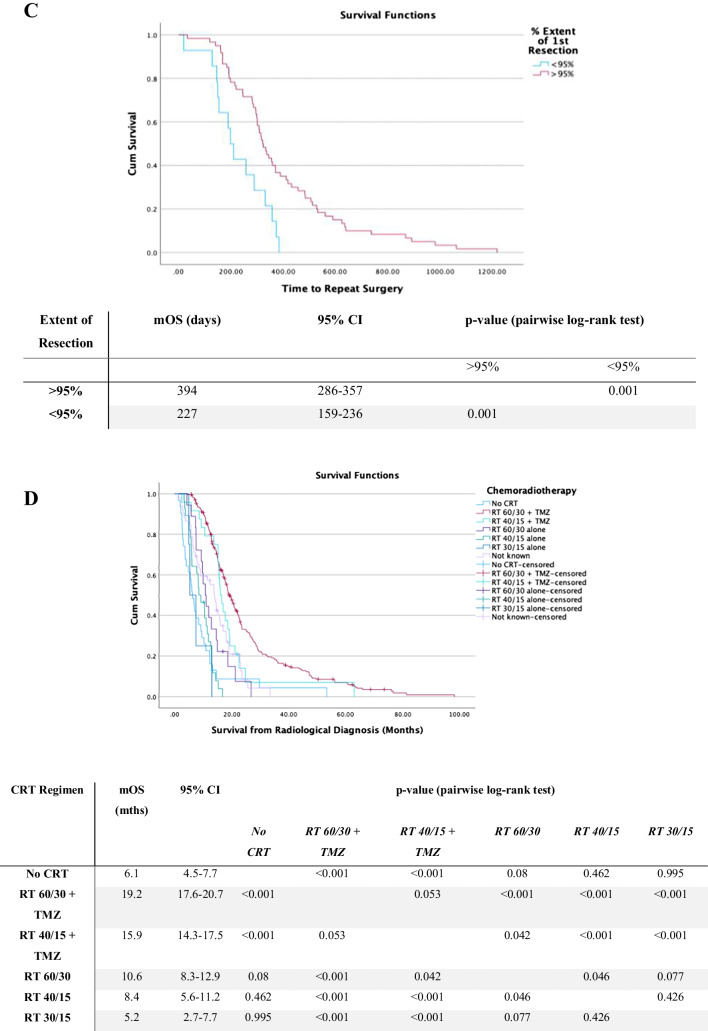
Kaplan–Meier curves for survival from radiological diagnosis. A Stratified by extent of resection of primary operation. B Stratified by extent of resection on second operation. C Kaplan–Meier demonstrating time to repeat operation in days stratified by extent of resection on primary operation. D survival from radiological diagnosis stratified for chemoradiotherapy regimen. Survival distributions were compared using pairwise log-rank test. mOS, median overall survival; 95%CI, 95% confidence intervals
Fig. 4
Fig. 4
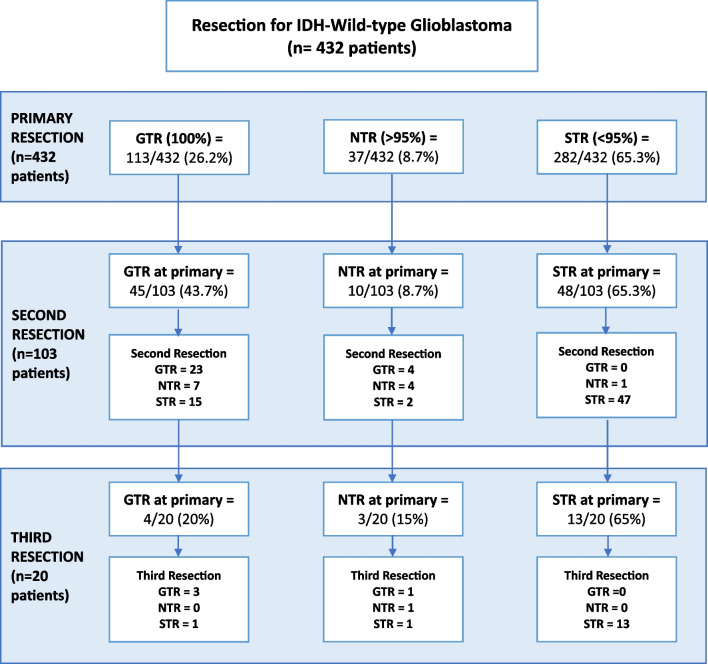
Flowchart summarising the completeness of resection achieved at primary operation and then subsequent resections. (Gross total resection (GTR) = 100%. Near total resection (NTR) =  > 95%. Subtotal resection (STR) =  < 95%.)

References

    1. Ammirati M, Galicich JH, Arbit E, Liao Y (1987) Reoperation in the treatment of recurrent intracranial malignant gliomas. Neurosurgery 21:607–614 - PubMed
    1. Azoulay M, Santos F, Shenouda G et al (2017) Benefit of re-operation and salvage therapies for recurrent glioblastoma multiforme: results from a single institution. J Neurooncol 132(3):419–426 - PubMed
    1. Barbagallo GMV, Jenkinson MD, Brodbelt AR (2008) ‘Recurrent’ glioblastoma multiforme, when should we reoperate? Br J Neurosurg 22(3):452–455 - PubMed
    1. Barker FG 2nd, Chang SM, Gutin PH et al (1998) Survival and functional status after resection of recurrent glioblastoma multiforme. Neurosurgery 42:709–723 - PubMed
    1. Bloch O, Han SJ, Cha S et al (2012) Impact of extent of resection for recurrent glioblastoma on overall survival: clinical article. J Neurosurg 117(6):1032–1038 - PubMed