


Photo-neuro-immuno-endocrinology: How the ultraviolet radiation regulates the body, brain, and immune system
- PMID: 38489380
- PMCID: PMC10998607
- DOI: 10.1073/pnas.2308374121
Photo-neuro-immuno-endocrinology: How the ultraviolet radiation regulates the body, brain, and immune system
Abstract
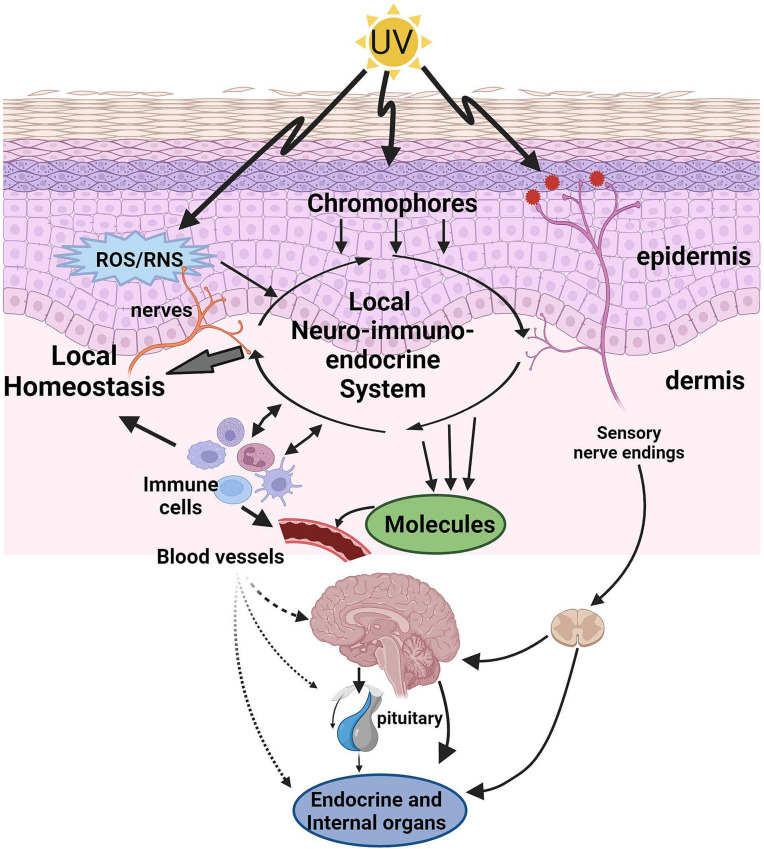
Ultraviolet radiation (UVR) is primarily recognized for its detrimental effects such as cancerogenesis, skin aging, eye damage, and autoimmune disorders. With exception of ultraviolet B (UVB) requirement in the production of vitamin D3, the positive role of UVR in modulation of homeostasis is underappreciated. Skin exposure to UVR triggers local responses secondary to the induction of chemical, hormonal, immune, and neural signals that are defined by the chromophores and extent of UVR penetration into skin compartments. These responses are not random and are coordinated by the cutaneous neuro-immuno-endocrine system, which counteracts the action of external stressors and accommodates local homeostasis to the changing environment. The UVR induces electrical, chemical, and biological signals to be sent to the brain, endocrine and immune systems, as well as other central organs, which in concert regulate body homeostasis. To achieve its central homeostatic goal, the UVR-induced signals are precisely computed locally with transmission through nerves or humoral signals release into the circulation to activate and/or modulate coordinating central centers or organs. Such modulatory effects will be dependent on UVA and UVB wavelengths. This leads to immunosuppression, the activation of brain and endocrine coordinating centers, and the modification of different organ functions. Therefore, it is imperative to understand the underlying mechanisms of UVR electromagnetic energy penetration deep into the body, with its impact on the brain and internal organs. Photo-neuro-immuno-endocrinology can offer novel therapeutic approaches in addiction and mood disorders; autoimmune, neurodegenerative, and chronic pain-generating disorders; or pathologies involving endocrine, cardiovascular, gastrointestinal, or reproductive systems.
Keywords: body homeostasis; neuroimmunoendocrinology; skin; stress; ultraviolet radiation.
Conflict of interest statement
Competing interests statement:The authors declare no competing interest.
Figures
References
-
- Bjorn L. O., Photobiology: The Sience of Life and Light (Springer, New York, NY, ed. 2, 2008).
MeSH terms
Grants and funding
LinkOut - more resources
Full Text Sources
