. 2024 Mar 16;15(1):2395.
doi: 10.1038/s41467-024-46780-0.

Temporospatial hierarchy and allele-specific expression of zygotic genome activation revealed by distant interspecific urochordate hybrids

Affiliations

Temporospatial hierarchy and allele-specific expression of zygotic genome activation revealed by distant interspecific urochordate hybrids

Jiankai Wei et al. Nat Commun. .

Abstract

Zygotic genome activation (ZGA) is a universal process in early embryogenesis of metazoan, when the quiescent zygotic nucleus initiates global transcription. However, the mechanisms related to massive genome activation and allele-specific expression (ASE) remain not well understood. Here, we develop hybrids from two deeply diverged (120 Mya) ascidian species to symmetrically document the dynamics of ZGA. We identify two coordinated ZGA waves represent early developmental and housekeeping gene reactivation, respectively. Single-cell RNA sequencing reveals that the major expression wave exhibits spatial heterogeneity and significantly correlates with cell fate. Moreover, allele-specific expression occurs in a species- rather than parent-related manner, demonstrating the divergence of cis-regulatory elements between the two species. These findings provide insights into ZGA in chordates.


Conflict of interest statement

The authors declare no competing interests.

Figures
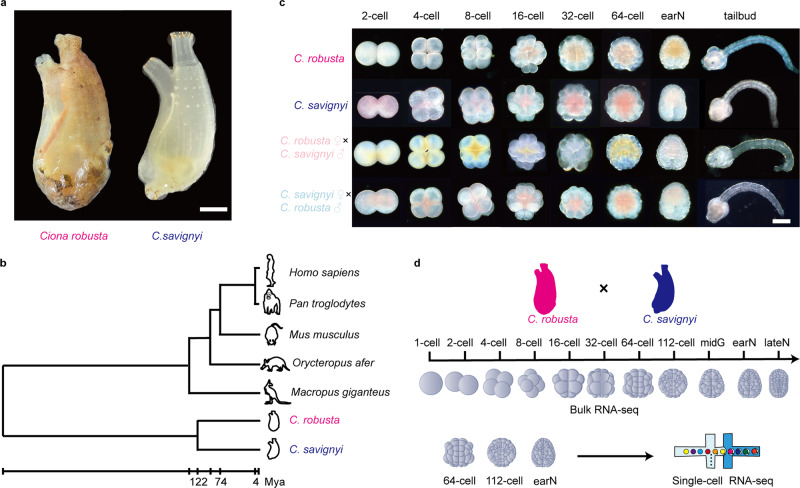
Fig. 1
Fig. 1. Generating hybrid and gene expression profiles from two divergent Ciona species.
a Morphology of adult C. robusta (left) and C. savignyi (right). Scale bar: 1 cm. b Phylogenetic position and divergence time estimation of Ciona. Divergence times are displayed below the phylogenetic tree. c Different developmental stages of four cross ascidians, including self-crossing C. robusta, self-crossing C. savignyi, C. savignyi as a male parent cross with C. robusta (forward cross), and C. robusta as a male parent cross with C. savignyi (reverse cross). Eight developmental stages were observed including 2-, 4-, 8-, 16-, 32-, and 64-cell, early-neurula (earN), and tailbud stages. Scale bar: 50 μm. The cross experiment was independently performed at least three times. d Overview of the gene expression profiling strategy. Forward and reverse cross embryos collected for bulk RNA sequencing included 1-, 2-, 4-, 8-, 16-, 32-, 64-, and 112-cell, mid-gastrula (midG), earN, and late-neurula (lateN) stages. Cross embryos at the 64- and 112-cell and earN stages were collected for single-cell RNA sequencing.
Fig. 2
Fig. 2. Two coordinated waves of ZGA during ascidian embryogenesis.
a Illustration of reads mapped to C. robusta and C. savignyi genomes at different developmental stages. Horizontal and vertical axes represent genome position and log2-transformed read number in each window, respectively. The bright red and bright blue indicated C. robusta and C. savignyi, while the light red and light blue indicated the forward and reverse cross samples, respectively. b read count ratios of paternal genes to all genes at different developmental stages. The red arrows indicated the two waves during ZGA. c Ratio of number of de-novo transcribed paternal genes to number of all paternal genes at different developmental stages. The red arrows indicated the minor and major ZGA which corresponded with the initiation of zygotic gene expression and housekeeping gene reactivation, respectively. d Heat map of H3K27ac CUT&Tag signals across activated genes and housekeeping genes in reverse cross hybrid embryos. Each line shows the normalized signals for a gene from -2k bp above TSS to +2k bp below TES. The number in parentheses indicated the de-novo transcribed gene number in each stage. e Heatmap of paternal gene expression in different modules in forward cross embryos. Module 1 included minor wave genes, the expression of which increased from the 16- to 32-cell stage, whereas modules 2 and 3 included major wave genes, the expression of which increased from the 64- to 112-cell stage. f Heatmap of paternal gene expression in different modules in reverse cross embryos. The description of the modules given in (e) also applies here. Source data are provided as a Source Data file.
Fig. 3
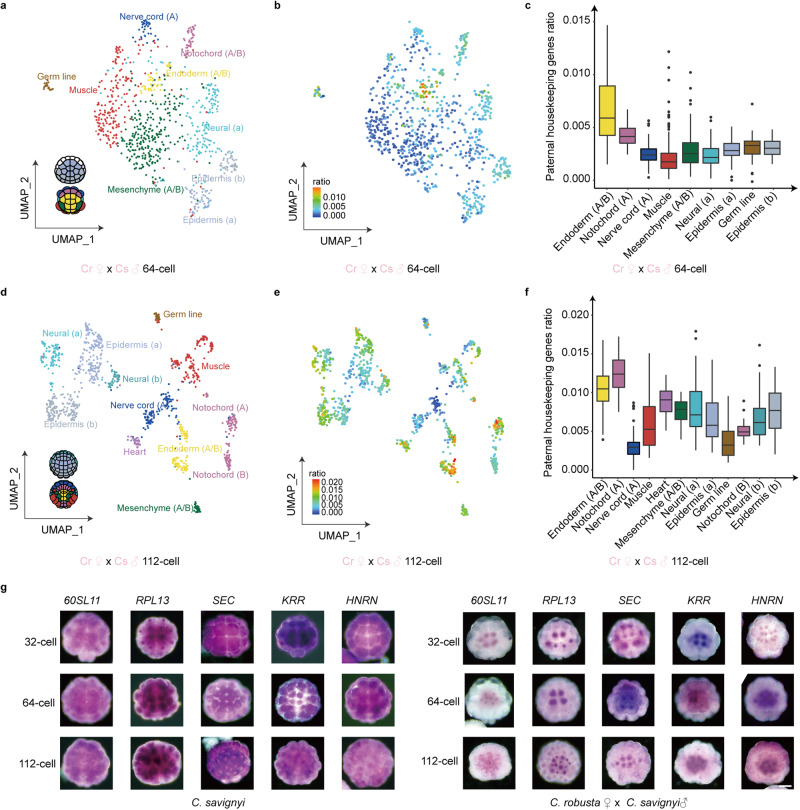
Fig. 3. Housekeeping gene reactivation revealed by single-cell transcriptome.
a UMAP plot of the 64-cell stage samples from forward cross embryos. In total, 844 cells were divided into 9 clusters and annotated as 8 cell types. The animal (up) and vegetal (down) blastomeres of a Ciona embryo at the 64-cell stage are shown. Font color corresponds to cell types. b Expression ratio of paternal housekeeping genes to all genes in each cell at the 64-cell stage from forward cross embryos. Colors represent the level of the expression ratio. c Boxplot of the expression ratio of paternal housekeeping genes in each cell type at the 64-cell stage from forward cross embryos. n = 40, 43, 32, 187, 259, 150, 70, 20, 43 cells for each cell type from endoderm to epidermis (b). d UMAP plot of the 112-cell-stage samples from forward cross embryos. In total, 1002 cells were divided into 12 clusters and annotated as 9 cell types. Animal (up) and vegetal (down) blastomeres of a Ciona embryo at the 112-cell stage are shown. Font color corresponds to cell type. e Expression ratio of paternal housekeeping genes to all genes in each cell at the 112-cell stage from forward cross embryos. Colors represent the expression ratio. f Boxplot of the expression ratio of paternal housekeeping genes in each cell type at the 112-cell stage from forward cross embryos. n = 98, 60, 107, 138, 33, 29, 95, 181, 27, 48, 43, 143 cells for each cell type from endoderm to epidermis (b). g Whole-mount in situ hybridization of 60SL11, RPL13, SEC, KRR and HNRN in self-cross C. savignyi embryos and forward cross embryos at 32-, 64- and 112-cell stages. Scale bar: 50 μm. In each box plot, the horizontal black lines represent median values; boxes extend from 25th to 75th percentile of each group’s distribution of values; the vertical extending lines indicate adjacent values, and dots mark observations outside the range of adjacent values. The experiment was independently performed at least three times. Source data are provided as a Source Data file.
Fig. 4
Fig. 4. Allelic gene activation during embryogenesis of hybrid animals.
a Expression heatmap of zygotic-only expressed genes from the 112-cell to late-neurula stage from both directional crosses. The genes were divided into four groups according to the expression preference. The purple, green, pink and orange groups contained C. robusta-, maternal-, C. savignyi- and paternal-dominant genes, respectively. b Gene expression preference quadrant for zygotic-only expressed genes from 112-cell to late-neurula stage. The quadrant is divided into four parts. X axis indicates the log2 transformed expression ratio between genes from C. robusta and the allelic genes from C. savignyi in reverse cross embryos. Y axis indicates the log2 transformed expression ratio between genes from C. robusta and the allelic genes from C. savignyi in forward cross embryos. Therefore, the first and third quadrants indicate genes with C. robusta- or C. savignyi-dominant expression, respectively, whereas the second and fourth quadrants indicate genes with maternal- or paternal-dominant expression, respectively. c Comparison of the distribution of a predicted cis-regulatory element and H3K27ac and Pol II occupancy by CUT&Tag at early neurula stage of titin gene from C. robusta and C. savignyi. The gene model and the predicted cis-regulatory element of titin were labeled. d Promoter activity test of titin. The promoters were cloned from C. robusta and C. savignyi, respectively. The swapped plasmids were cloned with exchange of motif regions. The plasmids were microinjected into C. savignyi embryos, and the GFP signals were observed from the early neurula to late tailbud stage. Scale bar: 50 μm. The experiment was independently performed at least three times. Source data are provided as a Source Data file.

References

    1. Vastenhouw NL, Cao WX, Lipshitz HD. The maternal-to-zygotic transition revisited. Development. 2019;146:dev161471. doi: 10.1242/dev.161471. - DOI - PubMed
    1. Jukam D, Shariati SAM, Skotheim JM. Zygotic genome activation in vertebrates. Dev. Cell. 2017;42:316–332. doi: 10.1016/j.devcel.2017.07.026. - DOI - PMC - PubMed
    1. Newport J, Kirschner M. A major developmental transition in early Xenopus embryos: I. characterization and timing of cellular changes at the midblastula stage. Cell. 1982;30:675–686. doi: 10.1016/0092-8674(82)90272-0. - DOI - PubMed
    1. Jevtić P, Levy Daniel L. Nuclear size scaling during Xenopus early development contributes to midblastula transition timing. Curr. Biol. 2015;25:45–52. doi: 10.1016/j.cub.2014.10.051. - DOI - PMC - PubMed
    1. Hahn S. Structure and mechanism of the RNA polymerase II transcription machinery. Nat. Struct. Mol. Biol. 2004;11:394–403. doi: 10.1038/nsmb763. - DOI - PMC - PubMed