


Association between early life exposure to agriculture, biodiversity, and green space and risk of inflammatory bowel disease: a population-based cohort study
- PMID: 38495524
- PMCID: PMC10940137
- DOI: 10.1016/j.eclinm.2024.102514
Association between early life exposure to agriculture, biodiversity, and green space and risk of inflammatory bowel disease: a population-based cohort study
Abstract
Background: Specific pollutants and environmental exposures are implicated in modulating inflammatory bowel disease (IBD) risk. However, the role of environmental exposures, particularly during the early life period, towards IBD risk, has not been systematically evaluated.
Methods: We conducted a nationwide population-based cohort study during the study period extending from January 1, 1995, to September 1, 2020, using cross-linked Danish registers, maps, and inventories to ascertain the impact of agricultural land use, biodiversity, green space, urban space, blue space, and normalized difference vegetation index during pregnancy and the first two years of life on IBD, Crohn's disease (CD), and ulcerative colitis (UC) risk, using adjusted Cox proportional hazards regression analyses. We adjusted for covariates sex, maternal age at delivery, calendar year of birth, municipal-level socioeconomic status, and first-degree relative with IBD.
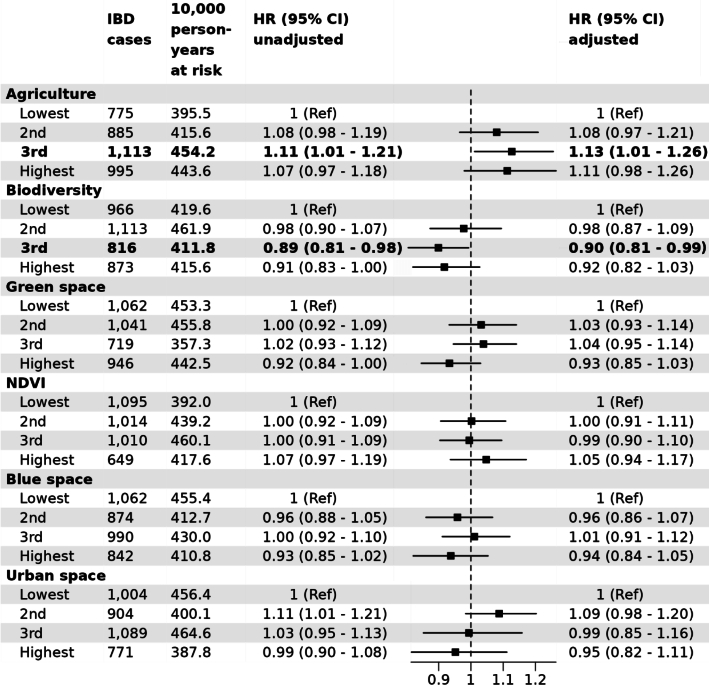
Findings: Of 1,438,487 individuals included in the study who were followed from age 2 years until a median (IQR) age of 14 (8-20) years, 3768 individuals were diagnosed with IBD. Exposure to the second, third and highest quartiles of agriculture land use during early life, relative to the lowest quartile, were associated with increased CD risk (aHR 1.12, 95% CI 1.01, 1.26, 1.19, 95% CI 1.05, 1.34 and, 1.24 95% CI 1.06, 1.46, respectively). There was no association of agriculture land use with UC risk. Conversely, exposure to the third quartile of biodiversity in early life, compared to the lowest quartile, were associated with a lower CD risk (aHR 0.86, 95% CI 0.75, 0.98). A protective effect of greenspace was noted in the highest quartile for CD (aHR 0.87, 95% CI 0.78, 0.98).
Interpretation: In a nationwide cohort with long-term follow up data, early life environmental exposures were associated with modulation of CD risk, with a harmful effect of agriculture land use and protective effect of biodiversity and green space.
Funding: Danish National Research Foundation, the International Organization for the Study of Inflammatory Bowel Disease, the National Institute of Diabetes and Digestive and Kidney Diseases.
Keywords: Crohn's disease; Epidemiology; Land use; Natural environment; Ulcerative colitis; Urban space.
© 2024 The Author(s).
Conflict of interest statement
The corresponding author confirms on behalf of all authors that there have been no involvements that might raise the question of bias in the work reported or in the conclusions, implications, or opinions stated. MA reports having consulted for Douglas Pharmaceuticals. AVH reports no conflict of interest. JFC reports receiving research grants from AbbVie, Janssen Pharmaceuticals and Takeda; receiving payment for lectures from AbbVie, Amgen, Allergan, Inc. Ferring Pharmaceuticals, Shire, and Takeda; receiving consulting fees from AbbVie, Amgen, Arena Pharmaceuticals, Boehringer Ingelheim, Bristol Myers Squibb, Celgene Corporation, Eli Lilly, Ferring Pharmaceuticals, Galmed Research, Glaxo Smith Kline, Geneva, Iterative Scopes, Janssen Pharmaceuticals, Kaleido Biosciences, Landos, Otsuka, Pfizer, Prometheus, Sanofi, Takeda, TiGenix,; and hold stock options in Intestinal Biotech Development. TJ reports having consulted for Ferring. KHA reports no conflict of interest.
Figures

References
-
- Ng S.C., Shi H.Y., Hamidi N., et al. Worldwide incidence and prevalence of inflammatory bowel disease in the 21st century: a systematic review of population-based studies. Lancet. 2018;390:2769–2778. - PubMed
-
- Torres J., Mehandru S., Colombel J.F., et al. Crohn's disease. Lancet. 2017;389:1741–1755. - PubMed
-
- Le Berre C., Honap S., Peyrin-Biroulet L. Ulcerative colitis. Lancet. 2023;402:571–584. - PubMed
Grants and funding
LinkOut - more resources
Full Text Sources
