


This is a preprint.
Generative interpolation and restoration of images using deep learning for improved 3D tissue mapping
- PMID: 38496512
- PMCID: PMC10942457
- DOI: 10.1101/2024.03.07.583909
Generative interpolation and restoration of images using deep learning for improved 3D tissue mapping
Update in
-
InterpolAI: deep learning-based optical flow interpolation and restoration of biomedical images for improved 3D tissue mapping.Nat Methods. 2025 Jul;22(7):1556-1567. doi: 10.1038/s41592-025-02712-4. Epub 2025 May 28. Nat Methods. 2025. PMID: 40437217 Free PMC article.
Abstract
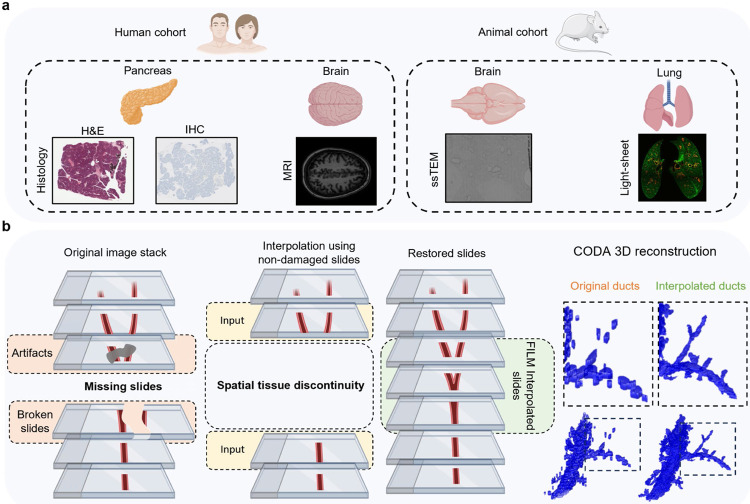
The development of novel imaging platforms has improved our ability to collect and analyze large three-dimensional (3D) biological imaging datasets. Advances in computing have led to an ability to extract complex spatial information from these data, such as the composition, morphology, and interactions of multi-cellular structures, rare events, and integration of multi-modal features combining anatomical, molecular, and transcriptomic (among other) information. Yet, the accuracy of these quantitative results is intrinsically limited by the quality of the input images, which can contain missing or damaged regions, or can be of poor resolution due to mechanical, temporal, or financial constraints. In applications ranging from intact imaging (e.g. light-sheet microscopy and magnetic resonance imaging) to sectioning based platforms (e.g. serial histology and serial section transmission electron microscopy), the quality and resolution of imaging data has become paramount. Here, we address these challenges by leveraging frame interpolation for large image motion (FILM), a generative AI model originally developed for temporal interpolation, for spatial interpolation of a range of 3D image types. Comparative analysis demonstrates the superiority of FILM over traditional linear interpolation to produce functional synthetic images, due to its ability to better preserve biological information including microanatomical features and cell counts, as well as image quality, such as contrast, variance, and luminance. FILM repairs tissue damages in images and reduces stitching artifacts. We show that FILM can decrease imaging time by synthesizing skipped images. We demonstrate the versatility of our method with a wide range of imaging modalities (histology, tissue-clearing/light-sheet microscopy, magnetic resonance imaging, serial section transmission electron microscopy), species (human, mouse), healthy and diseased tissues (pancreas, lung, brain), staining techniques (IHC, H&E), and pixel resolutions (8 nm, 2 μm, 1mm). Overall, we demonstrate the potential of generative AI in improving the resolution, throughput, and quality of biological image datasets, enabling improved 3D imaging.
Conflict of interest statement
Conflict of interest statement The authors declare no conflicts of interest.
Figures



References
-
- Forjaz A. et al. Three-dimensional assessments are necessary to determine the true spatial tissue composition of diseased tissues. bioRxiv 2023.12.04.569986 (2023) doi: 10.1101/2023.12.04.569986. - DOI
-
- Cline H. E., Dumoulin C. L., Hart H. R., Lorensen W. E. & Ludke S. 3D reconstruction of the brain from magnetic resonance images using a connectivity algorithm. Magn Reson Imaging 5, 345–352 (1987). - PubMed
-
- Consortium Mic. et al. Functional connectomics spanning multiple areas of mouse visual cortex. bioRxiv 2021.07.28.454025 (2021) doi: 10.1101/2021.07.28.454025. - DOI
Publication types
Grants and funding
LinkOut - more resources
Full Text Sources
