. 2024 Mar 18;15(1):2428.
doi: 10.1038/s41467-024-46424-3.

Hematopoietic stem cells with granulo-monocytic differentiation state overcome venetoclax sensitivity in patients with myelodysplastic syndromes

Affiliations

Hematopoietic stem cells with granulo-monocytic differentiation state overcome venetoclax sensitivity in patients with myelodysplastic syndromes

Juan Jose Rodriguez-Sevilla et al. Nat Commun. .

Abstract

The molecular mechanisms of venetoclax-based therapy failure in patients with acute myeloid leukemia were recently clarified, but the mechanisms by which patients with myelodysplastic syndromes (MDS) acquire secondary resistance to venetoclax after an initial response remain to be elucidated. Here, we show an expansion of MDS hematopoietic stem cells (HSCs) with a granulo-monocytic-biased transcriptional differentiation state in MDS patients who initially responded to venetoclax but eventually relapsed. While MDS HSCs in an undifferentiated cellular state are sensitive to venetoclax treatment, differentiation towards a granulo-monocytic-biased transcriptional state, through the acquisition or expansion of clones with STAG2 or RUNX1 mutations, affects HSCs' survival dependence from BCL2-mediated anti-apoptotic pathways to TNFα-induced pro-survival NF-κB signaling and drives resistance to venetoclax-mediated cytotoxicity. Our findings reveal how hematopoietic stem and progenitor cell (HSPC) can eventually overcome therapy-induced depletion and underscore the importance of using close molecular monitoring to prevent HSPC hierarchical change in MDS patients enrolled in clinical trials of venetoclax.


Conflict of interest statement

G.G.-M. reports clinical funding from AbbVie and Amgen. All other authors report no competing interests relative to this work.

Figures
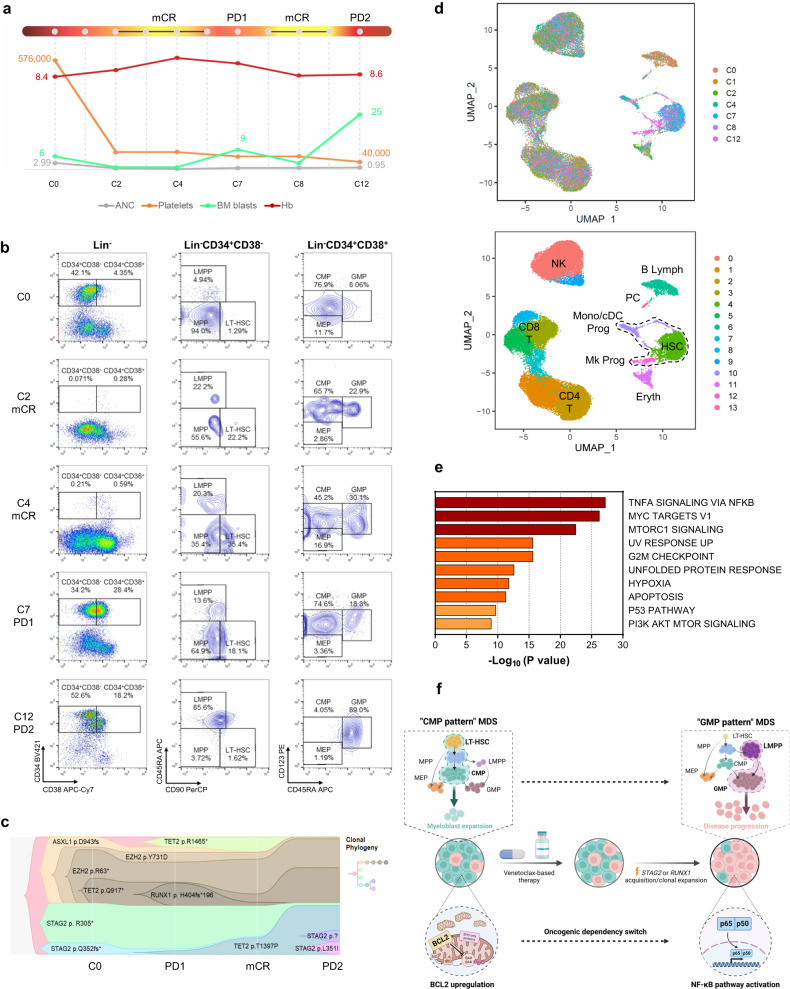
Fig. 1
Fig. 1. Mutation-induced MDS HSCs’ transcriptional reprogramming overcomes venetoclax-based therapy vulnerability.
a Schematic of UPN#1’s clinical course. After HMA therapy failure (cycle 0 [C0]), UPN#1 received 5-azacitidine (75 mg/m2 for 5 days) and venetoclax (400 mg/m2 for 14 days) every month. The patient had mCR at cycle 2 (C2); however, after the venetoclax dose was reduced to 100 mg/m2, the patient had an initial disease progression (PD1) at cycle 7 (C7). The patient had mCR after the venetoclax dose was increased to 200 mg/m2 at cycle 8 (C8) but had progression to AML (PD2) at cycle 12 (C12). Hb, hemoglobin; ANC, absolute neutrophil count. Units: blasts, %; Hb, g/dL; ANC, ×109/L; platelets, ×109/L. b Flow cytometry plots of lineage (Lin)-CD34+CD38- HSCs and Lin-CD34+CD38+ myeloid hematopoietic progenitor cells in the BM of UPN#1 at sequential timepoints before and during venetoclax-based therapy. LT-HSC long-term hematopoietic stem cells, MPP multipotent progenitors, LMPP lymphoid-primed multipotent progenitors, CMP common myeloid progenitors, GMP granulocytic-monocytic progenitors, MEP megakaryocyte erythroid progenitors. c Fish plot of the clonal evolution pattern inferred from NGS data for UPN#1. Phylogenetic trees show the estimated order of mutation acquisition and the proportion of subclones with different combinations of mutations at each timepoint. In UPN#1, clonal evolution was associated with the immunophenotypic HSPC hierarchical change and the acquisition of 2 STAG2 mutations. d UMAP plots of scRNA-seq data from BM MNCs isolated from UPN#1 (n = 39,206). Each dot represents 1 cell. Different colors indicate sample origin (top) and cluster identity (bottom). HSC hematopoietic stem cell, Mk megakaryocytic, Mono monocytic, cDC classic dendritic, Prog progenitors, Eryth erythroblasts, NK natural killer cells, Lymph lymphocytes, PC plasma cells. Dotted lines indicate the HSPC compartment. e Pathway enrichment analysis of the genes that were significantly upregulated in HSCs from UPN#1 (cluster 4 in d) at the time of PD2 compared with those in HSCs at the time of PD1 (P adj ≤ 0.05). The top 10 Hallmark gene sets are shown. f Proposed working model of venetoclax-based therapy failure. After an initial response to venetoclax-based therapy, the acquisition or expansion of clones with STAG2 or RUNX1 mutations reprograms the HSPC hierarchy and switches HSCs’ dependence from BCL2- to NF-κB-mediated survival programs, which leads to secondary venetoclax-based therapy failure.

References

    1. Ganan-Gomez I, et al. Stem cell architecture drives myelodysplastic syndrome progression and predicts response to venetoclax-based therapy. Nat. Med. 2022;28:557–567. doi: 10.1038/s41591-022-01696-4. - DOI - PMC - PubMed
    1. Bazinet A, et al. Azacitidine plus venetoclax in patients with high-risk myelodysplastic syndromes or chronic myelomonocytic leukaemia: phase 1 results of a single-centre, dose-escalation, dose-expansion, phase 1-2 study. Lancet Haematol. 2022;9:e756–e765. doi: 10.1016/S2352-3026(22)00216-2. - DOI - PubMed
    1. Nechiporuk T, et al. The TP53 apoptotic network is a primary mediator of resistance to BCL2 inhibition in AML cells. Cancer Discov. 2019;9:910–925. doi: 10.1158/2159-8290.CD-19-0125. - DOI - PMC - PubMed
    1. Jabbour E, et al. Outcome of patients with myelodysplastic syndrome after failure of decitabine therapy. Cancer. 2010;116:3830–3834. doi: 10.1002/cncr.25247. - DOI - PMC - PubMed
    1. Pei S, et al. Monocytic subclones confer resistance to venetoclax-based therapy in patients with acute myeloid leukemia. Cancer Discov. 2020;10:536–551. doi: 10.1158/2159-8290.CD-19-0710. - DOI - PMC - PubMed

MeSH terms
