


Investigating the role of CFTR in human and mouse myometrium
- PMID: 38501132
- PMCID: PMC10945125
- DOI: 10.1016/j.crphys.2024.100122
Investigating the role of CFTR in human and mouse myometrium
Abstract
Background: Abnormal cystic fibrosis transmembrane conductance regulator (CFTR) function in cystic fibrosis (CF) has been linked to airway smooth muscle abnormalities including bronchial hyperresponsiveness. However, a role for CFTR in other types of smooth muscle, including myometrium, remains largely unexplored. As CF life expectancy and the number of pregnancies increases, there is a need for an understanding of the potential role of CFTR in myometrial function.
Methods: We investigated the role of CFTR in human and mouse myometrium. We used immunofluorescence to identify CFTR expression, and carried out contractility studies on spontaneously contracting term pregnant and non-pregnant mouse myometrium and term pregnant human myometrial biopsies from caesarean sections.
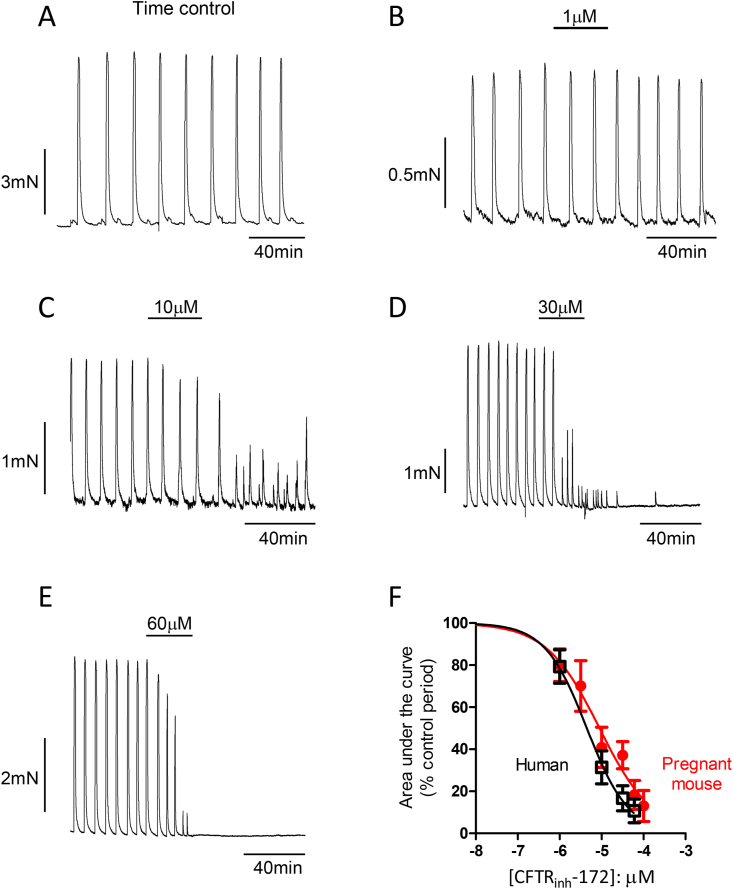
Results: CFTR was found to be expressed in term pregnant mouse myometrium. Inhibition of CFTR, with the selective inhibitor CFTRinh-172, significantly reduced contractility in pregnant mouse and human myometrium in a concentration-dependent manner (44.89 ± 11.02 term pregnant mouse, 9.23 ± 4.75 term-pregnant human; maximal effect at 60 μM expressed as a percentage of the pre-treatment control period). However, there was no effect of CFTRinh-172 in non-pregnant myometrium.
Conclusion: These results demonstrate decreased myometrial function when CFTR is inhibited, which may have implications on pregnancy and labour outcome and therapeutic decisions for labour in CF patients.
Keywords: CFTR; Contractility; Cystic fibrosis; Human; Mouse; Myometrium; Pregnancy.
© 2024 Published by Elsevier B.V.
Conflict of interest statement
The authors declare that they have no known competing financial interests or personal relationships that could have appeared to influence the work reported in this paper.
Figures




References
-
- Almohanna A., Noble K., Wray S. An investigation into the effects of extracellular acidification on mouse uterine contractions. Proc. Phys. Soc. 2016;37 PCA354 Poster Communications.
LinkOut - more resources
Full Text Sources
Research Materials
