. 2024 Mar 12;100(4):fiae027.
doi: 10.1093/femsec/fiae027.

Seedling microbiota engineering using bacterial synthetic community inoculation on seeds

Affiliations

Seedling microbiota engineering using bacterial synthetic community inoculation on seeds

Gontran Arnault et al. FEMS Microbiol Ecol. .

Erratum in

Abstract

Synthetic Communities (SynComs) are being developed and tested to manipulate plant microbiota and improve plant health. To date, only few studies proposed the use of SynCom on seed despite its potential for plant microbiota engineering. We developed and presented a simple and effective seedling microbiota engineering method using SynCom inoculation on seeds. The method was successful using a wide diversity of SynCom compositions and bacterial strains that are representative of the common bean seed microbiota. First, this method enables the modulation of seed microbiota composition and community size. Then, SynComs strongly outcompeted native seed and potting soil microbiota and contributed on average to 80% of the seedling microbiota. We showed that strain abundance on seed was a main driver of an effective seedling microbiota colonization. Also, selection was partly involved in seed and seedling colonization capacities since strains affiliated to Enterobacteriaceae and Erwiniaceae were good colonizers while Bacillaceae and Microbacteriaceae were poor colonizers. Additionally, the engineered seed microbiota modified the recruitment and assembly of seedling and rhizosphere microbiota through priority effects. This study shows that SynCom inoculation on seeds represents a promising approach to study plant microbiota assembly and its consequence on plant fitness.

Keywords: Synthetic Community; microbiota engineering; seed microbiota; seedling microbiota; transmission.


Conflict of interest statement

The authors declare that they have no conflicts of interest.

Figures

Figure 1.
Figure 1.
Design of the different experiments, strain selection, and SynCom compositions. (A) Overview of the different experiments. Experiment 1 was designed to test the influence of SynCom14 mass effect (composed of 14 bacterial strains) on surface-sterilized and unsterilized seeds using different concentrations (hypothesis 2). Experiment 2 was designed to study the influence of SynCom14 mass effect on seed and seedling microbiota assembly using different concentrations in a coalescence context with potting soil (hypotheses 2 and 4). Experiment 3 was set to study the influence of the inoculation of 12 different SynComs (with 3, 5, 8, or 11 bacterial strains) on seed and seedling microbiota assembly (hypothesis 3). (B) Phylogenetic tree of the 36 strains selected and composition of the 13 SynComs. SynCom14 was studied in experiments 1 and 2 and the others in experiment 3. The number in SynCom names indicates the SynCom richness. Relative abundance and prevalence of each strain in the original seed samples are plotted on the right side. Seven strains were selected while they were not detected using the metabarcoding approach. Panel A was created with Biorender.com.
Figure 2.
Figure 2.
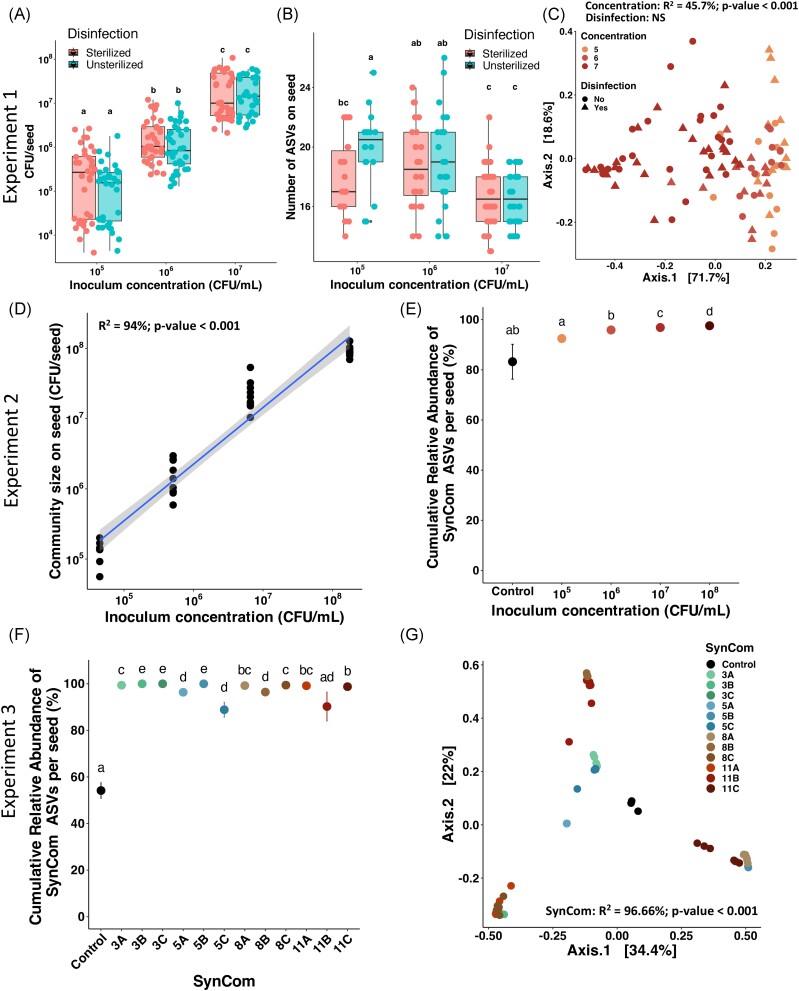
Effects of seed sterilization, SynCom mass effect and composition on seed microbiota assembly. Experiment 1: (A) community size on seed (CFU/seed) of SynCom14 in function of inoculum concentration (CFU/ml) and seed disinfection for the experiment 1 (36 seeds/treatment). The different letters represent the results of a post hoc Tukey HSD test. (B) Number of ASVs detected on seeds inoculated with SynCom14 in experiment 1 depending on inoculum concentration and seed disinfection (24 seeds/treatment). The different letters represent the results of a pairwise Wilcoxon test. (C) Influence of SynCom14 concentration and seed disinfection on seed bacterial community structure visualized through a PCoA ordination based on Bray–Curtis distances (PERMANOVA test; Disinfection effect: nonsignificant, Concentration: R2 = 45.7%, P-value < .001). Experiment 2: (D) linear model between community size on seed (CFU/seed) of SynCom14 in function of inoculum concentration (CFU/ml) for the experiment 2 (R2 = 94%, P-value < .001, 8 seeds/treatment). (E) Cumulative relative abundance of SynCom14 ASVs (SynCom colonization) in seeds from experiment 2 depending on inoculum concentration (8 seeds/treatment). The different letters represent the results of a pairwise Wilcoxon test. Experiment 3: (F) cumulative relative abundance of SynComs ASVs from experiment 3 (SynCom colonization) in seeds (8 seeds/treatment). The different letters represent the results of a pairwise Wilcoxon test. (G) Influence of SynCom composition of experiment 3 on seed bacterial community structure visualized through a PCoA ordination based on Bray–Curtis distances (PERMANOVA; SynCom condition: R2 = 96.66%, P-value < .001, 8 seeds/treatment).
Figure 3.
Figure 3.
Influence of SynCom mass effect and composition on seedling microbiota assembly. (A) and (B) Cumulative relative abundance of SynComs ASVs (SynCom colonization) in seedlings from experiments 2 (A) (16 seedlings/treatment) and 3 (8 seedlings/treatment) (B). The different letters represent the results of a pairwise Wilcoxon test. (C) Beta-dispersion analysis (distance to centroid) of seedlings inoculated with SynCom14 (experiment 2). The different letters represent the results of a post hoc Tukey HSD test. (D) Linear model between the cumulative relative abundance of SynCom ASVs in seedlings and the mean community size of inoculated seeds from experiment 3 (R2 = 44.94, P-value < .001). (E) Influence of SynCom14 concentration on seedling bacterial community structure visualized through a PCoA ordination based on Bray–Curtis distances (PERMANOVA; concentration: R2 = 11.65%, P-value < .001). (F) Influence of SynCom composition from experiment 3 on seedling bacterial community structure visualized through a PCoA ordination based on Bray–Curtis distances. (PERMANOVA; concentration: R2 = 79.84%, P-value < .001).
Figure 4.
Figure 4.
Influence of SynCom composition on taxonomic profiles of inocula, seeds, and seedlings from experiment 3. Relative abundance of inoculated strains in the inocula, seeds, and seedlings. Each stacked bar represents a sample. Only ASVs of the SynCom strains are colored, the black part represents uninoculated environmental taxa (e.g. potting soil and native seed microbiota). Per SynCom condition, one inoculum, 8 inoculated seeds, and 8 seedlings were characterized using amplicon sequencing of the gyrB gene. For the control condition (not inoculated), 3 seed batches of 25 seeds and 8 individual seedlings were characterized. For each treatment, a PERMANOVA was conducted to compare SynCom composition on seed versus seedling and reported in each corresponding panel.
Figure 5.
Figure 5.
Transmission of each strain from seed to seedling. (A) Transmission rate to the seedlings of each strain in the different SynComs of experiment 3 (8 seeds/treatment). (B) Strain’s ability to colonize seedlings compared to their initial relative abundance on seeds, depending on the SynCom composition of experiment 3 (8 seeds and 8 seedlings/treatment). The following ratio was calculated to assess this trait: log10(% relative abundance on seedling/% relative abundance on seed). (C) Linear model between each ASV relative abundance on seeds compared to their relative abundance on seedlings (R2 = 73.4%, P-value < .001). y = x dashed line was plotted to see if an ASVs is enriched or depleted in seedlings compared to its relative abundance on seeds (above or under the y = x dashed line, respectively). (D) Phylogenetic pattern of strains colonization ability to colonize seeds and seedlings. Phylosignal package was used to test the significance of the observed phylogenetic signal. The red barplots show the significantly (P-value < .05) enriched or depleted strains based on local indicator of Phylogenetic Association index (lipaMoran), using the lipaMoran function.
Figure 6.
Figure 6.
SynCom effect on environmental taxa recruitment of seedlings. (A) To assess the relative contribution of native seed microbiota, potting soil, and inoculated seed, a microbial source tracking analysis was conducted using FEAST. Control seed, inoculated seed, and potting soil microbiota were considered as sources of microorganisms and seedling were considered as sink. (See detailed boxplot for each source and SynCom and associated statistics in Figure S4, Supporting Information). (B) Influence of SynComs on seedling bacterial communities recruited from other sources (potting soil, air, and water) visualized through a PCoA ordination based on Bray–Curtis distances (PERMANOVA; SynCom: R2 = 38.76%, P-value < .001).
Figure 7.
Figure 7.
Effect of SynCom14 on rhizosphere community. (A) Potting soil bacterial community structure visualized through a PCoA ordination based on Bray–Curtis distances. The potting soil bacterial communities were studied without seedling (no seedling), with a seedling from a non-inoculated seed (control seedling), and with a seedling coming from inoculated-seed with the SynCom14 (PERMANOVA; SynCom: R2 = 54.84%, P-value < .001; seedling effect: R2 = 25.52%, P-value < .001). (B) Cumulative relative abundance of SynCom14 ASVs in rhizospheres of control and inoculated seedlings (NS: non significant Wilcoxon test). (C) Changes in the relative abundance of bacterial genera of rhizospheres of inoculated seedlings (SynCom14) or in control seedlings (not inoculated) at the different taxa levels using a linear model. Labels of the corresponding genera were plotted only if adjusted P-value < .05 and if estimate was below and above 0.01.

References

    1. Abdelfattah A, Tack AJM, Lobato C et al. From seed to seed: the role of microbial inheritance in the assembly of the plant microbiome. Trends Microbiol. 2023;31:346–55. 10.1016/j.tim.2022.10.009. - DOI - PubMed
    1. Alanjary M, Steinke K, Ziemert N. AutoMLST: an automated web server for generating multi-locus species trees highlighting natural product potential. Nucleic Acids Res. 2019;47:W276–82. 10.1093/nar/gkz282. - DOI - PMC - PubMed
    1. Arias SL, Block CC, Mayfield DA et al. Occurrence in seeds and potential seed transmission of Xanthomonas vasicola pv. vasculorum in maize in the United States. Phytopathology. 2020;110:1139–46. 10.1094/PHYTO-08-19-0306-R. - DOI - PubMed
    1. Armanhi JSL, de Souza RSC, Biazotti BB et al. Modulating drought stress response of maize by a synthetic bacterial community. Front Microbiol. 2021;12:747541. - PMC - PubMed
    1. Arnault G, Mony C, Vandenkoornhuyse P. Plant microbiota dysbiosis and the Anna Karenina principle. Trends Plant Sci. 2023;28:18–30. 10.1016/j.tplants.2022.08.012. - DOI - PubMed